

What Is Data-Driven Decision Making? A Practical Guide

Waiting weeks for a data analyst to build a dashboard is a relic of the past. If you're running your business on a gut feeling and a well-worn map, you're not just guessing—you're leaving money on the table.
Data-driven decision making (DDDM) is simple: it’s using hard facts, numbers, and clear metrics to guide your strategy. It swaps intuition for irrefutable proof. And thanks to modern tools, it's faster and more accessible than ever. You don't need to learn SQL or build complex dashboards. You just need to ask the right questions.
TL;DR: Your Cheat Sheet to Data-Driven Decisions
Ditch the Guesswork: Relying on gut feelings leads to wasted marketing spend, missed opportunities, and building products nobody wants. Data cuts through bias and shows you what’s actually working.
The Bottleneck is Over: Waiting days for an analyst to answer a simple question is no longer the norm. Modern tools give you answers in seconds.
Ask, Don't Analyze: The future of business intelligence is conversational. With a tool like Statspresso, a Conversational AI Data Analyst, you can skip the SQL. Just ask your data a question and get a chart in seconds.
Start Small, Win Big: You don't need massive datasets. Start with one important question, connect a single data source, and get a quick, valuable insight. Build from there.

The Hidden Costs Of Relying On Gut Feel
Running a business on intuition alone is like navigating a new city by just "feeling" your way around. You might get there, but you’re guaranteed to take wrong turns and burn a lot of expensive gas. Those detours aren't minor. Making decisions based on gut feel has real, tangible costs.
When you operate without data, you’re flying blind. You might pour marketing dollars into channels that feel right but deliver zero ROI. You could build a new feature you're excited about, only to discover your customers never wanted it. These missteps drain your budget and hand an advantage to your competition.
Wasted Spend And Missed Opportunities
The most immediate and painful cost of ignoring data is financial waste. Every decision made without evidence is a gamble. We see it all the time:
Inefficient Marketing Spend: Guessing which ads will perform is a surefire way to burn your budget. Data tells you exactly where to double down and where to cut your losses.
Overlooked Customer Segments: Your intuition might focus on one customer type, but data can reveal a completely different—and more profitable—group you've been ignoring.
Poor Product-Market Fit: Building based on assumptions leads to features nobody uses. Data ensures you're building what people actually need.
Instead of guessing, a better method is to let data point you toward hidden gems. For example, you can follow a data-driven guide to finding niches to uncover valuable opportunities you might have otherwise missed completely.
The Problem With Bias And Blind Spots
Let's be honest: our gut feelings are shaped by our own biases. You might favor a marketing strategy because it worked five years ago, even if the market has totally changed. Data forces you to confront today's reality. The difference is stark. Studies consistently show companies that use data analytics achieve 5-6% higher productivity than their peers.
This isn't about becoming a data scientist overnight. It’s about getting clear answers without the technical headaches. That's where a Conversational AI Data Analyst like Statspresso comes in. It lets you bypass the complexity entirely.
Wondering which of your marketing channels is really working?
Try asking Statspresso: "Show me my cost per acquisition by marketing channel for the last 90 days."
Getting insights this quickly prevents costly mistakes. It swaps ambiguity for answers, letting you steer your business with confidence.
A Simple Framework For Data-Driven Decisions
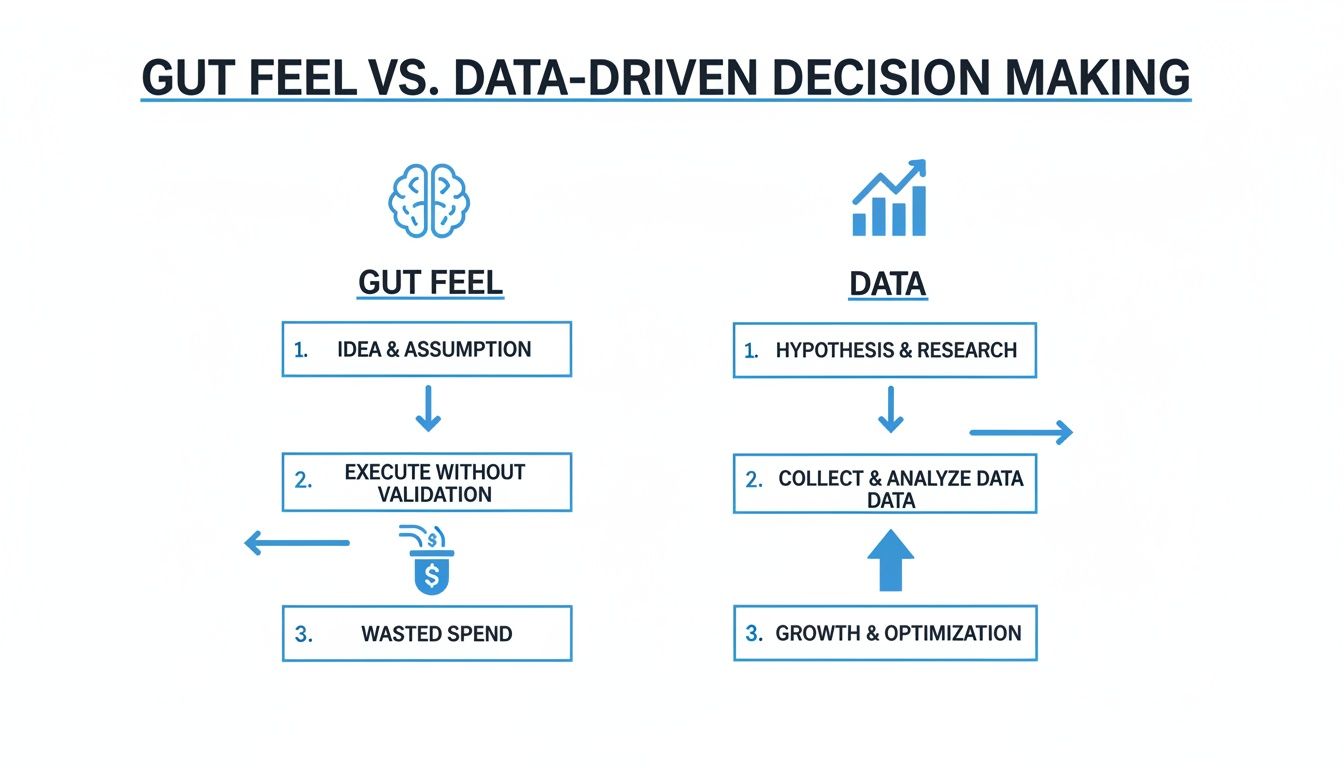
Making the switch from gut-feel to data-driven decision making can sound intimidating. Forget teams of data scientists and complex models. All it takes is a straightforward, four-step process to guide you from a question to a confident action.
The choice you're facing is pretty stark. You can keep relying on intuition, which often leads to wasted time and money, or you can start using data to find a clear path to growth.
Step 1: Ask The Right Question
Everything starts here. If you ask a vague question like, "How are sales going?" you're going to get a vague and useless answer. A good question is sharp and directly tied to a business goal. For example:
"Which feature from our last release is being adopted most by our paying customers?"
"What are the top three things users do right before they upgrade?"
"How does the churn rate for users who signed up in Q2 compare to Q1?"
These questions are specific, measurable, and point you toward a concrete business outcome. They give your analysis purpose.
Step 2: Gather The Relevant Data
With your question in hand, the next job is to hunt down the data. This usually means figuring out which of your tools has the information you need. For understanding churn, the data might be scattered across:
Pulling data from different sources used to be a technical pain. Thankfully, modern tools connect these dots for you.
Step 3: Uncover The Story
Now for the fun part—the analysis. This is where you dig into the data to find the story. It's also where most teams hit a wall. Why? Because it required a specialized skillset like SQL and expertise in BI tools like Tableau. That friction is a killer for momentum.
This is exactly the problem an AI analytics assistant like Statspresso, a Conversational AI Data Analyst, was designed to eliminate. Instead of writing code or wrestling with dashboards, you just ask your question in plain English. You skip the SQL and the technical hurdles. Just ask a question and get a chart in seconds.
Try asking Statspresso: "Show me user churn rate by sign-up cohort over the last six months."
In seconds, you get a clear visualization. A process that once took a week is now a moment of instant discovery.
Step 4: Act And Measure
The final step is what makes the whole thing worthwhile: act on what you've learned and measure the impact. An insight without action is just trivia.
If your analysis shows users who ignore a key feature are almost guaranteed to churn, the action is obvious: build a new onboarding flow that guides them to that feature. But you're not done yet. You have to close the loop by measuring the outcome. Did the new flow actually reduce churn?
This "act and measure" cycle is the engine that makes your business smarter. And it's essential, with industry reports predicting that 65% of organizations will make fully data-driven decisions by 2026. You can learn more about the benefits of this shift and why it’s non-negotiable for growth.
The Old Way vs. The New Way of Getting Answers
For years, getting a straight answer from your company's data was a painfully slow process. You'd have a critical question, fire off a ticket to the data team, and then... you'd wait.
This waiting game is the "old way" of doing business intelligence. The entire workflow was riddled with bottlenecks. Every question required an analyst to write custom SQL, build a new report, and send it back. The systems were built by technical experts, for technical experts. Founders, marketers, and product managers were left on the sidelines.
A Tale Of Two Workflows
What if you could just… ask? What if getting a chart was as simple as asking a colleague a question? That’s the promise of the "new way," driven by conversational analytics and automated BI.
The core problem with traditional BI was the friction between the question and the answer. This shift is about empowerment. When you can skip the SQL and just ask your data a question to get a chart in seconds, you build a culture of rapid learning and confident decisions.
The Old Way vs. The Statspresso Way
The difference between these two worlds is night and day. Let's put them side-by-side.
Aspect | The Old Way (Manual SQL) | The New Way (Statspresso) |
|---|---|---|
Time to Insight | Days or weeks. Involves ticketing systems and analyst queues. | Seconds. Ask a question and get an instant visualization. |
Required Skills | Deep knowledge of SQL and BI tools like Tableau. | The ability to ask a question in plain English. That’s it. |
Flexibility | Rigid. Follow-up questions restart the entire slow process. | Highly flexible. Instantly pivot and ask follow-up questions. |
Accessibility | Limited to technical users. A major bottleneck for business teams. | Democratized. Anyone on the team can get answers. |
This evolution is a massive advantage. Instead of rationing questions, your team can explore data freely. This is the heart of true self-serve business intelligence. Statspresso, as a Conversational AI Data Analyst, was built to make this new way the standard.
Try asking Statspresso: "Compare user activity for the 7 days before and after our new feature launch on October 15th."
You get the answer immediately, not next week. This is how modern, data-driven teams win.
Navigating Common Roadblocks to a Data-Driven Culture
Switching to a data-driven culture isn't about buying software. It’s about changing minds and habits. The good news is that the challenges are predictable. If you know what to look for, you can steer right around them.
Roadblock 1: Data Overload and Analysis Paralysis
You've got data. Piles of it. But more data doesn't mean more clarity. It often leads to analysis paralysis. Faced with an ocean of metrics, teams either freeze up or churn out reports with zero real direction.
The only way out is to get laser-focused. Instead of tracking everything, pinpoint the handful of key metrics tied to your most critical business goals, like knowing your key Business Performance Indicators.
Roadblock 2: Overly Complex Tools
The next major hurdle is tool complexity. Many businesses sink budgets into powerful analytics platforms, only to find they require a data science degree to operate. This just creates the exact bottleneck you were trying to solve.
The answer is to put accessibility first. You need tools that empower your whole team. This is where a Conversational AI Data Analyst like Statspresso shines. It lets anyone skip the SQL and just ask their data a question, turning a complex process into a simple conversation.
Try asking Statspresso: "Which of our blog posts brought in the most new signups last quarter?"
This immediate access fosters a culture of inquiry, turning data into a helpful partner.
Roadblock 3: Cultural Resistance and Old Habits
The final, and toughest, roadblock is cultural resistance. People are creatures of habit. If your team is used to making calls based on gut feelings, a shift to data-first thinking can feel threatening.
The best strategy is to start small and build momentum with undeniable proof. Find one high-impact problem and use data to solve it quickly. Show the marketing team exactly which ad campaign has a 0% return. These small, decisive wins build trust and demonstrate the practical power of data.
Your First Data-Driven Decision in Action
Let's see what data-driven decision-making actually looks like on the ground. Meet Alex, a Marketing Lead facing a new quarterly budget. The big question: "Where do I put our money to get the best return?" Alex has a gut feeling about LinkedIn ads but isn't sure.
Alex starts by framing a sharp, specific question:
"Which marketing channel delivered the highest Return on Investment (ROI) last quarter?"
From Scattered Data to a Single Answer
Not long ago, answering this meant days of exporting spreadsheets from Google Ads, HubSpot, and pestering the finance team. Instead, Alex uses a Conversational AI Data Analyst like Statspresso. After a quick, one-time setup to connect the data sources, Alex just asks a question in plain English.
Try asking Statspresso: “Show me my ROI by marketing channel for last quarter as a bar chart.”
In seconds, the system digests the question, pulls the right numbers from each source, calculates the ROI, and spits out a simple chart.

The Moment of Clarity
The chart appears instantly. The answer is crystal clear. While LinkedIn ads provided a decent return, the organic search traffic driven by the blog delivered an ROI that was a staggering 3x higher. The gut feeling wasn't wrong, but it completely overlooked the much bigger win.
This is that "aha!" moment. Alex can now confidently double down on the content and SEO strategy, knowing the move is backed by hard evidence. It’s about being able to skip the SQL and just ask your data a question to get a chart in seconds. This is how you go from wondering to knowing.
So, What's the Bottom Line?
We've covered a lot. If you remember just a few core truths about using data to make decisions, let them be these:
Guesswork is a liability. Relying on gut instinct is a surefire way to fall behind. Using data is now table stakes for growth.
The real barrier was access, not data. The agonizing wait for a report is over. The delay is a thing of the past.
The new edge is speed-to-insight. Winning teams move from a critical question to a clear, data-backed answer in moments, not weeks.
You don’t need to be a data scientist. With a Conversational AI Data Analyst like Statspresso, if you can ask a question, you can get an insight.
Making the switch to a data-first culture isn't some huge project for next year. It’s a practical step you can take today.
Ready to see for yourself? Connect your first data source for free and ask your first question. Experience what it feels like to get the answer you need in seconds.
Frequently Asked Questions
Even with a clear game plan, a few questions always pop up. Here are the straight answers we hear most from founders, marketers, and product managers.
How Much Data Do I Need to Start?
Probably less than you think. You don't need massive historical datasets. Start small. Pick one important question and gather only the data required to address it. Often, just hooking up a single source like Stripe or Google Analytics is all it takes to find your first game-changing insight.
Can Data-Driven Decision Making Replace Human Intuition?
No, and it shouldn't. The goal is to be data-informed, not data-dictated. Data gives you the objective "what," but your experience and intuition provide the critical "why" and "what should we do next?" Data makes your gut feelings smarter and far more reliable.
What Is The Real Difference Between BI And Conversational AI?
This question gets to the core of the shift in analytics. A traditional BI tool like Tableau or Power BI is like a complex workshop—powerful, but you need a trained expert to use it. A Conversational AI Data Analyst like Statspresso is like having that expert on call 24/7. It removes the technical hurdles. You skip the SQL and just ask your data a question to get a chart in seconds. It’s designed for the entire team, making insights truly instant and accessible.
Ready to stop waiting for answers? Statspresso was built to give you clarity, instantly.
Connect your first data source for free and ask your first question.
Waiting weeks for a data analyst to build a dashboard is a relic of the past. If you're running your business on a gut feeling and a well-worn map, you're not just guessing—you're leaving money on the table.
Data-driven decision making (DDDM) is simple: it’s using hard facts, numbers, and clear metrics to guide your strategy. It swaps intuition for irrefutable proof. And thanks to modern tools, it's faster and more accessible than ever. You don't need to learn SQL or build complex dashboards. You just need to ask the right questions.
TL;DR: Your Cheat Sheet to Data-Driven Decisions
Ditch the Guesswork: Relying on gut feelings leads to wasted marketing spend, missed opportunities, and building products nobody wants. Data cuts through bias and shows you what’s actually working.
The Bottleneck is Over: Waiting days for an analyst to answer a simple question is no longer the norm. Modern tools give you answers in seconds.
Ask, Don't Analyze: The future of business intelligence is conversational. With a tool like Statspresso, a Conversational AI Data Analyst, you can skip the SQL. Just ask your data a question and get a chart in seconds.
Start Small, Win Big: You don't need massive datasets. Start with one important question, connect a single data source, and get a quick, valuable insight. Build from there.

The Hidden Costs Of Relying On Gut Feel
Running a business on intuition alone is like navigating a new city by just "feeling" your way around. You might get there, but you’re guaranteed to take wrong turns and burn a lot of expensive gas. Those detours aren't minor. Making decisions based on gut feel has real, tangible costs.
When you operate without data, you’re flying blind. You might pour marketing dollars into channels that feel right but deliver zero ROI. You could build a new feature you're excited about, only to discover your customers never wanted it. These missteps drain your budget and hand an advantage to your competition.
Wasted Spend And Missed Opportunities
The most immediate and painful cost of ignoring data is financial waste. Every decision made without evidence is a gamble. We see it all the time:
Inefficient Marketing Spend: Guessing which ads will perform is a surefire way to burn your budget. Data tells you exactly where to double down and where to cut your losses.
Overlooked Customer Segments: Your intuition might focus on one customer type, but data can reveal a completely different—and more profitable—group you've been ignoring.
Poor Product-Market Fit: Building based on assumptions leads to features nobody uses. Data ensures you're building what people actually need.
Instead of guessing, a better method is to let data point you toward hidden gems. For example, you can follow a data-driven guide to finding niches to uncover valuable opportunities you might have otherwise missed completely.
The Problem With Bias And Blind Spots
Let's be honest: our gut feelings are shaped by our own biases. You might favor a marketing strategy because it worked five years ago, even if the market has totally changed. Data forces you to confront today's reality. The difference is stark. Studies consistently show companies that use data analytics achieve 5-6% higher productivity than their peers.
This isn't about becoming a data scientist overnight. It’s about getting clear answers without the technical headaches. That's where a Conversational AI Data Analyst like Statspresso comes in. It lets you bypass the complexity entirely.
Wondering which of your marketing channels is really working?
Try asking Statspresso: "Show me my cost per acquisition by marketing channel for the last 90 days."
Getting insights this quickly prevents costly mistakes. It swaps ambiguity for answers, letting you steer your business with confidence.
A Simple Framework For Data-Driven Decisions
Making the switch from gut-feel to data-driven decision making can sound intimidating. Forget teams of data scientists and complex models. All it takes is a straightforward, four-step process to guide you from a question to a confident action.
The choice you're facing is pretty stark. You can keep relying on intuition, which often leads to wasted time and money, or you can start using data to find a clear path to growth.

Step 1: Ask The Right Question
Everything starts here. If you ask a vague question like, "How are sales going?" you're going to get a vague and useless answer. A good question is sharp and directly tied to a business goal. For example:
"Which feature from our last release is being adopted most by our paying customers?"
"What are the top three things users do right before they upgrade?"
"How does the churn rate for users who signed up in Q2 compare to Q1?"
These questions are specific, measurable, and point you toward a concrete business outcome. They give your analysis purpose.
Step 2: Gather The Relevant Data
With your question in hand, the next job is to hunt down the data. This usually means figuring out which of your tools has the information you need. For understanding churn, the data might be scattered across:
Pulling data from different sources used to be a technical pain. Thankfully, modern tools connect these dots for you.
Step 3: Uncover The Story
Now for the fun part—the analysis. This is where you dig into the data to find the story. It's also where most teams hit a wall. Why? Because it required a specialized skillset like SQL and expertise in BI tools like Tableau. That friction is a killer for momentum.
This is exactly the problem an AI analytics assistant like Statspresso, a Conversational AI Data Analyst, was designed to eliminate. Instead of writing code or wrestling with dashboards, you just ask your question in plain English. You skip the SQL and the technical hurdles. Just ask a question and get a chart in seconds.
Try asking Statspresso: "Show me user churn rate by sign-up cohort over the last six months."
In seconds, you get a clear visualization. A process that once took a week is now a moment of instant discovery.
Step 4: Act And Measure
The final step is what makes the whole thing worthwhile: act on what you've learned and measure the impact. An insight without action is just trivia.
If your analysis shows users who ignore a key feature are almost guaranteed to churn, the action is obvious: build a new onboarding flow that guides them to that feature. But you're not done yet. You have to close the loop by measuring the outcome. Did the new flow actually reduce churn?
This "act and measure" cycle is the engine that makes your business smarter. And it's essential, with industry reports predicting that 65% of organizations will make fully data-driven decisions by 2026. You can learn more about the benefits of this shift and why it’s non-negotiable for growth.
The Old Way vs. The New Way of Getting Answers
For years, getting a straight answer from your company's data was a painfully slow process. You'd have a critical question, fire off a ticket to the data team, and then... you'd wait.
This waiting game is the "old way" of doing business intelligence. The entire workflow was riddled with bottlenecks. Every question required an analyst to write custom SQL, build a new report, and send it back. The systems were built by technical experts, for technical experts. Founders, marketers, and product managers were left on the sidelines.
A Tale Of Two Workflows
What if you could just… ask? What if getting a chart was as simple as asking a colleague a question? That’s the promise of the "new way," driven by conversational analytics and automated BI.
The core problem with traditional BI was the friction between the question and the answer. This shift is about empowerment. When you can skip the SQL and just ask your data a question to get a chart in seconds, you build a culture of rapid learning and confident decisions.
The Old Way vs. The Statspresso Way
The difference between these two worlds is night and day. Let's put them side-by-side.
Aspect | The Old Way (Manual SQL) | The New Way (Statspresso) |
|---|---|---|
Time to Insight | Days or weeks. Involves ticketing systems and analyst queues. | Seconds. Ask a question and get an instant visualization. |
Required Skills | Deep knowledge of SQL and BI tools like Tableau. | The ability to ask a question in plain English. That’s it. |
Flexibility | Rigid. Follow-up questions restart the entire slow process. | Highly flexible. Instantly pivot and ask follow-up questions. |
Accessibility | Limited to technical users. A major bottleneck for business teams. | Democratized. Anyone on the team can get answers. |
This evolution is a massive advantage. Instead of rationing questions, your team can explore data freely. This is the heart of true self-serve business intelligence. Statspresso, as a Conversational AI Data Analyst, was built to make this new way the standard.
Try asking Statspresso: "Compare user activity for the 7 days before and after our new feature launch on October 15th."
You get the answer immediately, not next week. This is how modern, data-driven teams win.
Navigating Common Roadblocks to a Data-Driven Culture
Switching to a data-driven culture isn't about buying software. It’s about changing minds and habits. The good news is that the challenges are predictable. If you know what to look for, you can steer right around them.
Roadblock 1: Data Overload and Analysis Paralysis
You've got data. Piles of it. But more data doesn't mean more clarity. It often leads to analysis paralysis. Faced with an ocean of metrics, teams either freeze up or churn out reports with zero real direction.
The only way out is to get laser-focused. Instead of tracking everything, pinpoint the handful of key metrics tied to your most critical business goals, like knowing your key Business Performance Indicators.
Roadblock 2: Overly Complex Tools
The next major hurdle is tool complexity. Many businesses sink budgets into powerful analytics platforms, only to find they require a data science degree to operate. This just creates the exact bottleneck you were trying to solve.
The answer is to put accessibility first. You need tools that empower your whole team. This is where a Conversational AI Data Analyst like Statspresso shines. It lets anyone skip the SQL and just ask their data a question, turning a complex process into a simple conversation.
Try asking Statspresso: "Which of our blog posts brought in the most new signups last quarter?"
This immediate access fosters a culture of inquiry, turning data into a helpful partner.
Roadblock 3: Cultural Resistance and Old Habits
The final, and toughest, roadblock is cultural resistance. People are creatures of habit. If your team is used to making calls based on gut feelings, a shift to data-first thinking can feel threatening.
The best strategy is to start small and build momentum with undeniable proof. Find one high-impact problem and use data to solve it quickly. Show the marketing team exactly which ad campaign has a 0% return. These small, decisive wins build trust and demonstrate the practical power of data.
Your First Data-Driven Decision in Action
Let's see what data-driven decision-making actually looks like on the ground. Meet Alex, a Marketing Lead facing a new quarterly budget. The big question: "Where do I put our money to get the best return?" Alex has a gut feeling about LinkedIn ads but isn't sure.
Alex starts by framing a sharp, specific question:
"Which marketing channel delivered the highest Return on Investment (ROI) last quarter?"
From Scattered Data to a Single Answer
Not long ago, answering this meant days of exporting spreadsheets from Google Ads, HubSpot, and pestering the finance team. Instead, Alex uses a Conversational AI Data Analyst like Statspresso. After a quick, one-time setup to connect the data sources, Alex just asks a question in plain English.
Try asking Statspresso: “Show me my ROI by marketing channel for last quarter as a bar chart.”
In seconds, the system digests the question, pulls the right numbers from each source, calculates the ROI, and spits out a simple chart.

The Moment of Clarity
The chart appears instantly. The answer is crystal clear. While LinkedIn ads provided a decent return, the organic search traffic driven by the blog delivered an ROI that was a staggering 3x higher. The gut feeling wasn't wrong, but it completely overlooked the much bigger win.
This is that "aha!" moment. Alex can now confidently double down on the content and SEO strategy, knowing the move is backed by hard evidence. It’s about being able to skip the SQL and just ask your data a question to get a chart in seconds. This is how you go from wondering to knowing.
So, What's the Bottom Line?
We've covered a lot. If you remember just a few core truths about using data to make decisions, let them be these:
Guesswork is a liability. Relying on gut instinct is a surefire way to fall behind. Using data is now table stakes for growth.
The real barrier was access, not data. The agonizing wait for a report is over. The delay is a thing of the past.
The new edge is speed-to-insight. Winning teams move from a critical question to a clear, data-backed answer in moments, not weeks.
You don’t need to be a data scientist. With a Conversational AI Data Analyst like Statspresso, if you can ask a question, you can get an insight.
Making the switch to a data-first culture isn't some huge project for next year. It’s a practical step you can take today.
Ready to see for yourself? Connect your first data source for free and ask your first question. Experience what it feels like to get the answer you need in seconds.
Frequently Asked Questions
Even with a clear game plan, a few questions always pop up. Here are the straight answers we hear most from founders, marketers, and product managers.
How Much Data Do I Need to Start?
Probably less than you think. You don't need massive historical datasets. Start small. Pick one important question and gather only the data required to address it. Often, just hooking up a single source like Stripe or Google Analytics is all it takes to find your first game-changing insight.
Can Data-Driven Decision Making Replace Human Intuition?
No, and it shouldn't. The goal is to be data-informed, not data-dictated. Data gives you the objective "what," but your experience and intuition provide the critical "why" and "what should we do next?" Data makes your gut feelings smarter and far more reliable.
What Is The Real Difference Between BI And Conversational AI?
This question gets to the core of the shift in analytics. A traditional BI tool like Tableau or Power BI is like a complex workshop—powerful, but you need a trained expert to use it. A Conversational AI Data Analyst like Statspresso is like having that expert on call 24/7. It removes the technical hurdles. You skip the SQL and just ask your data a question to get a chart in seconds. It’s designed for the entire team, making insights truly instant and accessible.
Ready to stop waiting for answers? Statspresso was built to give you clarity, instantly.
Connect your first data source for free and ask your first question.
Waiting weeks for a data analyst to build a dashboard is a relic of the past. If you're running your business on a gut feeling and a well-worn map, you're not just guessing—you're leaving money on the table.
Data-driven decision making (DDDM) is simple: it’s using hard facts, numbers, and clear metrics to guide your strategy. It swaps intuition for irrefutable proof. And thanks to modern tools, it's faster and more accessible than ever. You don't need to learn SQL or build complex dashboards. You just need to ask the right questions.
TL;DR: Your Cheat Sheet to Data-Driven Decisions
Ditch the Guesswork: Relying on gut feelings leads to wasted marketing spend, missed opportunities, and building products nobody wants. Data cuts through bias and shows you what’s actually working.
The Bottleneck is Over: Waiting days for an analyst to answer a simple question is no longer the norm. Modern tools give you answers in seconds.
Ask, Don't Analyze: The future of business intelligence is conversational. With a tool like Statspresso, a Conversational AI Data Analyst, you can skip the SQL. Just ask your data a question and get a chart in seconds.
Start Small, Win Big: You don't need massive datasets. Start with one important question, connect a single data source, and get a quick, valuable insight. Build from there.

The Hidden Costs Of Relying On Gut Feel
Running a business on intuition alone is like navigating a new city by just "feeling" your way around. You might get there, but you’re guaranteed to take wrong turns and burn a lot of expensive gas. Those detours aren't minor. Making decisions based on gut feel has real, tangible costs.
When you operate without data, you’re flying blind. You might pour marketing dollars into channels that feel right but deliver zero ROI. You could build a new feature you're excited about, only to discover your customers never wanted it. These missteps drain your budget and hand an advantage to your competition.
Wasted Spend And Missed Opportunities
The most immediate and painful cost of ignoring data is financial waste. Every decision made without evidence is a gamble. We see it all the time:
Inefficient Marketing Spend: Guessing which ads will perform is a surefire way to burn your budget. Data tells you exactly where to double down and where to cut your losses.
Overlooked Customer Segments: Your intuition might focus on one customer type, but data can reveal a completely different—and more profitable—group you've been ignoring.
Poor Product-Market Fit: Building based on assumptions leads to features nobody uses. Data ensures you're building what people actually need.
Instead of guessing, a better method is to let data point you toward hidden gems. For example, you can follow a data-driven guide to finding niches to uncover valuable opportunities you might have otherwise missed completely.
The Problem With Bias And Blind Spots
Let's be honest: our gut feelings are shaped by our own biases. You might favor a marketing strategy because it worked five years ago, even if the market has totally changed. Data forces you to confront today's reality. The difference is stark. Studies consistently show companies that use data analytics achieve 5-6% higher productivity than their peers.
This isn't about becoming a data scientist overnight. It’s about getting clear answers without the technical headaches. That's where a Conversational AI Data Analyst like Statspresso comes in. It lets you bypass the complexity entirely.
Wondering which of your marketing channels is really working?
Try asking Statspresso: "Show me my cost per acquisition by marketing channel for the last 90 days."
Getting insights this quickly prevents costly mistakes. It swaps ambiguity for answers, letting you steer your business with confidence.
A Simple Framework For Data-Driven Decisions
Making the switch from gut-feel to data-driven decision making can sound intimidating. Forget teams of data scientists and complex models. All it takes is a straightforward, four-step process to guide you from a question to a confident action.
The choice you're facing is pretty stark. You can keep relying on intuition, which often leads to wasted time and money, or you can start using data to find a clear path to growth.

Step 1: Ask The Right Question
Everything starts here. If you ask a vague question like, "How are sales going?" you're going to get a vague and useless answer. A good question is sharp and directly tied to a business goal. For example:
"Which feature from our last release is being adopted most by our paying customers?"
"What are the top three things users do right before they upgrade?"
"How does the churn rate for users who signed up in Q2 compare to Q1?"
These questions are specific, measurable, and point you toward a concrete business outcome. They give your analysis purpose.
Step 2: Gather The Relevant Data
With your question in hand, the next job is to hunt down the data. This usually means figuring out which of your tools has the information you need. For understanding churn, the data might be scattered across:
Pulling data from different sources used to be a technical pain. Thankfully, modern tools connect these dots for you.
Step 3: Uncover The Story
Now for the fun part—the analysis. This is where you dig into the data to find the story. It's also where most teams hit a wall. Why? Because it required a specialized skillset like SQL and expertise in BI tools like Tableau. That friction is a killer for momentum.
This is exactly the problem an AI analytics assistant like Statspresso, a Conversational AI Data Analyst, was designed to eliminate. Instead of writing code or wrestling with dashboards, you just ask your question in plain English. You skip the SQL and the technical hurdles. Just ask a question and get a chart in seconds.
Try asking Statspresso: "Show me user churn rate by sign-up cohort over the last six months."
In seconds, you get a clear visualization. A process that once took a week is now a moment of instant discovery.
Step 4: Act And Measure
The final step is what makes the whole thing worthwhile: act on what you've learned and measure the impact. An insight without action is just trivia.
If your analysis shows users who ignore a key feature are almost guaranteed to churn, the action is obvious: build a new onboarding flow that guides them to that feature. But you're not done yet. You have to close the loop by measuring the outcome. Did the new flow actually reduce churn?
This "act and measure" cycle is the engine that makes your business smarter. And it's essential, with industry reports predicting that 65% of organizations will make fully data-driven decisions by 2026. You can learn more about the benefits of this shift and why it’s non-negotiable for growth.
The Old Way vs. The New Way of Getting Answers
For years, getting a straight answer from your company's data was a painfully slow process. You'd have a critical question, fire off a ticket to the data team, and then... you'd wait.
This waiting game is the "old way" of doing business intelligence. The entire workflow was riddled with bottlenecks. Every question required an analyst to write custom SQL, build a new report, and send it back. The systems were built by technical experts, for technical experts. Founders, marketers, and product managers were left on the sidelines.
A Tale Of Two Workflows
What if you could just… ask? What if getting a chart was as simple as asking a colleague a question? That’s the promise of the "new way," driven by conversational analytics and automated BI.
The core problem with traditional BI was the friction between the question and the answer. This shift is about empowerment. When you can skip the SQL and just ask your data a question to get a chart in seconds, you build a culture of rapid learning and confident decisions.
The Old Way vs. The Statspresso Way
The difference between these two worlds is night and day. Let's put them side-by-side.
Aspect | The Old Way (Manual SQL) | The New Way (Statspresso) |
|---|---|---|
Time to Insight | Days or weeks. Involves ticketing systems and analyst queues. | Seconds. Ask a question and get an instant visualization. |
Required Skills | Deep knowledge of SQL and BI tools like Tableau. | The ability to ask a question in plain English. That’s it. |
Flexibility | Rigid. Follow-up questions restart the entire slow process. | Highly flexible. Instantly pivot and ask follow-up questions. |
Accessibility | Limited to technical users. A major bottleneck for business teams. | Democratized. Anyone on the team can get answers. |
This evolution is a massive advantage. Instead of rationing questions, your team can explore data freely. This is the heart of true self-serve business intelligence. Statspresso, as a Conversational AI Data Analyst, was built to make this new way the standard.
Try asking Statspresso: "Compare user activity for the 7 days before and after our new feature launch on October 15th."
You get the answer immediately, not next week. This is how modern, data-driven teams win.
Navigating Common Roadblocks to a Data-Driven Culture
Switching to a data-driven culture isn't about buying software. It’s about changing minds and habits. The good news is that the challenges are predictable. If you know what to look for, you can steer right around them.
Roadblock 1: Data Overload and Analysis Paralysis
You've got data. Piles of it. But more data doesn't mean more clarity. It often leads to analysis paralysis. Faced with an ocean of metrics, teams either freeze up or churn out reports with zero real direction.
The only way out is to get laser-focused. Instead of tracking everything, pinpoint the handful of key metrics tied to your most critical business goals, like knowing your key Business Performance Indicators.
Roadblock 2: Overly Complex Tools
The next major hurdle is tool complexity. Many businesses sink budgets into powerful analytics platforms, only to find they require a data science degree to operate. This just creates the exact bottleneck you were trying to solve.
The answer is to put accessibility first. You need tools that empower your whole team. This is where a Conversational AI Data Analyst like Statspresso shines. It lets anyone skip the SQL and just ask their data a question, turning a complex process into a simple conversation.
Try asking Statspresso: "Which of our blog posts brought in the most new signups last quarter?"
This immediate access fosters a culture of inquiry, turning data into a helpful partner.
Roadblock 3: Cultural Resistance and Old Habits
The final, and toughest, roadblock is cultural resistance. People are creatures of habit. If your team is used to making calls based on gut feelings, a shift to data-first thinking can feel threatening.
The best strategy is to start small and build momentum with undeniable proof. Find one high-impact problem and use data to solve it quickly. Show the marketing team exactly which ad campaign has a 0% return. These small, decisive wins build trust and demonstrate the practical power of data.
Your First Data-Driven Decision in Action
Let's see what data-driven decision-making actually looks like on the ground. Meet Alex, a Marketing Lead facing a new quarterly budget. The big question: "Where do I put our money to get the best return?" Alex has a gut feeling about LinkedIn ads but isn't sure.
Alex starts by framing a sharp, specific question:
"Which marketing channel delivered the highest Return on Investment (ROI) last quarter?"
From Scattered Data to a Single Answer
Not long ago, answering this meant days of exporting spreadsheets from Google Ads, HubSpot, and pestering the finance team. Instead, Alex uses a Conversational AI Data Analyst like Statspresso. After a quick, one-time setup to connect the data sources, Alex just asks a question in plain English.
Try asking Statspresso: “Show me my ROI by marketing channel for last quarter as a bar chart.”
In seconds, the system digests the question, pulls the right numbers from each source, calculates the ROI, and spits out a simple chart.

The Moment of Clarity
The chart appears instantly. The answer is crystal clear. While LinkedIn ads provided a decent return, the organic search traffic driven by the blog delivered an ROI that was a staggering 3x higher. The gut feeling wasn't wrong, but it completely overlooked the much bigger win.
This is that "aha!" moment. Alex can now confidently double down on the content and SEO strategy, knowing the move is backed by hard evidence. It’s about being able to skip the SQL and just ask your data a question to get a chart in seconds. This is how you go from wondering to knowing.
So, What's the Bottom Line?
We've covered a lot. If you remember just a few core truths about using data to make decisions, let them be these:
Guesswork is a liability. Relying on gut instinct is a surefire way to fall behind. Using data is now table stakes for growth.
The real barrier was access, not data. The agonizing wait for a report is over. The delay is a thing of the past.
The new edge is speed-to-insight. Winning teams move from a critical question to a clear, data-backed answer in moments, not weeks.
You don’t need to be a data scientist. With a Conversational AI Data Analyst like Statspresso, if you can ask a question, you can get an insight.
Making the switch to a data-first culture isn't some huge project for next year. It’s a practical step you can take today.
Ready to see for yourself? Connect your first data source for free and ask your first question. Experience what it feels like to get the answer you need in seconds.
Frequently Asked Questions
Even with a clear game plan, a few questions always pop up. Here are the straight answers we hear most from founders, marketers, and product managers.
How Much Data Do I Need to Start?
Probably less than you think. You don't need massive historical datasets. Start small. Pick one important question and gather only the data required to address it. Often, just hooking up a single source like Stripe or Google Analytics is all it takes to find your first game-changing insight.
Can Data-Driven Decision Making Replace Human Intuition?
No, and it shouldn't. The goal is to be data-informed, not data-dictated. Data gives you the objective "what," but your experience and intuition provide the critical "why" and "what should we do next?" Data makes your gut feelings smarter and far more reliable.
What Is The Real Difference Between BI And Conversational AI?
This question gets to the core of the shift in analytics. A traditional BI tool like Tableau or Power BI is like a complex workshop—powerful, but you need a trained expert to use it. A Conversational AI Data Analyst like Statspresso is like having that expert on call 24/7. It removes the technical hurdles. You skip the SQL and just ask your data a question to get a chart in seconds. It’s designed for the entire team, making insights truly instant and accessible.
Ready to stop waiting for answers? Statspresso was built to give you clarity, instantly.
Connect your first data source for free and ask your first question.