SQL Report Builder: Get Answers Now (2026)
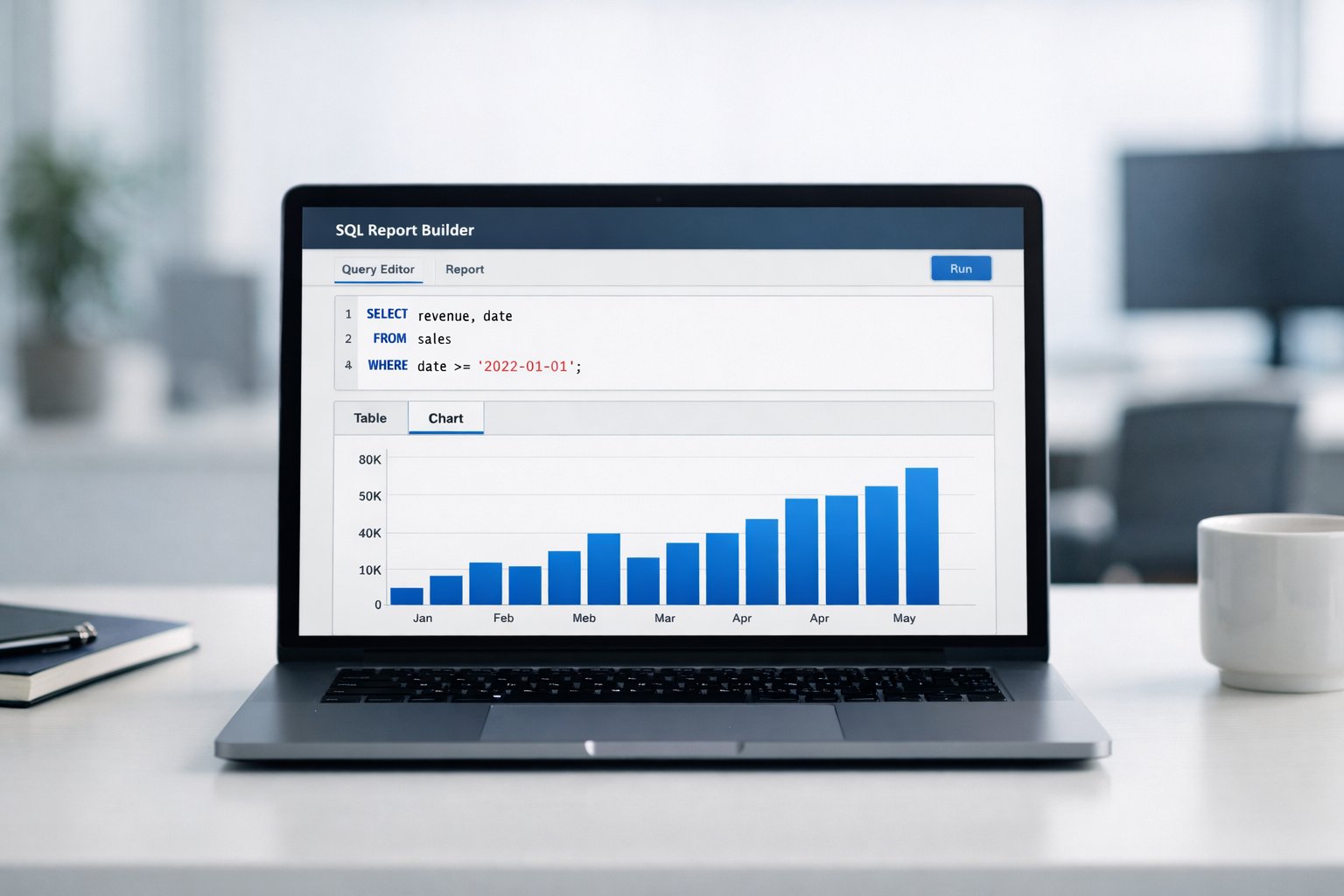
Waiting weeks for a data analyst to build a dashboard is a relic of the past. If you're running a team, you know the pain: you need a key number—right now—but the data is locked away. You file a ticket and the waiting game begins. This isn't just an inconvenience; it's a growth bottleneck. Every hour spent waiting is an hour you're not making a smart decision. It's time to stop waiting for data and start acting on it.
A traditional SQL report builder is like a DIY meal kit for data. It gives you the prepped ingredients, but you still have to be the chef who knows the SQL recipe. For busy founders and managers, that’s a dealbreaker.
TL;DR: The Key Takeaways
A SQL report builder is a tool for technical users to write SQL queries and create reports. It requires expertise and is slow for ad-hoc questions.
The old way of getting reports creates a bottleneck, forcing business teams to wait for analysts to pull simple numbers.
The new way is with a Conversational AI Data Analyst like Statspresso, which lets anyone ask questions in plain English and get charts in seconds.
Traditional builders are good for static, standardized reports (e.g., financial statements) but fail at dynamic, real-time business analysis.
The true cost of manual reporting isn't the software license; it's the analyst's salary and the price of delayed decisions.
The core benefit: Skip the SQL. Just ask your data a question and get a chart in seconds.
The Data Bottleneck You Know Too Well
If you're leading a team, this scene probably hits close to home. You desperately need a key business number, but it’s trapped in a database. You end up filing a ticket, and the waiting game begins. Days, or sometimes even weeks, later, a report finally lands in your inbox.
This isn't just a minor annoyance; it's a growth bottleneck. Every hour you spend waiting on an analyst to pull a number is an hour your team isn't making a smart, data-driven decision. This constant dependency on a technical specialist makes it harder to react to market shifts, answer urgent customer questions, or optimize your marketing budget.
The Soaring Demand for Answers
To get why these old tools are struggling, look at the bigger picture of metrics and reporting. The demand for instant answers is exploding. The global market for SQL Query Builders is on track to jump from $2,706.98 million to $4,311.45 million by 2025. That surge tells a clear story: traditional reporting tools can’t keep up. You can read more in the full research on SQL Query Builders.
This is exactly where a Conversational AI Data Analyst like Statspresso flips the script. Instead of getting in line for a manual report, you skip the SQL part altogether.
Try asking Statspresso: "Show me my revenue by month for the last year as a bar chart."
Imagine just asking your data a question and getting a chart back in seconds. It’s time to stop waiting and start acting.
The Old Way vs. The AI Way of Getting Reports
Let's draw a clear line in the sand. Getting answers from your data has traditionally been a manual, multi-step marathon. The "AI way" is a sprint straight to the insight.
The old process, built around a traditional SQL report builder, is painfully slow. It keeps critical business insights locked away with technical experts. When a founder or marketing lead needs a simple number, they have to get in line and wait.
This is a classic bottleneck that holds businesses back.
As you can see, the hold-up isn't the data itself—it’s the clunky process required to translate a simple business question into a technical report.
Breaking Down the Two Approaches
The difference here goes way beyond speed. It’s about accessibility and agility. The manual approach is rigid and gatekept by specialized skills; the AI approach is flexible and designed for anyone on your team.
To really see the difference, let’s compare the two workflows side-by-side. Imagine you need a straightforward report on last quarter's sales.
Manual SQL Reporting vs Conversational AI Analytics
Step | The Old Way (Manual SQL) | The New Way (Statspresso) |
|---|---|---|
Action | Write, debug, and run a complex SQL query. | Ask a question in plain English. |
Time | Hours to Days | Seconds |
Skills | Requires a dedicated data analyst or SQL expert. | Anyone on the team can ask a question. |
Output | Raw data export, needs separate visualization tool. | Instant, interactive chart or answer. |
Result | Slow decisions, team dependencies, report backlogs. | Immediate answers, team autonomy, fast action. |
This stark contrast is exactly why so many companies are finally moving toward genuine self-serve business intelligence. The goal is to eliminate the friction between question and answer.
This new way of working is powered by tools like Statspresso, a Conversational AI Data Analyst. It completely redefines what it means to be "data-driven." Instead of waiting for a report, your team can have a direct conversation with your data.
Try asking Statspresso: "Show me our top 5 products by revenue last quarter as a donut chart."
You skip the SQL entirely. You just ask a question and get a chart in seconds. This isn't just a faster way to build reports; it's a fundamentally new way to work. It breaks down the barriers that once made insights a luxury, empowering every team member to make smarter, faster decisions.
Key Features of a Traditional SQL Report Builder
Let's pop the hood on a typical SQL report builder. The best way to think about one is like a professional mechanic's toolbox. It’s filled with specialized tools for very specific jobs, but it won't fix the car for you. Every feature is designed for a step in the manual report-building process.
In the right hands, these tools are powerful. But they were never built for a founder who needs a quick answer minutes before a board meeting.
Data Source Connectors
The first tool you'll reach for is the Data Source Connector. This is your set of specialized wrenches, one designed to fit your Postgres database, another for your Shopify data, and so on. They create the initial connection between the report builder and your raw data.
The catch is, a connector just opens the door. It doesn't tell you which data to grab or how to piece it all together. That heavy lifting is still on your analyst’s to-do list. With relational platforms holding a massive 57.30% of the database market, having solid SQL connectors is a must, but it's just the start. You can get more context from the latest database market report.
The Query Designer
Next, you have the Query Designer. This is basically a text editor where the SQL magic (or madness) happens. It’s where your analyst writes, line by line, the exact code that instructs the database on what information to pull.
A query designer helps you structure your SQL, but it doesn't write the actual logic. It's the difference between having a blank piece of paper and having a finished essay.
Formatting and Exporting
Finally, you’ll work with a Formatting Engine and an Export/Scheduling Module. The formatting engine gives you tools to arrange raw data into tables or charts. Then, the export module acts like a delivery truck, letting you save the report as a PDF or schedule it to land in everyone's inbox on Monday morning.
The whole process is incredibly rigid. If a new question comes up, someone has to go back to the query designer, rewrite the SQL, and run everything again. It’s a repetitive cycle that keeps answers locked behind a technical wall.
This is precisely the bottleneck a Conversational AI Data Analyst like Statspresso eliminates.
Try asking Statspresso: 'What was our average customer lifetime value for users acquired in Q2?'
You skip the connectors, the query writing, and the formatting. You just ask and get the answer.
When SQL Report Builders Work and When They Fail
A traditional SQL report builder isn't obsolete, but you need to know what it was built for. Think of it as a printing press: great for churning out thousands of identical newspapers. But if you need to change a single headline, you have to stop the presses and start over.
These tools are at their best when you need standardized, unchanging reports day after day. They are workhorses for tasks where consistency is king.
Where They Excel: Standardized Reporting
A SQL report builder is the right tool when you're dealing with routine, predictable data needs.
Financial Statements: Perfect for generating pixel-perfect, formatted reports like monthly P&L statements or quarterly balance sheets.
Operational Dashboards: Great for displaying fixed KPIs, like units-per-hour on a manufacturing line or on-time delivery stats.
Compliance and Audits: Essential for creating documents that must follow strict regulatory formats, leaving zero room for changes.
In these cases, the rigid nature of a SQL-based process is a feature, not a bug. It guarantees everyone sees the exact same numbers in the exact same format.
Where They Fail: Dynamic Business Needs
On the flip side, that printing press model completely falls apart when faced with the demands of a fast-moving business. They simply weren't designed for ad-hoc analysis and urgent, one-off questions.
The moment your Head of Marketing asks, "What happened to our sign-ups from Google Ads yesterday afternoon?" the traditional process grinds to a halt. You can't afford to file a ticket and wait hours for an analyst to write custom SQL. That delay costs you real money.
The issue isn't just technical; it's a fundamental mismatch between the tool's design and the speed your business operates at.
This is where a tool like Statspresso, a Conversational AI Data Analyst, changes the game. It’s built for the messy, unpredictable questions that drive a business forward. Instead of waiting for a manual report, you skip the SQL altogether.
Try asking Statspresso: 'Compare revenue from our top 3 marketing channels month-over-month for the last 6 months as a line chart.'
You get an answer in seconds, not days. This allows you to go from question to insight instantly, turning curiosity into action without breaking your stride.
The Hidden Costs of Manual Reporting
Thinking the license fee for a traditional SQL report builder is the main expense is a common mistake. The real costs are tangled up in the day-to-day process. They don't show up on an invoice, but you feel their weight in stalled decisions.
Think about who runs these reports. An effective SQL tool needs an expert, which usually means hiring a data analyst. That's a six-figure salary for someone who ends up spending most of their time acting as a human go-between for your business teams and the database. It’s an expensive bottleneck.
The Incalculable Price of Waiting
But the real killer is the waiting game. Every moment your marketing, sales, or product teams are stuck waiting on a report is a moment they aren't acting. Market opportunities don't pause for your analyst's backlog. This delay is a direct tax on your company's agility.
And what happens when that report finally arrives? One answer almost always sparks a follow-up question. With a manual process, even a small tweak sends the request right back to the end of the line. This inflexibility discourages curiosity. Soon, your team stops asking deeper questions because it’s just too much trouble.
This manual effort is a huge piece of the $20.7 billion SQL Server Transformation market. In fact, the data integration scripts used to wrangle data sources account for over a third of that market. It’s a staggering amount of money spent on what is essentially manual labor.
This is precisely where a Conversational AI Data Analyst like Statspresso changes the financial picture. By empowering your team to get answers for themselves, you eliminate these hidden costs. You skip the SQL and get straight to the insight, turning a major expense into a competitive advantage.
Is It Time to Move Beyond SQL Report Builders?
Let’s be honest. Are you truly getting the most from your data, or are you just getting by? Traditional SQL report builders were a huge step forward, but for a modern business, they can often feel more like an anchor than a sail.
If you suspect your team has hit the limits of these tools, the warning signs are usually clear. This is a quick gut-check to see if those frustrations are symptoms of a bigger bottleneck.
Your Team Has Outgrown Manual Reporting If…
Do any of these scenarios hit a little too close to home? If you're nodding along, the old way is holding you back.
Your business teams constantly ask for 'quick' data pulls. Your marketing, sales, and ops folks are experts in their fields, not SQL. When every simple question becomes a ticket, momentum dies.
Your data analyst has become a bottleneck. Their real value is in deep, strategic work—uncovering the why behind the numbers. Instead, they're trapped in a reactive loop of pulling basic reports.
You can't get immediate answers in meetings. A critical question pops up, but the best anyone can offer is, "Good question, let's circle back." The inability to query data on the fly kills productive discussions.
'Dashboard sprawl' means nobody trusts the data. You've got dozens of dashboards, each showing slightly different numbers for the same metric. Soon, nobody knows which report is the source of truth.
As organizations improve their data capabilities, a modern data management platform can centralize and activate data, offering agility that goes beyond traditional report builders.
The Next Step Toward Data-Driven Decisions
If those points feel familiar, the solution isn't to hire another analyst. The real fix is to empower your business teams with a tool that removes the analyst as the gatekeeper.
This is where a Conversational AI Data Analyst like Statspresso changes the game. It doesn't need to replace your entire reporting stack. Think of it as an express lane for your business teams, giving them the power to get answers for themselves, instantly.
The idea is simple: Skip the SQL. Just ask your data a question and get a chart in seconds. This isn't just about making reports faster; it's about fostering a culture where anyone can use data to make smarter decisions.
Try asking Statspresso: "Show me which marketing campaigns had the highest ROI last month."
Frequently Asked Questions
It's natural to have questions when a new approach to data comes along. Here are a few common things we hear about SQL report builders and how AI-driven analytics are changing the game.
Do I Need to Know SQL to Use Statspresso?
Not at all. Statspresso is a Conversational AI Data Analyst built for people who aren't data experts.
The entire point is to let you ask questions in plain English—the same way you'd ask a person on your team. The AI handles writing the SQL, running the analysis, and creating the charts for you. It's made for founders, marketers, and product managers who need quick answers, not another complex tool to master.
Is a SQL Report Builder the Same as Tableau?
That's a great question. Think of a traditional SQL report builder as just one piece of a much larger puzzle. It's often a feature inside big Business Intelligence (BI) platforms like Tableau or Power BI. Its primary job is to help a technical user write the queries that pull data.
While a full BI tool offers more powerful dashboards, both still require significant technical skill to get right. Conversational AI tools like Statspresso are a completely different approach. You get to skip the SQL and the complicated dashboard-building process.
How Hard Is It to Switch from a SQL Report Builder to AI Analytics?
The transition is simpler than you might think because you aren't "migrating" anything. You don't have to rebuild old, rigid reports one by one.
With a tool like Statspresso, you just connect your data sources directly—your Postgres database, Shopify account, or HubSpot data. This takes a few minutes. From that moment on, anyone on your team can start asking questions and getting answers.
The key takeaway: You skip the old reporting process entirely. You just ask your data a question and get a chart in seconds.
Ready to stop waiting for reports and start getting answers? With Statspresso, you can connect your first data source for free and ask your first question in minutes.
Connect your first data source for free and ask your first question.
Waiting weeks for a data analyst to build a dashboard is a relic of the past. If you're running a team, you know the pain: you need a key number—right now—but the data is locked away. You file a ticket and the waiting game begins. This isn't just an inconvenience; it's a growth bottleneck. Every hour spent waiting is an hour you're not making a smart decision. It's time to stop waiting for data and start acting on it.
A traditional SQL report builder is like a DIY meal kit for data. It gives you the prepped ingredients, but you still have to be the chef who knows the SQL recipe. For busy founders and managers, that’s a dealbreaker.
TL;DR: The Key Takeaways
A SQL report builder is a tool for technical users to write SQL queries and create reports. It requires expertise and is slow for ad-hoc questions.
The old way of getting reports creates a bottleneck, forcing business teams to wait for analysts to pull simple numbers.
The new way is with a Conversational AI Data Analyst like Statspresso, which lets anyone ask questions in plain English and get charts in seconds.
Traditional builders are good for static, standardized reports (e.g., financial statements) but fail at dynamic, real-time business analysis.
The true cost of manual reporting isn't the software license; it's the analyst's salary and the price of delayed decisions.
The core benefit: Skip the SQL. Just ask your data a question and get a chart in seconds.
The Data Bottleneck You Know Too Well
If you're leading a team, this scene probably hits close to home. You desperately need a key business number, but it’s trapped in a database. You end up filing a ticket, and the waiting game begins. Days, or sometimes even weeks, later, a report finally lands in your inbox.
This isn't just a minor annoyance; it's a growth bottleneck. Every hour you spend waiting on an analyst to pull a number is an hour your team isn't making a smart, data-driven decision. This constant dependency on a technical specialist makes it harder to react to market shifts, answer urgent customer questions, or optimize your marketing budget.
The Soaring Demand for Answers
To get why these old tools are struggling, look at the bigger picture of metrics and reporting. The demand for instant answers is exploding. The global market for SQL Query Builders is on track to jump from $2,706.98 million to $4,311.45 million by 2025. That surge tells a clear story: traditional reporting tools can’t keep up. You can read more in the full research on SQL Query Builders.
This is exactly where a Conversational AI Data Analyst like Statspresso flips the script. Instead of getting in line for a manual report, you skip the SQL part altogether.
Try asking Statspresso: "Show me my revenue by month for the last year as a bar chart."
Imagine just asking your data a question and getting a chart back in seconds. It’s time to stop waiting and start acting.
The Old Way vs. The AI Way of Getting Reports
Let's draw a clear line in the sand. Getting answers from your data has traditionally been a manual, multi-step marathon. The "AI way" is a sprint straight to the insight.
The old process, built around a traditional SQL report builder, is painfully slow. It keeps critical business insights locked away with technical experts. When a founder or marketing lead needs a simple number, they have to get in line and wait.
This is a classic bottleneck that holds businesses back.
As you can see, the hold-up isn't the data itself—it’s the clunky process required to translate a simple business question into a technical report.
Breaking Down the Two Approaches
The difference here goes way beyond speed. It’s about accessibility and agility. The manual approach is rigid and gatekept by specialized skills; the AI approach is flexible and designed for anyone on your team.
To really see the difference, let’s compare the two workflows side-by-side. Imagine you need a straightforward report on last quarter's sales.
Manual SQL Reporting vs Conversational AI Analytics
Step | The Old Way (Manual SQL) | The New Way (Statspresso) |
|---|---|---|
Action | Write, debug, and run a complex SQL query. | Ask a question in plain English. |
Time | Hours to Days | Seconds |
Skills | Requires a dedicated data analyst or SQL expert. | Anyone on the team can ask a question. |
Output | Raw data export, needs separate visualization tool. | Instant, interactive chart or answer. |
Result | Slow decisions, team dependencies, report backlogs. | Immediate answers, team autonomy, fast action. |
This stark contrast is exactly why so many companies are finally moving toward genuine self-serve business intelligence. The goal is to eliminate the friction between question and answer.
This new way of working is powered by tools like Statspresso, a Conversational AI Data Analyst. It completely redefines what it means to be "data-driven." Instead of waiting for a report, your team can have a direct conversation with your data.
Try asking Statspresso: "Show me our top 5 products by revenue last quarter as a donut chart."
You skip the SQL entirely. You just ask a question and get a chart in seconds. This isn't just a faster way to build reports; it's a fundamentally new way to work. It breaks down the barriers that once made insights a luxury, empowering every team member to make smarter, faster decisions.
Key Features of a Traditional SQL Report Builder
Let's pop the hood on a typical SQL report builder. The best way to think about one is like a professional mechanic's toolbox. It’s filled with specialized tools for very specific jobs, but it won't fix the car for you. Every feature is designed for a step in the manual report-building process.
In the right hands, these tools are powerful. But they were never built for a founder who needs a quick answer minutes before a board meeting.
Data Source Connectors
The first tool you'll reach for is the Data Source Connector. This is your set of specialized wrenches, one designed to fit your Postgres database, another for your Shopify data, and so on. They create the initial connection between the report builder and your raw data.
The catch is, a connector just opens the door. It doesn't tell you which data to grab or how to piece it all together. That heavy lifting is still on your analyst’s to-do list. With relational platforms holding a massive 57.30% of the database market, having solid SQL connectors is a must, but it's just the start. You can get more context from the latest database market report.
The Query Designer
Next, you have the Query Designer. This is basically a text editor where the SQL magic (or madness) happens. It’s where your analyst writes, line by line, the exact code that instructs the database on what information to pull.
A query designer helps you structure your SQL, but it doesn't write the actual logic. It's the difference between having a blank piece of paper and having a finished essay.
Formatting and Exporting
Finally, you’ll work with a Formatting Engine and an Export/Scheduling Module. The formatting engine gives you tools to arrange raw data into tables or charts. Then, the export module acts like a delivery truck, letting you save the report as a PDF or schedule it to land in everyone's inbox on Monday morning.
The whole process is incredibly rigid. If a new question comes up, someone has to go back to the query designer, rewrite the SQL, and run everything again. It’s a repetitive cycle that keeps answers locked behind a technical wall.
This is precisely the bottleneck a Conversational AI Data Analyst like Statspresso eliminates.
Try asking Statspresso: 'What was our average customer lifetime value for users acquired in Q2?'
You skip the connectors, the query writing, and the formatting. You just ask and get the answer.
When SQL Report Builders Work and When They Fail
A traditional SQL report builder isn't obsolete, but you need to know what it was built for. Think of it as a printing press: great for churning out thousands of identical newspapers. But if you need to change a single headline, you have to stop the presses and start over.
These tools are at their best when you need standardized, unchanging reports day after day. They are workhorses for tasks where consistency is king.
Where They Excel: Standardized Reporting
A SQL report builder is the right tool when you're dealing with routine, predictable data needs.
Financial Statements: Perfect for generating pixel-perfect, formatted reports like monthly P&L statements or quarterly balance sheets.
Operational Dashboards: Great for displaying fixed KPIs, like units-per-hour on a manufacturing line or on-time delivery stats.
Compliance and Audits: Essential for creating documents that must follow strict regulatory formats, leaving zero room for changes.
In these cases, the rigid nature of a SQL-based process is a feature, not a bug. It guarantees everyone sees the exact same numbers in the exact same format.
Where They Fail: Dynamic Business Needs
On the flip side, that printing press model completely falls apart when faced with the demands of a fast-moving business. They simply weren't designed for ad-hoc analysis and urgent, one-off questions.
The moment your Head of Marketing asks, "What happened to our sign-ups from Google Ads yesterday afternoon?" the traditional process grinds to a halt. You can't afford to file a ticket and wait hours for an analyst to write custom SQL. That delay costs you real money.
The issue isn't just technical; it's a fundamental mismatch between the tool's design and the speed your business operates at.
This is where a tool like Statspresso, a Conversational AI Data Analyst, changes the game. It’s built for the messy, unpredictable questions that drive a business forward. Instead of waiting for a manual report, you skip the SQL altogether.
Try asking Statspresso: 'Compare revenue from our top 3 marketing channels month-over-month for the last 6 months as a line chart.'
You get an answer in seconds, not days. This allows you to go from question to insight instantly, turning curiosity into action without breaking your stride.
The Hidden Costs of Manual Reporting
Thinking the license fee for a traditional SQL report builder is the main expense is a common mistake. The real costs are tangled up in the day-to-day process. They don't show up on an invoice, but you feel their weight in stalled decisions.
Think about who runs these reports. An effective SQL tool needs an expert, which usually means hiring a data analyst. That's a six-figure salary for someone who ends up spending most of their time acting as a human go-between for your business teams and the database. It’s an expensive bottleneck.
The Incalculable Price of Waiting
But the real killer is the waiting game. Every moment your marketing, sales, or product teams are stuck waiting on a report is a moment they aren't acting. Market opportunities don't pause for your analyst's backlog. This delay is a direct tax on your company's agility.
And what happens when that report finally arrives? One answer almost always sparks a follow-up question. With a manual process, even a small tweak sends the request right back to the end of the line. This inflexibility discourages curiosity. Soon, your team stops asking deeper questions because it’s just too much trouble.
This manual effort is a huge piece of the $20.7 billion SQL Server Transformation market. In fact, the data integration scripts used to wrangle data sources account for over a third of that market. It’s a staggering amount of money spent on what is essentially manual labor.
This is precisely where a Conversational AI Data Analyst like Statspresso changes the financial picture. By empowering your team to get answers for themselves, you eliminate these hidden costs. You skip the SQL and get straight to the insight, turning a major expense into a competitive advantage.
Is It Time to Move Beyond SQL Report Builders?
Let’s be honest. Are you truly getting the most from your data, or are you just getting by? Traditional SQL report builders were a huge step forward, but for a modern business, they can often feel more like an anchor than a sail.
If you suspect your team has hit the limits of these tools, the warning signs are usually clear. This is a quick gut-check to see if those frustrations are symptoms of a bigger bottleneck.
Your Team Has Outgrown Manual Reporting If…
Do any of these scenarios hit a little too close to home? If you're nodding along, the old way is holding you back.
Your business teams constantly ask for 'quick' data pulls. Your marketing, sales, and ops folks are experts in their fields, not SQL. When every simple question becomes a ticket, momentum dies.
Your data analyst has become a bottleneck. Their real value is in deep, strategic work—uncovering the why behind the numbers. Instead, they're trapped in a reactive loop of pulling basic reports.
You can't get immediate answers in meetings. A critical question pops up, but the best anyone can offer is, "Good question, let's circle back." The inability to query data on the fly kills productive discussions.
'Dashboard sprawl' means nobody trusts the data. You've got dozens of dashboards, each showing slightly different numbers for the same metric. Soon, nobody knows which report is the source of truth.
As organizations improve their data capabilities, a modern data management platform can centralize and activate data, offering agility that goes beyond traditional report builders.
The Next Step Toward Data-Driven Decisions
If those points feel familiar, the solution isn't to hire another analyst. The real fix is to empower your business teams with a tool that removes the analyst as the gatekeeper.
This is where a Conversational AI Data Analyst like Statspresso changes the game. It doesn't need to replace your entire reporting stack. Think of it as an express lane for your business teams, giving them the power to get answers for themselves, instantly.
The idea is simple: Skip the SQL. Just ask your data a question and get a chart in seconds. This isn't just about making reports faster; it's about fostering a culture where anyone can use data to make smarter decisions.
Try asking Statspresso: "Show me which marketing campaigns had the highest ROI last month."
Frequently Asked Questions
It's natural to have questions when a new approach to data comes along. Here are a few common things we hear about SQL report builders and how AI-driven analytics are changing the game.
Do I Need to Know SQL to Use Statspresso?
Not at all. Statspresso is a Conversational AI Data Analyst built for people who aren't data experts.
The entire point is to let you ask questions in plain English—the same way you'd ask a person on your team. The AI handles writing the SQL, running the analysis, and creating the charts for you. It's made for founders, marketers, and product managers who need quick answers, not another complex tool to master.
Is a SQL Report Builder the Same as Tableau?
That's a great question. Think of a traditional SQL report builder as just one piece of a much larger puzzle. It's often a feature inside big Business Intelligence (BI) platforms like Tableau or Power BI. Its primary job is to help a technical user write the queries that pull data.
While a full BI tool offers more powerful dashboards, both still require significant technical skill to get right. Conversational AI tools like Statspresso are a completely different approach. You get to skip the SQL and the complicated dashboard-building process.
How Hard Is It to Switch from a SQL Report Builder to AI Analytics?
The transition is simpler than you might think because you aren't "migrating" anything. You don't have to rebuild old, rigid reports one by one.
With a tool like Statspresso, you just connect your data sources directly—your Postgres database, Shopify account, or HubSpot data. This takes a few minutes. From that moment on, anyone on your team can start asking questions and getting answers.
The key takeaway: You skip the old reporting process entirely. You just ask your data a question and get a chart in seconds.
Ready to stop waiting for reports and start getting answers? With Statspresso, you can connect your first data source for free and ask your first question in minutes.
Connect your first data source for free and ask your first question.
Waiting weeks for a data analyst to build a dashboard is a relic of the past. If you're running a team, you know the pain: you need a key number—right now—but the data is locked away. You file a ticket and the waiting game begins. This isn't just an inconvenience; it's a growth bottleneck. Every hour spent waiting is an hour you're not making a smart decision. It's time to stop waiting for data and start acting on it.
A traditional SQL report builder is like a DIY meal kit for data. It gives you the prepped ingredients, but you still have to be the chef who knows the SQL recipe. For busy founders and managers, that’s a dealbreaker.
TL;DR: The Key Takeaways
A SQL report builder is a tool for technical users to write SQL queries and create reports. It requires expertise and is slow for ad-hoc questions.
The old way of getting reports creates a bottleneck, forcing business teams to wait for analysts to pull simple numbers.
The new way is with a Conversational AI Data Analyst like Statspresso, which lets anyone ask questions in plain English and get charts in seconds.
Traditional builders are good for static, standardized reports (e.g., financial statements) but fail at dynamic, real-time business analysis.
The true cost of manual reporting isn't the software license; it's the analyst's salary and the price of delayed decisions.
The core benefit: Skip the SQL. Just ask your data a question and get a chart in seconds.
The Data Bottleneck You Know Too Well
If you're leading a team, this scene probably hits close to home. You desperately need a key business number, but it’s trapped in a database. You end up filing a ticket, and the waiting game begins. Days, or sometimes even weeks, later, a report finally lands in your inbox.
This isn't just a minor annoyance; it's a growth bottleneck. Every hour you spend waiting on an analyst to pull a number is an hour your team isn't making a smart, data-driven decision. This constant dependency on a technical specialist makes it harder to react to market shifts, answer urgent customer questions, or optimize your marketing budget.
The Soaring Demand for Answers
To get why these old tools are struggling, look at the bigger picture of metrics and reporting. The demand for instant answers is exploding. The global market for SQL Query Builders is on track to jump from $2,706.98 million to $4,311.45 million by 2025. That surge tells a clear story: traditional reporting tools can’t keep up. You can read more in the full research on SQL Query Builders.
This is exactly where a Conversational AI Data Analyst like Statspresso flips the script. Instead of getting in line for a manual report, you skip the SQL part altogether.
Try asking Statspresso: "Show me my revenue by month for the last year as a bar chart."
Imagine just asking your data a question and getting a chart back in seconds. It’s time to stop waiting and start acting.
The Old Way vs. The AI Way of Getting Reports
Let's draw a clear line in the sand. Getting answers from your data has traditionally been a manual, multi-step marathon. The "AI way" is a sprint straight to the insight.
The old process, built around a traditional SQL report builder, is painfully slow. It keeps critical business insights locked away with technical experts. When a founder or marketing lead needs a simple number, they have to get in line and wait.
This is a classic bottleneck that holds businesses back.
As you can see, the hold-up isn't the data itself—it’s the clunky process required to translate a simple business question into a technical report.
Breaking Down the Two Approaches
The difference here goes way beyond speed. It’s about accessibility and agility. The manual approach is rigid and gatekept by specialized skills; the AI approach is flexible and designed for anyone on your team.
To really see the difference, let’s compare the two workflows side-by-side. Imagine you need a straightforward report on last quarter's sales.
Manual SQL Reporting vs Conversational AI Analytics
Step | The Old Way (Manual SQL) | The New Way (Statspresso) |
|---|---|---|
Action | Write, debug, and run a complex SQL query. | Ask a question in plain English. |
Time | Hours to Days | Seconds |
Skills | Requires a dedicated data analyst or SQL expert. | Anyone on the team can ask a question. |
Output | Raw data export, needs separate visualization tool. | Instant, interactive chart or answer. |
Result | Slow decisions, team dependencies, report backlogs. | Immediate answers, team autonomy, fast action. |
This stark contrast is exactly why so many companies are finally moving toward genuine self-serve business intelligence. The goal is to eliminate the friction between question and answer.
This new way of working is powered by tools like Statspresso, a Conversational AI Data Analyst. It completely redefines what it means to be "data-driven." Instead of waiting for a report, your team can have a direct conversation with your data.
Try asking Statspresso: "Show me our top 5 products by revenue last quarter as a donut chart."
You skip the SQL entirely. You just ask a question and get a chart in seconds. This isn't just a faster way to build reports; it's a fundamentally new way to work. It breaks down the barriers that once made insights a luxury, empowering every team member to make smarter, faster decisions.
Key Features of a Traditional SQL Report Builder
Let's pop the hood on a typical SQL report builder. The best way to think about one is like a professional mechanic's toolbox. It’s filled with specialized tools for very specific jobs, but it won't fix the car for you. Every feature is designed for a step in the manual report-building process.
In the right hands, these tools are powerful. But they were never built for a founder who needs a quick answer minutes before a board meeting.
Data Source Connectors
The first tool you'll reach for is the Data Source Connector. This is your set of specialized wrenches, one designed to fit your Postgres database, another for your Shopify data, and so on. They create the initial connection between the report builder and your raw data.
The catch is, a connector just opens the door. It doesn't tell you which data to grab or how to piece it all together. That heavy lifting is still on your analyst’s to-do list. With relational platforms holding a massive 57.30% of the database market, having solid SQL connectors is a must, but it's just the start. You can get more context from the latest database market report.
The Query Designer
Next, you have the Query Designer. This is basically a text editor where the SQL magic (or madness) happens. It’s where your analyst writes, line by line, the exact code that instructs the database on what information to pull.
A query designer helps you structure your SQL, but it doesn't write the actual logic. It's the difference between having a blank piece of paper and having a finished essay.
Formatting and Exporting
Finally, you’ll work with a Formatting Engine and an Export/Scheduling Module. The formatting engine gives you tools to arrange raw data into tables or charts. Then, the export module acts like a delivery truck, letting you save the report as a PDF or schedule it to land in everyone's inbox on Monday morning.
The whole process is incredibly rigid. If a new question comes up, someone has to go back to the query designer, rewrite the SQL, and run everything again. It’s a repetitive cycle that keeps answers locked behind a technical wall.
This is precisely the bottleneck a Conversational AI Data Analyst like Statspresso eliminates.
Try asking Statspresso: 'What was our average customer lifetime value for users acquired in Q2?'
You skip the connectors, the query writing, and the formatting. You just ask and get the answer.
When SQL Report Builders Work and When They Fail
A traditional SQL report builder isn't obsolete, but you need to know what it was built for. Think of it as a printing press: great for churning out thousands of identical newspapers. But if you need to change a single headline, you have to stop the presses and start over.
These tools are at their best when you need standardized, unchanging reports day after day. They are workhorses for tasks where consistency is king.
Where They Excel: Standardized Reporting
A SQL report builder is the right tool when you're dealing with routine, predictable data needs.
Financial Statements: Perfect for generating pixel-perfect, formatted reports like monthly P&L statements or quarterly balance sheets.
Operational Dashboards: Great for displaying fixed KPIs, like units-per-hour on a manufacturing line or on-time delivery stats.
Compliance and Audits: Essential for creating documents that must follow strict regulatory formats, leaving zero room for changes.
In these cases, the rigid nature of a SQL-based process is a feature, not a bug. It guarantees everyone sees the exact same numbers in the exact same format.
Where They Fail: Dynamic Business Needs
On the flip side, that printing press model completely falls apart when faced with the demands of a fast-moving business. They simply weren't designed for ad-hoc analysis and urgent, one-off questions.
The moment your Head of Marketing asks, "What happened to our sign-ups from Google Ads yesterday afternoon?" the traditional process grinds to a halt. You can't afford to file a ticket and wait hours for an analyst to write custom SQL. That delay costs you real money.
The issue isn't just technical; it's a fundamental mismatch between the tool's design and the speed your business operates at.
This is where a tool like Statspresso, a Conversational AI Data Analyst, changes the game. It’s built for the messy, unpredictable questions that drive a business forward. Instead of waiting for a manual report, you skip the SQL altogether.
Try asking Statspresso: 'Compare revenue from our top 3 marketing channels month-over-month for the last 6 months as a line chart.'
You get an answer in seconds, not days. This allows you to go from question to insight instantly, turning curiosity into action without breaking your stride.
The Hidden Costs of Manual Reporting
Thinking the license fee for a traditional SQL report builder is the main expense is a common mistake. The real costs are tangled up in the day-to-day process. They don't show up on an invoice, but you feel their weight in stalled decisions.
Think about who runs these reports. An effective SQL tool needs an expert, which usually means hiring a data analyst. That's a six-figure salary for someone who ends up spending most of their time acting as a human go-between for your business teams and the database. It’s an expensive bottleneck.
The Incalculable Price of Waiting
But the real killer is the waiting game. Every moment your marketing, sales, or product teams are stuck waiting on a report is a moment they aren't acting. Market opportunities don't pause for your analyst's backlog. This delay is a direct tax on your company's agility.
And what happens when that report finally arrives? One answer almost always sparks a follow-up question. With a manual process, even a small tweak sends the request right back to the end of the line. This inflexibility discourages curiosity. Soon, your team stops asking deeper questions because it’s just too much trouble.
This manual effort is a huge piece of the $20.7 billion SQL Server Transformation market. In fact, the data integration scripts used to wrangle data sources account for over a third of that market. It’s a staggering amount of money spent on what is essentially manual labor.
This is precisely where a Conversational AI Data Analyst like Statspresso changes the financial picture. By empowering your team to get answers for themselves, you eliminate these hidden costs. You skip the SQL and get straight to the insight, turning a major expense into a competitive advantage.
Is It Time to Move Beyond SQL Report Builders?
Let’s be honest. Are you truly getting the most from your data, or are you just getting by? Traditional SQL report builders were a huge step forward, but for a modern business, they can often feel more like an anchor than a sail.
If you suspect your team has hit the limits of these tools, the warning signs are usually clear. This is a quick gut-check to see if those frustrations are symptoms of a bigger bottleneck.
Your Team Has Outgrown Manual Reporting If…
Do any of these scenarios hit a little too close to home? If you're nodding along, the old way is holding you back.
Your business teams constantly ask for 'quick' data pulls. Your marketing, sales, and ops folks are experts in their fields, not SQL. When every simple question becomes a ticket, momentum dies.
Your data analyst has become a bottleneck. Their real value is in deep, strategic work—uncovering the why behind the numbers. Instead, they're trapped in a reactive loop of pulling basic reports.
You can't get immediate answers in meetings. A critical question pops up, but the best anyone can offer is, "Good question, let's circle back." The inability to query data on the fly kills productive discussions.
'Dashboard sprawl' means nobody trusts the data. You've got dozens of dashboards, each showing slightly different numbers for the same metric. Soon, nobody knows which report is the source of truth.
As organizations improve their data capabilities, a modern data management platform can centralize and activate data, offering agility that goes beyond traditional report builders.
The Next Step Toward Data-Driven Decisions
If those points feel familiar, the solution isn't to hire another analyst. The real fix is to empower your business teams with a tool that removes the analyst as the gatekeeper.
This is where a Conversational AI Data Analyst like Statspresso changes the game. It doesn't need to replace your entire reporting stack. Think of it as an express lane for your business teams, giving them the power to get answers for themselves, instantly.
The idea is simple: Skip the SQL. Just ask your data a question and get a chart in seconds. This isn't just about making reports faster; it's about fostering a culture where anyone can use data to make smarter decisions.
Try asking Statspresso: "Show me which marketing campaigns had the highest ROI last month."
Frequently Asked Questions
It's natural to have questions when a new approach to data comes along. Here are a few common things we hear about SQL report builders and how AI-driven analytics are changing the game.
Do I Need to Know SQL to Use Statspresso?
Not at all. Statspresso is a Conversational AI Data Analyst built for people who aren't data experts.
The entire point is to let you ask questions in plain English—the same way you'd ask a person on your team. The AI handles writing the SQL, running the analysis, and creating the charts for you. It's made for founders, marketers, and product managers who need quick answers, not another complex tool to master.
Is a SQL Report Builder the Same as Tableau?
That's a great question. Think of a traditional SQL report builder as just one piece of a much larger puzzle. It's often a feature inside big Business Intelligence (BI) platforms like Tableau or Power BI. Its primary job is to help a technical user write the queries that pull data.
While a full BI tool offers more powerful dashboards, both still require significant technical skill to get right. Conversational AI tools like Statspresso are a completely different approach. You get to skip the SQL and the complicated dashboard-building process.
How Hard Is It to Switch from a SQL Report Builder to AI Analytics?
The transition is simpler than you might think because you aren't "migrating" anything. You don't have to rebuild old, rigid reports one by one.
With a tool like Statspresso, you just connect your data sources directly—your Postgres database, Shopify account, or HubSpot data. This takes a few minutes. From that moment on, anyone on your team can start asking questions and getting answers.
The key takeaway: You skip the old reporting process entirely. You just ask your data a question and get a chart in seconds.
Ready to stop waiting for reports and start getting answers? With Statspresso, you can connect your first data source for free and ask your first question in minutes.
Connect your first data source for free and ask your first question.