

Mar 10, 2026

Platform Business Intelligence: Your Guide to Instant Data Answers

Waiting weeks for a data analyst to build a dashboard is a relic of the past. Your business has questions, and the answers are trapped in databases. It’s time to unlock them. Platform business intelligence creates a single, reliable source for your data that anyone—and I mean anyone—can query in plain English. No SQL required.

TL;DR: Key Takeaways

  • Platform BI is a single source of truth: It centralizes your data from various sources (Postgres, Shopify, etc.) into one usable hub.

  • It's for everyone, not just analysts: The goal is true self-service, empowering marketing, product, and leadership to get their own answers.

  • Conversational AI is the key: Tools like Statspresso act as a Conversational AI Data Analyst. You skip the SQL and just ask questions to get charts.

  • Implementation is fast: You can connect a data source and get your first insights in minutes, not months.

Why Your Data's Answers Are Locked Away

A concerned businessman reaches for data icons (coins, shopping bag) inside a transparent digital container.

Your business is sitting on a goldmine of insights. The problem? All that value is trapped inside databases like Postgres or apps like Shopify. Getting to it feels like a chore.

This creates a frustrating loop:

  • You have a question.

  • You file a ticket with the data team.

  • You wait.

  • You get an outdated spreadsheet.

  • You end up making a decision based on your gut anyway.

It’s not just annoying—it’s a growth killer. The whole point of having data is to have a conversation with it. That’s where a Conversational AI Data Analyst comes in. Imagine skipping the code, the queues, and the chaos. Just ask your data a question and get a chart in seconds.

What Is Platform Business Intelligence?

Let's cut the jargon. Platform business intelligence is your company's single source of truth for data—a centralized hub that anyone can actually use, not just a handful of analysts. It’s a shift from clunky, disconnected tools to a unified system built for genuine self-service.

Here's a simple comparison:

The Old Way (Manual BI)

The New Way (Platform BI with Statspresso)

Data is siloed in different apps.

All data is connected in one place.

Only SQL experts can get answers.

Anyone can ask questions in plain English.

Insights take days or weeks.

Charts and answers appear in seconds.

You're stuck with static dashboards.

You can explore data with interactive chat.

This is where a Conversational AI Data Analyst like Statspresso flips the script. Instead of wrestling with complex dashboards or writing SQL queries, you just ask.

Try asking Statspresso: "Show me our top 5 products by revenue this quarter as a pie chart."

The Pillars of a True BI Platform

Not all "BI tools" are created equal. A simple charting tool is nice, but a true platform business intelligence solution is built on a few core pillars that turn raw data into fast, reliable answers for your entire team.

It all starts with comprehensive data connectors. Your data is everywhere—Postgres, Shopify, HubSpot, you name it. A real platform connects to all of them, pulling that information together.

Next, you need a powerful semantic layer. This is the secret sauce. It’s the translation engine that turns cryptic database names like fct_transactions_v2 into a simple business term like 'Revenue'. It ensures everyone speaks the same language.
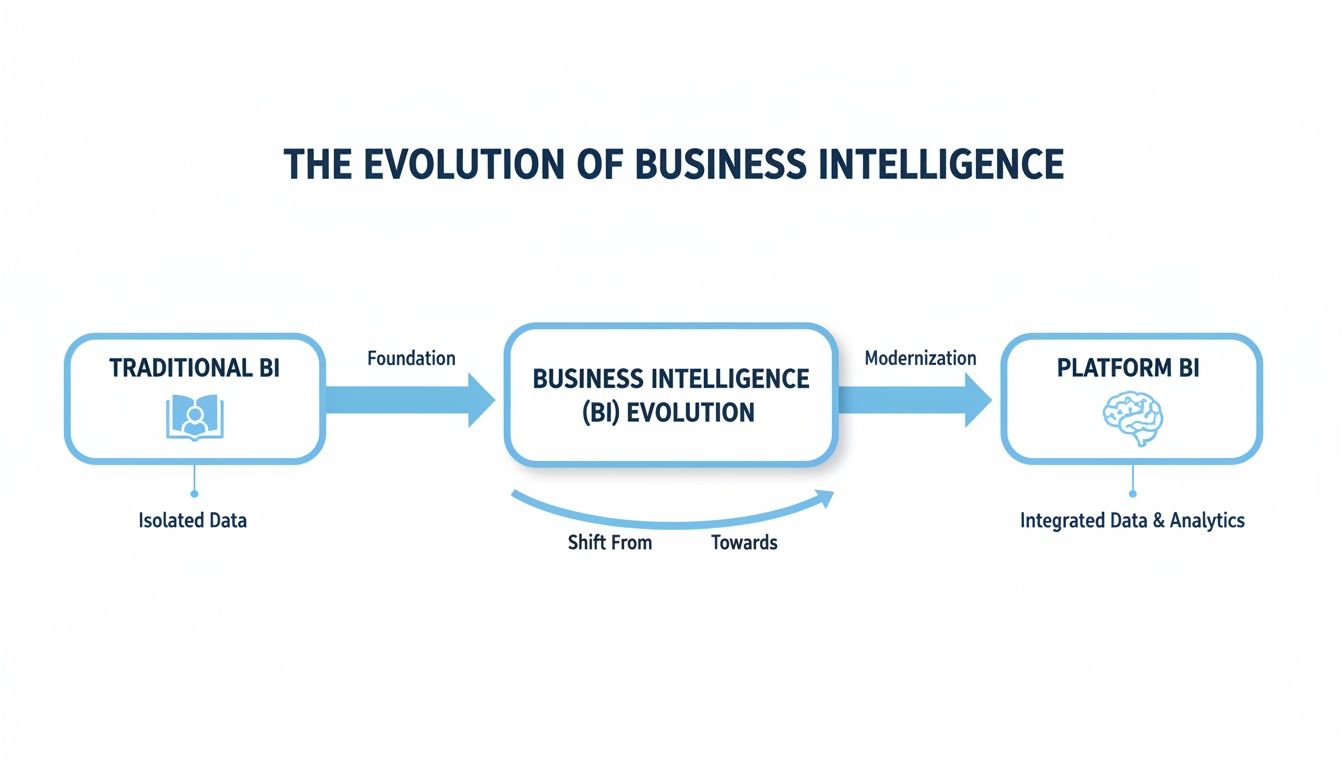
Flowchart showing the evolution of Business Intelligence from traditional BI with isolated data to platform BI with integrated data and analytics.

This brings us to the heart of a modern platform: conversational self-serve analytics. This is about making data analysis as easy as asking a question. Your product manager shouldn't have to write SQL; they should be able to ask, “What was our user retention rate last month?” and get an instant chart. Dive deeper into this concept in our guide to self-serve business intelligence.

These pillars are all held together by strong governance—features a Conversational AI Data Analyst like Statspresso delivers right out of the box.

How Platform BI Drives Business Growth

Two smiling business professionals flank a vibrant, data-filled brain representing business intelligence.

So, what does this actually look like day-to-day?

For product teams, it means faster iteration. They get immediate answers to crucial questions like, ‘Which features are our enterprise customers using the most?’ instead of waiting weeks for a report.

For marketing leads, it’s real-time campaign optimization. Imagine asking, ‘What’s the LTV of customers from our last Google Ads campaign?’ and getting the answer on the spot. No data request ticket needed.

According to Gartner, by 2026, conversational analytics and natural language processing will be a primary driver for new BI platform adoption. This isn't a future trend; it's happening now. Platform BI is the engine for true Data Driven Growth, making automated BI accessible to everyone.

Try asking Statspresso: "Compare monthly recurring revenue (MRR) growth between our Standard and Pro plans."

Your BI Platform Implementation Checklist

Getting a data platform running shouldn't be a six-month headache. Aim for a quick win and build from there. You can see results in days.

Here’s a simple checklist to guide you.

Start Small, Win Fast

1. Nail Down 3-5 Core Business Questions
Don't try to boil the ocean. Seriously. Pinpoint the most urgent questions your team needs answered right now. Think: "Which marketing channel has the highest conversion rate?" or "What's our daily active user count?"

2. Connect One Key Data Source
Pick the single source of truth that holds the answers. This might be your production Postgres database or your sales data from Shopify. Get the most valuable data flowing first.

3. Define Your Semantic Layer
This is where the magic happens. A Conversational AI Data Analyst like Statspresso helps you translate technical jargon into plain English. You'll map cust_acq__dt to "Customer Acquisition Date." This step makes self-service possible.

4. Empower a Pilot Team
Bring in a small, eager group to test things out. Let them start asking questions and getting answers without writing a line of SQL.

5. Measure Success and Expand
Track your progress. How many ad-hoc report requests have disappeared? Once your pilot team is saving time, you'll have a powerful case study to roll the platform out to the wider organization.

Choosing the Right Vendor For Your Team

The business intelligence market is a sea of vendors. To find the right fit, you need a clear checklist focused on what your team actually needs, not just marketing fluff. This isn't about ticking off features; it's about finding a platform that delivers value without a painful, six-month implementation.

For a detailed breakdown of tools, this Business Intelligence Software Comparison is a great resource.

Key Evaluation Criteria

  • Automation That Works: Does the platform intelligently handle complex data models? A true platform business intelligence solution should do the heavy lifting, not leave your team to fix broken queries.

  • Rock-Solid Governance: How granular are the security controls? You need to ensure the right people see the right data—and only the right data.

  • Deep and Dependable Integrations: How well does the platform connect to your existing stack? A platform's authority comes from its ability to connect seamlessly and reliably.

Frequently Asked Questions About Platform BI

When people first hear about platform business intelligence and conversational analytics, a few common questions pop up. Let's tackle them head-on.

Isn't this just another dashboard tool?

Fair question, but no. While a BI platform can produce dashboards, the core difference is how you get insights.

Traditional tools are a static paper map. An expert creates it, and if you need a new destination, you need a new map. A modern BI platform, especially one powered by a Conversational AI Data Analyst like Statspresso, is like a live GPS. Anyone can ask new questions and get fresh charts instantly.

How secure is connecting our company database?

Security is everything. Modern platforms are built with this in mind.

First, they use read-only access. This is critical. The platform can never write, change, or delete your source data. It's strictly for analysis.

On top of that, you get granular control over who sees what, right down to specific rows or columns. Everything is encrypted, and platforms adhere to rigorous standards like SOC 2 compliance.

How much technical knowledge do I need?

This is the best part: next to none. The initial data source connection is a one-time task that takes about 5 minutes.

After that, the entire point of a Conversational AI Data Analyst is to eliminate technical hurdles. If you can type a question, you have all the skill you need to skip the SQL and get answers in seconds.

Reading about it is one thing. Seeing it is another.

The only way to grasp what a Conversational AI Data Analyst can do is to ask it a question yourself. Connect your first data source to Statspresso for free and ask your first question in the next 10 minutes.

Get started now.

Waiting weeks for a data analyst to build a dashboard is a relic of the past. Your business has questions, and the answers are trapped in databases. It’s time to unlock them. Platform business intelligence creates a single, reliable source for your data that anyone—and I mean anyone—can query in plain English. No SQL required.

TL;DR: Key Takeaways

  • Platform BI is a single source of truth: It centralizes your data from various sources (Postgres, Shopify, etc.) into one usable hub.

  • It's for everyone, not just analysts: The goal is true self-service, empowering marketing, product, and leadership to get their own answers.

  • Conversational AI is the key: Tools like Statspresso act as a Conversational AI Data Analyst. You skip the SQL and just ask questions to get charts.

  • Implementation is fast: You can connect a data source and get your first insights in minutes, not months.

Why Your Data's Answers Are Locked Away

A concerned businessman reaches for data icons (coins, shopping bag) inside a transparent digital container.

Your business is sitting on a goldmine of insights. The problem? All that value is trapped inside databases like Postgres or apps like Shopify. Getting to it feels like a chore.

This creates a frustrating loop:

  • You have a question.

  • You file a ticket with the data team.

  • You wait.

  • You get an outdated spreadsheet.

  • You end up making a decision based on your gut anyway.

It’s not just annoying—it’s a growth killer. The whole point of having data is to have a conversation with it. That’s where a Conversational AI Data Analyst comes in. Imagine skipping the code, the queues, and the chaos. Just ask your data a question and get a chart in seconds.

What Is Platform Business Intelligence?

Let's cut the jargon. Platform business intelligence is your company's single source of truth for data—a centralized hub that anyone can actually use, not just a handful of analysts. It’s a shift from clunky, disconnected tools to a unified system built for genuine self-service.

Here's a simple comparison:

The Old Way (Manual BI)

The New Way (Platform BI with Statspresso)

Data is siloed in different apps.

All data is connected in one place.

Only SQL experts can get answers.

Anyone can ask questions in plain English.

Insights take days or weeks.

Charts and answers appear in seconds.

You're stuck with static dashboards.

You can explore data with interactive chat.

This is where a Conversational AI Data Analyst like Statspresso flips the script. Instead of wrestling with complex dashboards or writing SQL queries, you just ask.

Try asking Statspresso: "Show me our top 5 products by revenue this quarter as a pie chart."

The Pillars of a True BI Platform

Not all "BI tools" are created equal. A simple charting tool is nice, but a true platform business intelligence solution is built on a few core pillars that turn raw data into fast, reliable answers for your entire team.

It all starts with comprehensive data connectors. Your data is everywhere—Postgres, Shopify, HubSpot, you name it. A real platform connects to all of them, pulling that information together.

Next, you need a powerful semantic layer. This is the secret sauce. It’s the translation engine that turns cryptic database names like fct_transactions_v2 into a simple business term like 'Revenue'. It ensures everyone speaks the same language.

Flowchart showing the evolution of Business Intelligence from traditional BI with isolated data to platform BI with integrated data and analytics.

This brings us to the heart of a modern platform: conversational self-serve analytics. This is about making data analysis as easy as asking a question. Your product manager shouldn't have to write SQL; they should be able to ask, “What was our user retention rate last month?” and get an instant chart. Dive deeper into this concept in our guide to self-serve business intelligence.

These pillars are all held together by strong governance—features a Conversational AI Data Analyst like Statspresso delivers right out of the box.

How Platform BI Drives Business Growth

Two smiling business professionals flank a vibrant, data-filled brain representing business intelligence.

So, what does this actually look like day-to-day?

For product teams, it means faster iteration. They get immediate answers to crucial questions like, ‘Which features are our enterprise customers using the most?’ instead of waiting weeks for a report.

For marketing leads, it’s real-time campaign optimization. Imagine asking, ‘What’s the LTV of customers from our last Google Ads campaign?’ and getting the answer on the spot. No data request ticket needed.

According to Gartner, by 2026, conversational analytics and natural language processing will be a primary driver for new BI platform adoption. This isn't a future trend; it's happening now. Platform BI is the engine for true Data Driven Growth, making automated BI accessible to everyone.

Try asking Statspresso: "Compare monthly recurring revenue (MRR) growth between our Standard and Pro plans."

Your BI Platform Implementation Checklist

Getting a data platform running shouldn't be a six-month headache. Aim for a quick win and build from there. You can see results in days.

Here’s a simple checklist to guide you.

Start Small, Win Fast

1. Nail Down 3-5 Core Business Questions
Don't try to boil the ocean. Seriously. Pinpoint the most urgent questions your team needs answered right now. Think: "Which marketing channel has the highest conversion rate?" or "What's our daily active user count?"

2. Connect One Key Data Source
Pick the single source of truth that holds the answers. This might be your production Postgres database or your sales data from Shopify. Get the most valuable data flowing first.

3. Define Your Semantic Layer
This is where the magic happens. A Conversational AI Data Analyst like Statspresso helps you translate technical jargon into plain English. You'll map cust_acq__dt to "Customer Acquisition Date." This step makes self-service possible.

4. Empower a Pilot Team
Bring in a small, eager group to test things out. Let them start asking questions and getting answers without writing a line of SQL.

5. Measure Success and Expand
Track your progress. How many ad-hoc report requests have disappeared? Once your pilot team is saving time, you'll have a powerful case study to roll the platform out to the wider organization.

Choosing the Right Vendor For Your Team

The business intelligence market is a sea of vendors. To find the right fit, you need a clear checklist focused on what your team actually needs, not just marketing fluff. This isn't about ticking off features; it's about finding a platform that delivers value without a painful, six-month implementation.

For a detailed breakdown of tools, this Business Intelligence Software Comparison is a great resource.

Key Evaluation Criteria

  • Automation That Works: Does the platform intelligently handle complex data models? A true platform business intelligence solution should do the heavy lifting, not leave your team to fix broken queries.

  • Rock-Solid Governance: How granular are the security controls? You need to ensure the right people see the right data—and only the right data.

  • Deep and Dependable Integrations: How well does the platform connect to your existing stack? A platform's authority comes from its ability to connect seamlessly and reliably.

Frequently Asked Questions About Platform BI

When people first hear about platform business intelligence and conversational analytics, a few common questions pop up. Let's tackle them head-on.

Isn't this just another dashboard tool?

Fair question, but no. While a BI platform can produce dashboards, the core difference is how you get insights.

Traditional tools are a static paper map. An expert creates it, and if you need a new destination, you need a new map. A modern BI platform, especially one powered by a Conversational AI Data Analyst like Statspresso, is like a live GPS. Anyone can ask new questions and get fresh charts instantly.

How secure is connecting our company database?

Security is everything. Modern platforms are built with this in mind.

First, they use read-only access. This is critical. The platform can never write, change, or delete your source data. It's strictly for analysis.

On top of that, you get granular control over who sees what, right down to specific rows or columns. Everything is encrypted, and platforms adhere to rigorous standards like SOC 2 compliance.

How much technical knowledge do I need?

This is the best part: next to none. The initial data source connection is a one-time task that takes about 5 minutes.

After that, the entire point of a Conversational AI Data Analyst is to eliminate technical hurdles. If you can type a question, you have all the skill you need to skip the SQL and get answers in seconds.

Reading about it is one thing. Seeing it is another.

The only way to grasp what a Conversational AI Data Analyst can do is to ask it a question yourself. Connect your first data source to Statspresso for free and ask your first question in the next 10 minutes.

Get started now.

Waiting weeks for a data analyst to build a dashboard is a relic of the past. Your business has questions, and the answers are trapped in databases. It’s time to unlock them. Platform business intelligence creates a single, reliable source for your data that anyone—and I mean anyone—can query in plain English. No SQL required.

TL;DR: Key Takeaways

  • Platform BI is a single source of truth: It centralizes your data from various sources (Postgres, Shopify, etc.) into one usable hub.

  • It's for everyone, not just analysts: The goal is true self-service, empowering marketing, product, and leadership to get their own answers.

  • Conversational AI is the key: Tools like Statspresso act as a Conversational AI Data Analyst. You skip the SQL and just ask questions to get charts.

  • Implementation is fast: You can connect a data source and get your first insights in minutes, not months.

Why Your Data's Answers Are Locked Away

A concerned businessman reaches for data icons (coins, shopping bag) inside a transparent digital container.

Your business is sitting on a goldmine of insights. The problem? All that value is trapped inside databases like Postgres or apps like Shopify. Getting to it feels like a chore.

This creates a frustrating loop:

  • You have a question.

  • You file a ticket with the data team.

  • You wait.

  • You get an outdated spreadsheet.

  • You end up making a decision based on your gut anyway.

It’s not just annoying—it’s a growth killer. The whole point of having data is to have a conversation with it. That’s where a Conversational AI Data Analyst comes in. Imagine skipping the code, the queues, and the chaos. Just ask your data a question and get a chart in seconds.

What Is Platform Business Intelligence?

Let's cut the jargon. Platform business intelligence is your company's single source of truth for data—a centralized hub that anyone can actually use, not just a handful of analysts. It’s a shift from clunky, disconnected tools to a unified system built for genuine self-service.

Here's a simple comparison:

The Old Way (Manual BI)

The New Way (Platform BI with Statspresso)

Data is siloed in different apps.

All data is connected in one place.

Only SQL experts can get answers.

Anyone can ask questions in plain English.

Insights take days or weeks.

Charts and answers appear in seconds.

You're stuck with static dashboards.

You can explore data with interactive chat.

This is where a Conversational AI Data Analyst like Statspresso flips the script. Instead of wrestling with complex dashboards or writing SQL queries, you just ask.

Try asking Statspresso: "Show me our top 5 products by revenue this quarter as a pie chart."

The Pillars of a True BI Platform

Not all "BI tools" are created equal. A simple charting tool is nice, but a true platform business intelligence solution is built on a few core pillars that turn raw data into fast, reliable answers for your entire team.

It all starts with comprehensive data connectors. Your data is everywhere—Postgres, Shopify, HubSpot, you name it. A real platform connects to all of them, pulling that information together.

Next, you need a powerful semantic layer. This is the secret sauce. It’s the translation engine that turns cryptic database names like fct_transactions_v2 into a simple business term like 'Revenue'. It ensures everyone speaks the same language.

Flowchart showing the evolution of Business Intelligence from traditional BI with isolated data to platform BI with integrated data and analytics.

This brings us to the heart of a modern platform: conversational self-serve analytics. This is about making data analysis as easy as asking a question. Your product manager shouldn't have to write SQL; they should be able to ask, “What was our user retention rate last month?” and get an instant chart. Dive deeper into this concept in our guide to self-serve business intelligence.

These pillars are all held together by strong governance—features a Conversational AI Data Analyst like Statspresso delivers right out of the box.

How Platform BI Drives Business Growth

Two smiling business professionals flank a vibrant, data-filled brain representing business intelligence.

So, what does this actually look like day-to-day?

For product teams, it means faster iteration. They get immediate answers to crucial questions like, ‘Which features are our enterprise customers using the most?’ instead of waiting weeks for a report.

For marketing leads, it’s real-time campaign optimization. Imagine asking, ‘What’s the LTV of customers from our last Google Ads campaign?’ and getting the answer on the spot. No data request ticket needed.

According to Gartner, by 2026, conversational analytics and natural language processing will be a primary driver for new BI platform adoption. This isn't a future trend; it's happening now. Platform BI is the engine for true Data Driven Growth, making automated BI accessible to everyone.

Try asking Statspresso: "Compare monthly recurring revenue (MRR) growth between our Standard and Pro plans."

Your BI Platform Implementation Checklist

Getting a data platform running shouldn't be a six-month headache. Aim for a quick win and build from there. You can see results in days.

Here’s a simple checklist to guide you.

Start Small, Win Fast

1. Nail Down 3-5 Core Business Questions
Don't try to boil the ocean. Seriously. Pinpoint the most urgent questions your team needs answered right now. Think: "Which marketing channel has the highest conversion rate?" or "What's our daily active user count?"

2. Connect One Key Data Source
Pick the single source of truth that holds the answers. This might be your production Postgres database or your sales data from Shopify. Get the most valuable data flowing first.

3. Define Your Semantic Layer
This is where the magic happens. A Conversational AI Data Analyst like Statspresso helps you translate technical jargon into plain English. You'll map cust_acq__dt to "Customer Acquisition Date." This step makes self-service possible.

4. Empower a Pilot Team
Bring in a small, eager group to test things out. Let them start asking questions and getting answers without writing a line of SQL.

5. Measure Success and Expand
Track your progress. How many ad-hoc report requests have disappeared? Once your pilot team is saving time, you'll have a powerful case study to roll the platform out to the wider organization.

Choosing the Right Vendor For Your Team

The business intelligence market is a sea of vendors. To find the right fit, you need a clear checklist focused on what your team actually needs, not just marketing fluff. This isn't about ticking off features; it's about finding a platform that delivers value without a painful, six-month implementation.

For a detailed breakdown of tools, this Business Intelligence Software Comparison is a great resource.

Key Evaluation Criteria

  • Automation That Works: Does the platform intelligently handle complex data models? A true platform business intelligence solution should do the heavy lifting, not leave your team to fix broken queries.

  • Rock-Solid Governance: How granular are the security controls? You need to ensure the right people see the right data—and only the right data.

  • Deep and Dependable Integrations: How well does the platform connect to your existing stack? A platform's authority comes from its ability to connect seamlessly and reliably.

Frequently Asked Questions About Platform BI

When people first hear about platform business intelligence and conversational analytics, a few common questions pop up. Let's tackle them head-on.

Isn't this just another dashboard tool?

Fair question, but no. While a BI platform can produce dashboards, the core difference is how you get insights.

Traditional tools are a static paper map. An expert creates it, and if you need a new destination, you need a new map. A modern BI platform, especially one powered by a Conversational AI Data Analyst like Statspresso, is like a live GPS. Anyone can ask new questions and get fresh charts instantly.

How secure is connecting our company database?

Security is everything. Modern platforms are built with this in mind.

First, they use read-only access. This is critical. The platform can never write, change, or delete your source data. It's strictly for analysis.

On top of that, you get granular control over who sees what, right down to specific rows or columns. Everything is encrypted, and platforms adhere to rigorous standards like SOC 2 compliance.

How much technical knowledge do I need?

This is the best part: next to none. The initial data source connection is a one-time task that takes about 5 minutes.

After that, the entire point of a Conversational AI Data Analyst is to eliminate technical hurdles. If you can type a question, you have all the skill you need to skip the SQL and get answers in seconds.

Reading about it is one thing. Seeing it is another.

The only way to grasp what a Conversational AI Data Analyst can do is to ask it a question yourself. Connect your first data source to Statspresso for free and ask your first question in the next 10 minutes.

Get started now.