
Generative Business Intelligence Explained Simply (The 2026 Guide)

TL;DR: The Quick Read
The Old Way: Wait weeks for a data analyst to build a dashboard that creates more questions than answers.
The New Way: Ask your data a direct question in plain English and get a chart or a number back in seconds. This is generative business intelligence (GenBI).
How it Works: It uses AI (like ChatGPT) but applies it securely to your business data. It understands your question, writes the SQL code for you, and generates the answer.
Why It Matters: It eliminates data bottlenecks. Founders, product managers, and marketers can finally get their own answers without learning complex tools like Tableau or waiting for the data team.
The Key Tool: A Conversational AI Data Analyst like Statspresso lets you skip the SQL and just ask.
Waiting weeks for a data analyst to build a dashboard is a relic of the past. Your business is sitting on a mountain of data, but getting a straight answer feels like filing a ticket into a black hole. You need insights now, not next quarter.
This is the exact problem generative business intelligence (GenBI) solves. It’s a new approach that lets you skip the ticket queues and complex software. Instead, you just talk to your data.

From Complex Dashboards to Simple Conversation
Think about traditional BI platforms like Tableau or Power BI. Powerful, yes. But they were built for data analysts who speak SQL and data modeling. They were never designed for a marketing lead who just needs to know if last week's campaign worked.
Generative BI flips that model on its head. It uses the same kind of large language model (LLM) that powers tools like ChatGPT, but applies it securely to your business data. Instead of learning a complex new tool, you just ask a question in plain English.
Think of Statspresso as your team's on-demand Conversational AI Data Analyst. You can skip the SQL. Just ask your data a question and get a chart in seconds.
For example, a founder could ask a direct question and get an answer instantly, without pulling their finance lead out of a meeting.
Try asking Statspresso: "What's our monthly recurring revenue (MRR) trend for the past 12 months?"
This opens up data-driven decisions to everyone, not just the experts. Your data stops being a locked-away resource and starts becoming your most valuable advisor.
What Is Generative Business Intelligence, Really?
Forget the buzzwords. At its core, generative business intelligence (GenBI) is about changing how you talk to your data. It’s the difference between wrestling with complex software and simply having a conversation to get the answers you need.
For decades, getting insights was a painful process. It was like being a librarian in a chaotic library, tasked with finding one fact buried in thousands of books. You'd spend days hunting, cross-referencing, and manually piecing everything together. It was slow and tedious.
Generative BI is like having an expert researcher by your side who has already read every book. You just ask, "How did our sales in Q2 compare to Q1?" In seconds, they pull the exact information, summarize the key takeaways, and even sketch a quick chart. That’s the magic—it’s direct and immediate.
From Vague Suggestions to Concrete Answers
You might be thinking, "Isn't that just augmented analytics?" Fair question, but there’s a key difference. Augmented analytics, found in many traditional BI tools, gives you a helpful nudge. It might flag a data spike but still leaves the heavy lifting to you.
GenBI, on the other hand, doesn't just suggest; it generates. Powered by the same tech as ChatGPT, it understands your plain-English questions. It then writes the necessary code on its own, queries your data, and builds the finished answer right in front of you.
This could be:
A complete bar chart visualizing monthly recurring revenue.
A neat table of your top 10 customers by lifetime value.
A plain-text summary explaining why user churn suddenly increased.
It’s a two-way dialogue that produces a final result, letting you get straight to the insight.
The New Standard for Accessing Data
This conversational approach is rapidly becoming the default. Businesses are tired of the old bottlenecks. According to a 2026 industry report from Forrester, AI-driven conversational analytics is the fastest-growing segment in BI. The market's explosive growth reflects that. You can learn more about the meteoric rise of generative AI to see just how quickly this is happening.
We built Statspresso as a Conversational AI Data Analyst for this exact reason. It’s designed for busy founders and product managers who don’t have time to master SQL. Skip the SQL. Just ask your data a question and get a chart in seconds.
Instead of gatekeeping insights, GenBI puts the power of analysis into the hands of decision-makers.
Try asking Statspresso: "Show me my revenue by month for the last year as a bar chart."
Ultimately, this creates a culture of curiosity where data becomes a partner in every decision, not a roadblock.
The Old Way vs. The New Way of BI
To get why GenBI is turning heads, you have to understand the pain of the old way. The difference isn't just faster answers; it’s a total overhaul of how teams interact with data. Think of it as having a direct conversation versus standing in a long line.
The Painful Path to a Simple Answer
We’ve all seen this story. A Product Manager notices user engagement has dipped. She suspects it's tied to a recent feature launch, but needs data to be sure.
Under the traditional model, her path is long. She files a ticket with the data team. It lands in a queue. Weeks later, an analyst builds her a static dashboard in Power BI. But the dashboard only shows overall churn; it doesn't segment the data. So she files another ticket, and the waiting game starts again.
This is the "Cost of Delay." Every week spent waiting is a week your team operates with incomplete information. The bottleneck isn't the analyst; it's the rigid process that punishes follow-up questions.
A New Way: From Weeks to Minutes
Now, let's rewind and play that scenario back with generative BI.
Our Product Manager connects her database to Statspresso, our Conversational AI Data Analyst. Instead of writing a ticket, she simply asks a question.
Try asking Statspresso: "Show me user churn by cohort for the last 6 months as a line chart."
An interactive chart appears instantly. She sees a churn spike in one specific group: users who signed up in the last 30 days. She asks her next question in the same chat.
"Okay, now filter that cohort and show me their adoption rate of the 'new project template' feature."
A new chart is generated. The answer is clear: adoption of the new feature is near zero for that exact cohort. In minutes, she’s gone from a vague hunch to a root cause. She found an actionable insight in less time than it takes to brew coffee. To truly grasp the future, it's worth exploring emerging frameworks like the Bank Intelligence and Action System (BIAS), which signifies a new epoch in data-driven decision making.
The BI Showdown: Manual SQL vs. Generative AI
The contrast is stark. The old world of BI was defined by waiting and complexity. The new world is about conversation, speed, and curiosity.
Attribute | The Old Way (Manual SQL & Dashboards) | The New Way (Generative BI with Statspresso) |
|---|---|---|
Time to Insight | Days or weeks, slowed by ticket queues. | Seconds or minutes. Just ask. |
Required Skills | Deep expertise in SQL, Tableau, or Power BI. | The ability to ask a clear question in English. |
Flexibility | Rigid. Follow-up questions reset the clock. | Highly flexible. Ask unlimited follow-up questions. |
Cost of Delay | High. Decisions are delayed for weeks. | Minimal. Insights are immediate, enabling quick action. |
This shift breaks data analysis out of its silo and puts its power directly into the hands of the people who need it most.
How Generative BI Works Under the Hood
Ever wonder how you can ask a machine a question in English and get back a perfect chart? It feels like magic, but it’s a clever, four-step process. Let’s pull back the curtain on how a generative business intelligence platform like Statspresso works, without the jargon.
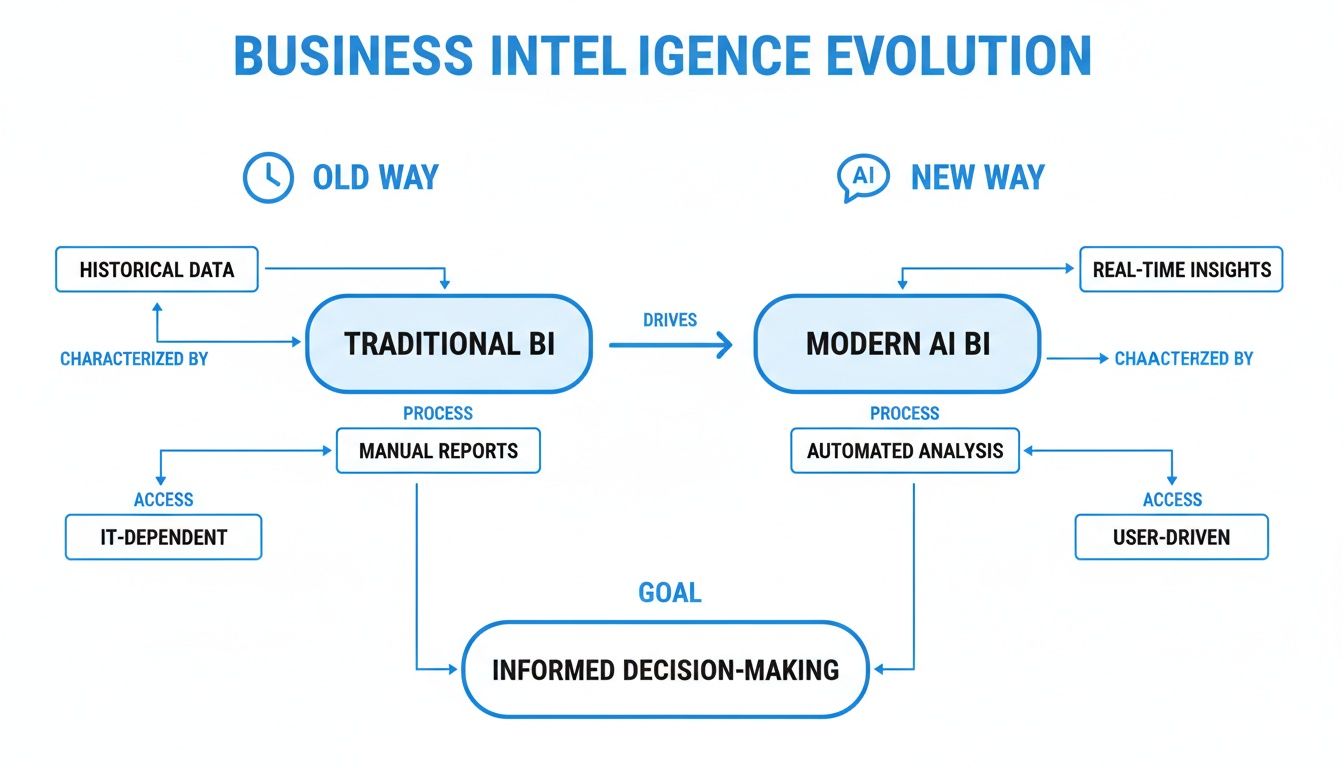
It’s a clear evolution—moving from a world of waiting to one defined by conversation.
The Four Pillars of Generative BI
To trust the answers, it helps to know what's happening when you type a question. It all boils down to these four core components.
Secure Data Connectors (The Plugs): First, the tool needs to see your data. Connectors act as secure, read-only "plugs" that link the BI platform to your database. Security is the top priority, meaning the AI can analyze but never, ever change your original data.
LLM Integration (The Brain): At the heart is a Large Language Model (LLM). This is the engine that understands what you’re asking. When you type, "What were my top 5 selling products last quarter?" the LLM translates that into a set of commands.
Grounding & Traceability (The Fact-Checker): This is the most critical piece. An LLM can "hallucinate" or make things up. Grounding is the process that chains the AI to reality by forcing it to base every answer exclusively on your connected data.
Insight Generation (The Artist): Once the question is understood and facts are checked, the system writes the necessary SQL code, runs the query, and decides the best way to present the findings—a chart, a table, or a simple summary.
Why Grounding Is Non-Negotiable
A GenBI tool without solid grounding is just a toy. You can't make mission-critical decisions on fabricated data. The core technique making this possible is known as Retrieval Augmented Generation (RAG), which ensures the AI pulls information directly from your specific knowledge base.
Traceability is the other side of that coin. Any good GenBI platform will "show its work," letting you see the exact query it ran. This transparency builds confidence.
According to Gartner’s 2026 market analysis, the combined market for business intelligence and generative AI is projected to reach over $100 billion by 2028. This growth is driven by businesses adopting this technology to automate complex data work. With a Conversational AI Data Analyst like Statspresso, you get the speed of AI with the reliability of a human analyst.
Try asking Statspresso: 'What were my top 5 selling products last quarter and show me their sales trend?'
Real-World Use Cases For Your Team
Okay, the tech is impressive, but what does conversational analytics actually do? How does it help your team hit its numbers? The magic is how it empowers different people to solve their own problems without waiting in line for a data report.
It’s about turning that nagging question in your mind into a clear answer, right now.

For The Founder
As a founder, time is your most precious resource and uncertainty is your biggest enemy. You need a constant, clear view of the business's health—from cash flow to customer growth.
With a Conversational AI Data Analyst like Statspresso, you get a snapshot of the business in seconds. No more pinging your team for updated charts.
Common founder questions:
"What is our current monthly recurring revenue and how does it compare to this time last year?"
"Show me a list of our top 10 customers by lifetime value."
"What's our customer acquisition cost trend over the last six months?"
Try asking Statspresso: "Show me my weekly new user sign-ups for the past 90 days as a line chart."
For The Product Manager
Product managers are obsessed with how people use their products. Understanding every click and user journey is vital for building a better roadmap. Waiting for an analyst to pull a report on feature adoption kills momentum.
Generative BI lets you investigate user behavior in real time. The moment you see a dip in engagement, you can start asking "why" and get immediate clues without writing a single line of SQL. For more on this, check out our guide on using an AI data analyst to guide product decisions.
Key product manager questions:
"Compare feature adoption rates for users on our free plan versus our pro plan."
"What percentage of users who signed up last month have used our new integration feature?"
"Show me a funnel chart of our user onboarding flow from last week."
For The Marketing Lead
Marketing runs on data. The faster you can see what’s working, the smarter you can spend your budget. An end-of-month report doesn't cut it in 2026.
With conversational analytics, you get daily feedback. You can ask pointed questions about a Google Ads campaign's ROI or where your best leads are coming from. This creates a clear line between marketing activities and business outcomes.
Typical marketing lead questions:
"Which of my blog posts from last month drove the most new user sign-ups?"
"What was our cost per lead from Facebook Ads versus Google Ads last week?"
"Show me the top 5 traffic sources for our landing page in a pie chart."
No matter your role, the goal is the same: move faster and make better decisions.
Your Roadmap to Adopting Generative BI
Getting started with generative business intelligence sounds like a massive IT project. It isn't. You can get real value from a tool like Statspresso today by focusing on quick wins. This isn’t about boiling the ocean; it’s about making a small change that delivers immediate results.
The market is already shifting. The global BI market, which stood at USD 28,262.01 million in 2026, is on track to nearly double by 2035. When you consider the GenAI market is projected to hit USD 83.3 billion in 2026, it's clear self-serve insights are the new normal. For a deeper dive, read the full research on the growing BI and generative AI markets.
A Simple Five-Step Plan to Get Started
Think of this as a guide to get from zero to insightful in the time it takes to have a team lunch.
Pinpoint Your Top Questions: What are the 3-5 questions your team asks constantly? "What's our MRR?" or "Which marketing channel performed best?" Write them down.
Connect One Key Data Source: Don't hook up everything. Just pick the one source that holds the answers, like your production database (Postgres) or CRM (HubSpot).
Ask Simple Questions First: Once connected, ask those core questions to validate the data and build trust. When the revenue number matches what you know is right, you build confidence.
Create a "Source of Truth" Dashboard: Use a tool like Statspresso to save the most important charts to a shared dashboard. This creates a go-to spot for the team.
Expand Access: Once the dashboard is live and trusted, invite more people. Encourage them to ask their own questions. This is how you build a culture of curiosity.
How to Handle Governance and Accuracy (Without the Headaches)
"How do I know the AI is giving me the right answers?" It's a great question. Modern GenBI tools are built with guardrails to ensure accuracy.
Every answer from a Conversational AI Data Analyst like Statspresso is grounded in your own data. It provides full traceability, showing you the exact SQL query it wrote. That transparency builds trust. You don't need a heavy-handed governance committee; the governance is baked into the tool.
Adoption is about empowering your team to answer their own questions, instantly. You can start right now.
Ready to get started? Connect your first data source for free and ask your first question.
Frequently Asked Questions About Generative BI
It's smart to ask tough questions before adopting new tech. When it comes to your data, a healthy dose of skepticism is a good thing. Let's tackle the most common questions we hear about generative business intelligence.
Is My Company's Data Secure?
Yes, it’s secure. Any serious GenBI platform, including Statspresso, is designed with security at its foundation.
Here’s how:
Read-Only Connections: The platform connects to your data sources with read-only permissions. The AI can see your data to analyze it, but has zero power to change or delete anything.
Data Encryption: All data is encrypted in transit and at rest, protecting it at every step.
Strict Access Controls: You decide exactly who on your team gets access and which datasets they can query.
Think of it like giving a consultant temporary, view-only access to your analytics.
How Do I Know The Answers Are Accurate?
A great follow-up. An AI that makes things up is dangerous. This is why grounding and traceability are must-haves.
A trustworthy Conversational AI Data Analyst has to "show its work." Every answer should be directly tied to your company's data. You should be able to instantly see the exact SQL query it ran and the raw data it used. This transparency is what builds trust. It isn't about blindly believing the AI; it’s about having verifiable answers you can act on.
Do I Need Technical Skills to Use It?
Not at all. The entire point is to eliminate that barrier. If you can ask a question in an email, you're an expert. You’re not learning to code; you’re just having a conversation with your data.
Try asking Statspresso: “Which marketing channels had the best conversion rate last month?”
The system takes your question, translates it to code, runs the query, and presents the answer as a chart—all in seconds. It's built for busy people who have data but no time to become analysts.
The best way to understand the potential is to start asking your own questions. Statspresso helps you move from curiosity to clarity, fast. Connect your first data source for free and ask your first question.
TL;DR: The Quick Read
The Old Way: Wait weeks for a data analyst to build a dashboard that creates more questions than answers.
The New Way: Ask your data a direct question in plain English and get a chart or a number back in seconds. This is generative business intelligence (GenBI).
How it Works: It uses AI (like ChatGPT) but applies it securely to your business data. It understands your question, writes the SQL code for you, and generates the answer.
Why It Matters: It eliminates data bottlenecks. Founders, product managers, and marketers can finally get their own answers without learning complex tools like Tableau or waiting for the data team.
The Key Tool: A Conversational AI Data Analyst like Statspresso lets you skip the SQL and just ask.
Waiting weeks for a data analyst to build a dashboard is a relic of the past. Your business is sitting on a mountain of data, but getting a straight answer feels like filing a ticket into a black hole. You need insights now, not next quarter.
This is the exact problem generative business intelligence (GenBI) solves. It’s a new approach that lets you skip the ticket queues and complex software. Instead, you just talk to your data.

From Complex Dashboards to Simple Conversation
Think about traditional BI platforms like Tableau or Power BI. Powerful, yes. But they were built for data analysts who speak SQL and data modeling. They were never designed for a marketing lead who just needs to know if last week's campaign worked.
Generative BI flips that model on its head. It uses the same kind of large language model (LLM) that powers tools like ChatGPT, but applies it securely to your business data. Instead of learning a complex new tool, you just ask a question in plain English.
Think of Statspresso as your team's on-demand Conversational AI Data Analyst. You can skip the SQL. Just ask your data a question and get a chart in seconds.
For example, a founder could ask a direct question and get an answer instantly, without pulling their finance lead out of a meeting.
Try asking Statspresso: "What's our monthly recurring revenue (MRR) trend for the past 12 months?"
This opens up data-driven decisions to everyone, not just the experts. Your data stops being a locked-away resource and starts becoming your most valuable advisor.
What Is Generative Business Intelligence, Really?
Forget the buzzwords. At its core, generative business intelligence (GenBI) is about changing how you talk to your data. It’s the difference between wrestling with complex software and simply having a conversation to get the answers you need.
For decades, getting insights was a painful process. It was like being a librarian in a chaotic library, tasked with finding one fact buried in thousands of books. You'd spend days hunting, cross-referencing, and manually piecing everything together. It was slow and tedious.
Generative BI is like having an expert researcher by your side who has already read every book. You just ask, "How did our sales in Q2 compare to Q1?" In seconds, they pull the exact information, summarize the key takeaways, and even sketch a quick chart. That’s the magic—it’s direct and immediate.
From Vague Suggestions to Concrete Answers
You might be thinking, "Isn't that just augmented analytics?" Fair question, but there’s a key difference. Augmented analytics, found in many traditional BI tools, gives you a helpful nudge. It might flag a data spike but still leaves the heavy lifting to you.
GenBI, on the other hand, doesn't just suggest; it generates. Powered by the same tech as ChatGPT, it understands your plain-English questions. It then writes the necessary code on its own, queries your data, and builds the finished answer right in front of you.
This could be:
A complete bar chart visualizing monthly recurring revenue.
A neat table of your top 10 customers by lifetime value.
A plain-text summary explaining why user churn suddenly increased.
It’s a two-way dialogue that produces a final result, letting you get straight to the insight.
The New Standard for Accessing Data
This conversational approach is rapidly becoming the default. Businesses are tired of the old bottlenecks. According to a 2026 industry report from Forrester, AI-driven conversational analytics is the fastest-growing segment in BI. The market's explosive growth reflects that. You can learn more about the meteoric rise of generative AI to see just how quickly this is happening.
We built Statspresso as a Conversational AI Data Analyst for this exact reason. It’s designed for busy founders and product managers who don’t have time to master SQL. Skip the SQL. Just ask your data a question and get a chart in seconds.
Instead of gatekeeping insights, GenBI puts the power of analysis into the hands of decision-makers.
Try asking Statspresso: "Show me my revenue by month for the last year as a bar chart."
Ultimately, this creates a culture of curiosity where data becomes a partner in every decision, not a roadblock.
The Old Way vs. The New Way of BI
To get why GenBI is turning heads, you have to understand the pain of the old way. The difference isn't just faster answers; it’s a total overhaul of how teams interact with data. Think of it as having a direct conversation versus standing in a long line.
The Painful Path to a Simple Answer
We’ve all seen this story. A Product Manager notices user engagement has dipped. She suspects it's tied to a recent feature launch, but needs data to be sure.
Under the traditional model, her path is long. She files a ticket with the data team. It lands in a queue. Weeks later, an analyst builds her a static dashboard in Power BI. But the dashboard only shows overall churn; it doesn't segment the data. So she files another ticket, and the waiting game starts again.
This is the "Cost of Delay." Every week spent waiting is a week your team operates with incomplete information. The bottleneck isn't the analyst; it's the rigid process that punishes follow-up questions.
A New Way: From Weeks to Minutes
Now, let's rewind and play that scenario back with generative BI.
Our Product Manager connects her database to Statspresso, our Conversational AI Data Analyst. Instead of writing a ticket, she simply asks a question.
Try asking Statspresso: "Show me user churn by cohort for the last 6 months as a line chart."
An interactive chart appears instantly. She sees a churn spike in one specific group: users who signed up in the last 30 days. She asks her next question in the same chat.
"Okay, now filter that cohort and show me their adoption rate of the 'new project template' feature."
A new chart is generated. The answer is clear: adoption of the new feature is near zero for that exact cohort. In minutes, she’s gone from a vague hunch to a root cause. She found an actionable insight in less time than it takes to brew coffee. To truly grasp the future, it's worth exploring emerging frameworks like the Bank Intelligence and Action System (BIAS), which signifies a new epoch in data-driven decision making.
The BI Showdown: Manual SQL vs. Generative AI
The contrast is stark. The old world of BI was defined by waiting and complexity. The new world is about conversation, speed, and curiosity.
Attribute | The Old Way (Manual SQL & Dashboards) | The New Way (Generative BI with Statspresso) |
|---|---|---|
Time to Insight | Days or weeks, slowed by ticket queues. | Seconds or minutes. Just ask. |
Required Skills | Deep expertise in SQL, Tableau, or Power BI. | The ability to ask a clear question in English. |
Flexibility | Rigid. Follow-up questions reset the clock. | Highly flexible. Ask unlimited follow-up questions. |
Cost of Delay | High. Decisions are delayed for weeks. | Minimal. Insights are immediate, enabling quick action. |
This shift breaks data analysis out of its silo and puts its power directly into the hands of the people who need it most.
How Generative BI Works Under the Hood
Ever wonder how you can ask a machine a question in English and get back a perfect chart? It feels like magic, but it’s a clever, four-step process. Let’s pull back the curtain on how a generative business intelligence platform like Statspresso works, without the jargon.

It’s a clear evolution—moving from a world of waiting to one defined by conversation.
The Four Pillars of Generative BI
To trust the answers, it helps to know what's happening when you type a question. It all boils down to these four core components.
Secure Data Connectors (The Plugs): First, the tool needs to see your data. Connectors act as secure, read-only "plugs" that link the BI platform to your database. Security is the top priority, meaning the AI can analyze but never, ever change your original data.
LLM Integration (The Brain): At the heart is a Large Language Model (LLM). This is the engine that understands what you’re asking. When you type, "What were my top 5 selling products last quarter?" the LLM translates that into a set of commands.
Grounding & Traceability (The Fact-Checker): This is the most critical piece. An LLM can "hallucinate" or make things up. Grounding is the process that chains the AI to reality by forcing it to base every answer exclusively on your connected data.
Insight Generation (The Artist): Once the question is understood and facts are checked, the system writes the necessary SQL code, runs the query, and decides the best way to present the findings—a chart, a table, or a simple summary.
Why Grounding Is Non-Negotiable
A GenBI tool without solid grounding is just a toy. You can't make mission-critical decisions on fabricated data. The core technique making this possible is known as Retrieval Augmented Generation (RAG), which ensures the AI pulls information directly from your specific knowledge base.
Traceability is the other side of that coin. Any good GenBI platform will "show its work," letting you see the exact query it ran. This transparency builds confidence.
According to Gartner’s 2026 market analysis, the combined market for business intelligence and generative AI is projected to reach over $100 billion by 2028. This growth is driven by businesses adopting this technology to automate complex data work. With a Conversational AI Data Analyst like Statspresso, you get the speed of AI with the reliability of a human analyst.
Try asking Statspresso: 'What were my top 5 selling products last quarter and show me their sales trend?'
Real-World Use Cases For Your Team
Okay, the tech is impressive, but what does conversational analytics actually do? How does it help your team hit its numbers? The magic is how it empowers different people to solve their own problems without waiting in line for a data report.
It’s about turning that nagging question in your mind into a clear answer, right now.

For The Founder
As a founder, time is your most precious resource and uncertainty is your biggest enemy. You need a constant, clear view of the business's health—from cash flow to customer growth.
With a Conversational AI Data Analyst like Statspresso, you get a snapshot of the business in seconds. No more pinging your team for updated charts.
Common founder questions:
"What is our current monthly recurring revenue and how does it compare to this time last year?"
"Show me a list of our top 10 customers by lifetime value."
"What's our customer acquisition cost trend over the last six months?"
Try asking Statspresso: "Show me my weekly new user sign-ups for the past 90 days as a line chart."
For The Product Manager
Product managers are obsessed with how people use their products. Understanding every click and user journey is vital for building a better roadmap. Waiting for an analyst to pull a report on feature adoption kills momentum.
Generative BI lets you investigate user behavior in real time. The moment you see a dip in engagement, you can start asking "why" and get immediate clues without writing a single line of SQL. For more on this, check out our guide on using an AI data analyst to guide product decisions.
Key product manager questions:
"Compare feature adoption rates for users on our free plan versus our pro plan."
"What percentage of users who signed up last month have used our new integration feature?"
"Show me a funnel chart of our user onboarding flow from last week."
For The Marketing Lead
Marketing runs on data. The faster you can see what’s working, the smarter you can spend your budget. An end-of-month report doesn't cut it in 2026.
With conversational analytics, you get daily feedback. You can ask pointed questions about a Google Ads campaign's ROI or where your best leads are coming from. This creates a clear line between marketing activities and business outcomes.
Typical marketing lead questions:
"Which of my blog posts from last month drove the most new user sign-ups?"
"What was our cost per lead from Facebook Ads versus Google Ads last week?"
"Show me the top 5 traffic sources for our landing page in a pie chart."
No matter your role, the goal is the same: move faster and make better decisions.
Your Roadmap to Adopting Generative BI
Getting started with generative business intelligence sounds like a massive IT project. It isn't. You can get real value from a tool like Statspresso today by focusing on quick wins. This isn’t about boiling the ocean; it’s about making a small change that delivers immediate results.
The market is already shifting. The global BI market, which stood at USD 28,262.01 million in 2026, is on track to nearly double by 2035. When you consider the GenAI market is projected to hit USD 83.3 billion in 2026, it's clear self-serve insights are the new normal. For a deeper dive, read the full research on the growing BI and generative AI markets.
A Simple Five-Step Plan to Get Started
Think of this as a guide to get from zero to insightful in the time it takes to have a team lunch.
Pinpoint Your Top Questions: What are the 3-5 questions your team asks constantly? "What's our MRR?" or "Which marketing channel performed best?" Write them down.
Connect One Key Data Source: Don't hook up everything. Just pick the one source that holds the answers, like your production database (Postgres) or CRM (HubSpot).
Ask Simple Questions First: Once connected, ask those core questions to validate the data and build trust. When the revenue number matches what you know is right, you build confidence.
Create a "Source of Truth" Dashboard: Use a tool like Statspresso to save the most important charts to a shared dashboard. This creates a go-to spot for the team.
Expand Access: Once the dashboard is live and trusted, invite more people. Encourage them to ask their own questions. This is how you build a culture of curiosity.
How to Handle Governance and Accuracy (Without the Headaches)
"How do I know the AI is giving me the right answers?" It's a great question. Modern GenBI tools are built with guardrails to ensure accuracy.
Every answer from a Conversational AI Data Analyst like Statspresso is grounded in your own data. It provides full traceability, showing you the exact SQL query it wrote. That transparency builds trust. You don't need a heavy-handed governance committee; the governance is baked into the tool.
Adoption is about empowering your team to answer their own questions, instantly. You can start right now.
Ready to get started? Connect your first data source for free and ask your first question.
Frequently Asked Questions About Generative BI
It's smart to ask tough questions before adopting new tech. When it comes to your data, a healthy dose of skepticism is a good thing. Let's tackle the most common questions we hear about generative business intelligence.
Is My Company's Data Secure?
Yes, it’s secure. Any serious GenBI platform, including Statspresso, is designed with security at its foundation.
Here’s how:
Read-Only Connections: The platform connects to your data sources with read-only permissions. The AI can see your data to analyze it, but has zero power to change or delete anything.
Data Encryption: All data is encrypted in transit and at rest, protecting it at every step.
Strict Access Controls: You decide exactly who on your team gets access and which datasets they can query.
Think of it like giving a consultant temporary, view-only access to your analytics.
How Do I Know The Answers Are Accurate?
A great follow-up. An AI that makes things up is dangerous. This is why grounding and traceability are must-haves.
A trustworthy Conversational AI Data Analyst has to "show its work." Every answer should be directly tied to your company's data. You should be able to instantly see the exact SQL query it ran and the raw data it used. This transparency is what builds trust. It isn't about blindly believing the AI; it’s about having verifiable answers you can act on.
Do I Need Technical Skills to Use It?
Not at all. The entire point is to eliminate that barrier. If you can ask a question in an email, you're an expert. You’re not learning to code; you’re just having a conversation with your data.
Try asking Statspresso: “Which marketing channels had the best conversion rate last month?”
The system takes your question, translates it to code, runs the query, and presents the answer as a chart—all in seconds. It's built for busy people who have data but no time to become analysts.
The best way to understand the potential is to start asking your own questions. Statspresso helps you move from curiosity to clarity, fast. Connect your first data source for free and ask your first question.
TL;DR: The Quick Read
The Old Way: Wait weeks for a data analyst to build a dashboard that creates more questions than answers.
The New Way: Ask your data a direct question in plain English and get a chart or a number back in seconds. This is generative business intelligence (GenBI).
How it Works: It uses AI (like ChatGPT) but applies it securely to your business data. It understands your question, writes the SQL code for you, and generates the answer.
Why It Matters: It eliminates data bottlenecks. Founders, product managers, and marketers can finally get their own answers without learning complex tools like Tableau or waiting for the data team.
The Key Tool: A Conversational AI Data Analyst like Statspresso lets you skip the SQL and just ask.
Waiting weeks for a data analyst to build a dashboard is a relic of the past. Your business is sitting on a mountain of data, but getting a straight answer feels like filing a ticket into a black hole. You need insights now, not next quarter.
This is the exact problem generative business intelligence (GenBI) solves. It’s a new approach that lets you skip the ticket queues and complex software. Instead, you just talk to your data.

From Complex Dashboards to Simple Conversation
Think about traditional BI platforms like Tableau or Power BI. Powerful, yes. But they were built for data analysts who speak SQL and data modeling. They were never designed for a marketing lead who just needs to know if last week's campaign worked.
Generative BI flips that model on its head. It uses the same kind of large language model (LLM) that powers tools like ChatGPT, but applies it securely to your business data. Instead of learning a complex new tool, you just ask a question in plain English.
Think of Statspresso as your team's on-demand Conversational AI Data Analyst. You can skip the SQL. Just ask your data a question and get a chart in seconds.
For example, a founder could ask a direct question and get an answer instantly, without pulling their finance lead out of a meeting.
Try asking Statspresso: "What's our monthly recurring revenue (MRR) trend for the past 12 months?"
This opens up data-driven decisions to everyone, not just the experts. Your data stops being a locked-away resource and starts becoming your most valuable advisor.
What Is Generative Business Intelligence, Really?
Forget the buzzwords. At its core, generative business intelligence (GenBI) is about changing how you talk to your data. It’s the difference between wrestling with complex software and simply having a conversation to get the answers you need.
For decades, getting insights was a painful process. It was like being a librarian in a chaotic library, tasked with finding one fact buried in thousands of books. You'd spend days hunting, cross-referencing, and manually piecing everything together. It was slow and tedious.
Generative BI is like having an expert researcher by your side who has already read every book. You just ask, "How did our sales in Q2 compare to Q1?" In seconds, they pull the exact information, summarize the key takeaways, and even sketch a quick chart. That’s the magic—it’s direct and immediate.
From Vague Suggestions to Concrete Answers
You might be thinking, "Isn't that just augmented analytics?" Fair question, but there’s a key difference. Augmented analytics, found in many traditional BI tools, gives you a helpful nudge. It might flag a data spike but still leaves the heavy lifting to you.
GenBI, on the other hand, doesn't just suggest; it generates. Powered by the same tech as ChatGPT, it understands your plain-English questions. It then writes the necessary code on its own, queries your data, and builds the finished answer right in front of you.
This could be:
A complete bar chart visualizing monthly recurring revenue.
A neat table of your top 10 customers by lifetime value.
A plain-text summary explaining why user churn suddenly increased.
It’s a two-way dialogue that produces a final result, letting you get straight to the insight.
The New Standard for Accessing Data
This conversational approach is rapidly becoming the default. Businesses are tired of the old bottlenecks. According to a 2026 industry report from Forrester, AI-driven conversational analytics is the fastest-growing segment in BI. The market's explosive growth reflects that. You can learn more about the meteoric rise of generative AI to see just how quickly this is happening.
We built Statspresso as a Conversational AI Data Analyst for this exact reason. It’s designed for busy founders and product managers who don’t have time to master SQL. Skip the SQL. Just ask your data a question and get a chart in seconds.
Instead of gatekeeping insights, GenBI puts the power of analysis into the hands of decision-makers.
Try asking Statspresso: "Show me my revenue by month for the last year as a bar chart."
Ultimately, this creates a culture of curiosity where data becomes a partner in every decision, not a roadblock.
The Old Way vs. The New Way of BI
To get why GenBI is turning heads, you have to understand the pain of the old way. The difference isn't just faster answers; it’s a total overhaul of how teams interact with data. Think of it as having a direct conversation versus standing in a long line.
The Painful Path to a Simple Answer
We’ve all seen this story. A Product Manager notices user engagement has dipped. She suspects it's tied to a recent feature launch, but needs data to be sure.
Under the traditional model, her path is long. She files a ticket with the data team. It lands in a queue. Weeks later, an analyst builds her a static dashboard in Power BI. But the dashboard only shows overall churn; it doesn't segment the data. So she files another ticket, and the waiting game starts again.
This is the "Cost of Delay." Every week spent waiting is a week your team operates with incomplete information. The bottleneck isn't the analyst; it's the rigid process that punishes follow-up questions.
A New Way: From Weeks to Minutes
Now, let's rewind and play that scenario back with generative BI.
Our Product Manager connects her database to Statspresso, our Conversational AI Data Analyst. Instead of writing a ticket, she simply asks a question.
Try asking Statspresso: "Show me user churn by cohort for the last 6 months as a line chart."
An interactive chart appears instantly. She sees a churn spike in one specific group: users who signed up in the last 30 days. She asks her next question in the same chat.
"Okay, now filter that cohort and show me their adoption rate of the 'new project template' feature."
A new chart is generated. The answer is clear: adoption of the new feature is near zero for that exact cohort. In minutes, she’s gone from a vague hunch to a root cause. She found an actionable insight in less time than it takes to brew coffee. To truly grasp the future, it's worth exploring emerging frameworks like the Bank Intelligence and Action System (BIAS), which signifies a new epoch in data-driven decision making.
The BI Showdown: Manual SQL vs. Generative AI
The contrast is stark. The old world of BI was defined by waiting and complexity. The new world is about conversation, speed, and curiosity.
Attribute | The Old Way (Manual SQL & Dashboards) | The New Way (Generative BI with Statspresso) |
|---|---|---|
Time to Insight | Days or weeks, slowed by ticket queues. | Seconds or minutes. Just ask. |
Required Skills | Deep expertise in SQL, Tableau, or Power BI. | The ability to ask a clear question in English. |
Flexibility | Rigid. Follow-up questions reset the clock. | Highly flexible. Ask unlimited follow-up questions. |
Cost of Delay | High. Decisions are delayed for weeks. | Minimal. Insights are immediate, enabling quick action. |
This shift breaks data analysis out of its silo and puts its power directly into the hands of the people who need it most.
How Generative BI Works Under the Hood
Ever wonder how you can ask a machine a question in English and get back a perfect chart? It feels like magic, but it’s a clever, four-step process. Let’s pull back the curtain on how a generative business intelligence platform like Statspresso works, without the jargon.

It’s a clear evolution—moving from a world of waiting to one defined by conversation.
The Four Pillars of Generative BI
To trust the answers, it helps to know what's happening when you type a question. It all boils down to these four core components.
Secure Data Connectors (The Plugs): First, the tool needs to see your data. Connectors act as secure, read-only "plugs" that link the BI platform to your database. Security is the top priority, meaning the AI can analyze but never, ever change your original data.
LLM Integration (The Brain): At the heart is a Large Language Model (LLM). This is the engine that understands what you’re asking. When you type, "What were my top 5 selling products last quarter?" the LLM translates that into a set of commands.
Grounding & Traceability (The Fact-Checker): This is the most critical piece. An LLM can "hallucinate" or make things up. Grounding is the process that chains the AI to reality by forcing it to base every answer exclusively on your connected data.
Insight Generation (The Artist): Once the question is understood and facts are checked, the system writes the necessary SQL code, runs the query, and decides the best way to present the findings—a chart, a table, or a simple summary.
Why Grounding Is Non-Negotiable
A GenBI tool without solid grounding is just a toy. You can't make mission-critical decisions on fabricated data. The core technique making this possible is known as Retrieval Augmented Generation (RAG), which ensures the AI pulls information directly from your specific knowledge base.
Traceability is the other side of that coin. Any good GenBI platform will "show its work," letting you see the exact query it ran. This transparency builds confidence.
According to Gartner’s 2026 market analysis, the combined market for business intelligence and generative AI is projected to reach over $100 billion by 2028. This growth is driven by businesses adopting this technology to automate complex data work. With a Conversational AI Data Analyst like Statspresso, you get the speed of AI with the reliability of a human analyst.
Try asking Statspresso: 'What were my top 5 selling products last quarter and show me their sales trend?'
Real-World Use Cases For Your Team
Okay, the tech is impressive, but what does conversational analytics actually do? How does it help your team hit its numbers? The magic is how it empowers different people to solve their own problems without waiting in line for a data report.
It’s about turning that nagging question in your mind into a clear answer, right now.

For The Founder
As a founder, time is your most precious resource and uncertainty is your biggest enemy. You need a constant, clear view of the business's health—from cash flow to customer growth.
With a Conversational AI Data Analyst like Statspresso, you get a snapshot of the business in seconds. No more pinging your team for updated charts.
Common founder questions:
"What is our current monthly recurring revenue and how does it compare to this time last year?"
"Show me a list of our top 10 customers by lifetime value."
"What's our customer acquisition cost trend over the last six months?"
Try asking Statspresso: "Show me my weekly new user sign-ups for the past 90 days as a line chart."
For The Product Manager
Product managers are obsessed with how people use their products. Understanding every click and user journey is vital for building a better roadmap. Waiting for an analyst to pull a report on feature adoption kills momentum.
Generative BI lets you investigate user behavior in real time. The moment you see a dip in engagement, you can start asking "why" and get immediate clues without writing a single line of SQL. For more on this, check out our guide on using an AI data analyst to guide product decisions.
Key product manager questions:
"Compare feature adoption rates for users on our free plan versus our pro plan."
"What percentage of users who signed up last month have used our new integration feature?"
"Show me a funnel chart of our user onboarding flow from last week."
For The Marketing Lead
Marketing runs on data. The faster you can see what’s working, the smarter you can spend your budget. An end-of-month report doesn't cut it in 2026.
With conversational analytics, you get daily feedback. You can ask pointed questions about a Google Ads campaign's ROI or where your best leads are coming from. This creates a clear line between marketing activities and business outcomes.
Typical marketing lead questions:
"Which of my blog posts from last month drove the most new user sign-ups?"
"What was our cost per lead from Facebook Ads versus Google Ads last week?"
"Show me the top 5 traffic sources for our landing page in a pie chart."
No matter your role, the goal is the same: move faster and make better decisions.
Your Roadmap to Adopting Generative BI
Getting started with generative business intelligence sounds like a massive IT project. It isn't. You can get real value from a tool like Statspresso today by focusing on quick wins. This isn’t about boiling the ocean; it’s about making a small change that delivers immediate results.
The market is already shifting. The global BI market, which stood at USD 28,262.01 million in 2026, is on track to nearly double by 2035. When you consider the GenAI market is projected to hit USD 83.3 billion in 2026, it's clear self-serve insights are the new normal. For a deeper dive, read the full research on the growing BI and generative AI markets.
A Simple Five-Step Plan to Get Started
Think of this as a guide to get from zero to insightful in the time it takes to have a team lunch.
Pinpoint Your Top Questions: What are the 3-5 questions your team asks constantly? "What's our MRR?" or "Which marketing channel performed best?" Write them down.
Connect One Key Data Source: Don't hook up everything. Just pick the one source that holds the answers, like your production database (Postgres) or CRM (HubSpot).
Ask Simple Questions First: Once connected, ask those core questions to validate the data and build trust. When the revenue number matches what you know is right, you build confidence.
Create a "Source of Truth" Dashboard: Use a tool like Statspresso to save the most important charts to a shared dashboard. This creates a go-to spot for the team.
Expand Access: Once the dashboard is live and trusted, invite more people. Encourage them to ask their own questions. This is how you build a culture of curiosity.
How to Handle Governance and Accuracy (Without the Headaches)
"How do I know the AI is giving me the right answers?" It's a great question. Modern GenBI tools are built with guardrails to ensure accuracy.
Every answer from a Conversational AI Data Analyst like Statspresso is grounded in your own data. It provides full traceability, showing you the exact SQL query it wrote. That transparency builds trust. You don't need a heavy-handed governance committee; the governance is baked into the tool.
Adoption is about empowering your team to answer their own questions, instantly. You can start right now.
Ready to get started? Connect your first data source for free and ask your first question.
Frequently Asked Questions About Generative BI
It's smart to ask tough questions before adopting new tech. When it comes to your data, a healthy dose of skepticism is a good thing. Let's tackle the most common questions we hear about generative business intelligence.
Is My Company's Data Secure?
Yes, it’s secure. Any serious GenBI platform, including Statspresso, is designed with security at its foundation.
Here’s how:
Read-Only Connections: The platform connects to your data sources with read-only permissions. The AI can see your data to analyze it, but has zero power to change or delete anything.
Data Encryption: All data is encrypted in transit and at rest, protecting it at every step.
Strict Access Controls: You decide exactly who on your team gets access and which datasets they can query.
Think of it like giving a consultant temporary, view-only access to your analytics.
How Do I Know The Answers Are Accurate?
A great follow-up. An AI that makes things up is dangerous. This is why grounding and traceability are must-haves.
A trustworthy Conversational AI Data Analyst has to "show its work." Every answer should be directly tied to your company's data. You should be able to instantly see the exact SQL query it ran and the raw data it used. This transparency is what builds trust. It isn't about blindly believing the AI; it’s about having verifiable answers you can act on.
Do I Need Technical Skills to Use It?
Not at all. The entire point is to eliminate that barrier. If you can ask a question in an email, you're an expert. You’re not learning to code; you’re just having a conversation with your data.
Try asking Statspresso: “Which marketing channels had the best conversion rate last month?”
The system takes your question, translates it to code, runs the query, and presents the answer as a chart—all in seconds. It's built for busy people who have data but no time to become analysts.
The best way to understand the potential is to start asking your own questions. Statspresso helps you move from curiosity to clarity, fast. Connect your first data source for free and ask your first question.