
A Practical Guide to Generative AI for Business in 2026

Your business is drowning in data but starving for answers. Waiting weeks for an analyst to build a simple dashboard is a relic of the past. Your competitors? They’re already using generative AI for business to get insights in seconds, not sprints. This is for the founders, product managers, and marketing leads who have the data but no time to learn SQL.

TL;DR: Key Takeaways

  • Problem: Traditional BI is slow and expensive. You have data but no easy way to get answers.

  • Solution: A Conversational AI Data Analyst like Statspresso lets you ask questions in plain English.

  • Benefit: You can skip the SQL and just ask your data a question to get a chart in seconds.

  • Who Wins: Marketing, Sales, and Product teams can now make faster, data-driven decisions without a technical bottleneck.

  • Getting Started: Connect one data source (like Postgres or your CRM) securely and ask your first question.

Your Data Is Your Biggest Untapped Asset

Businessman stands on data-filled waves of documents, reaching for a tablet with charts, a symbol of analytics solutions.

You've got a goldmine of information locked in tools like Postgres, Shopify, and your CRM. You know the answers to your most urgent questions are hiding in there, but getting to them feels impossible.

This is a frustration I hear constantly. The data is there, but who has the time to learn SQL or become a Tableau wizard just to ask a straightforward question?

The Problem With Traditional BI

The old way of doing business intelligence is broken. It’s slow, expensive, and creates a massive bottleneck where your team is stuck waiting on a single analyst.

The old process is a painful memory for many:

  • You file a ticket for a new report and get in line.

  • You wait for an analyst to write complex SQL queries.

  • You go back and forth for days, tweaking the chart.

  • By the time you get the dashboard, the data is already stale.

This cycle forces you to be reactive. Thankfully, generative AI for business has changed the game.

The Shift to Conversational Analytics

What if you could just ask your data a question, in plain English, and get an answer instantly? That's the premise behind a Conversational AI Data Analyst like Statspresso. You can skip the SQL and just ask your data a question to get a chart in seconds.

Try asking Statspresso: "Show me my monthly recurring revenue (MRR) growth over the last 12 months."

This isn't a far-off vision; it’s happening now. A recent 2026 industry report shows 62% of SMB leaders believe their business won't stay competitive without GenBI. Adopting this technology is no longer an advantage—it's essential. You can dive deeper into these generative AI statistics and trends to see the full picture.

Understanding Generative AI for Business Analytics

When most people hear "AI," they think of complex code or sci-fi robots. But for generative AI in business analytics, the reality is much more practical.

Think of traditional BI tools as a giant library. The answers are in there, but you need to know the specific "language"—like SQL or Python—to find anything.

Generative BI, on the other hand, is like having an expert researcher next to you. This is what a tool like Statspresso is—a Conversational AI Data Analyst. You don't need to know the complex filing system of your database. Just ask a question, and the researcher finds the data and presents the chart you need.

What Makes It "Generative"?

The magic is in the name: generative. Traditional AI is great at classifying or predicting. It can tell you if an email is spam.

Generative AI creates something new. It doesn't just pull up an old report. It generates a brand-new chart for your exact question. It can also produce:

  • Text summaries that explain what a chart means.

  • New dashboards built from several questions.

  • Bulleted lists of key insights you might not have spotted.

This ability to create is what separates modern tools from the static dashboards of yesterday. You can have a real, dynamic conversation with your data.

From Jargon to Actionable Insights

You'll hear terms like "GenBI" and "Conversational Analytics." They all describe the same powerful shift: translating human language into data-driven answers.

This technology closes the gap between your questions and your data. It takes analytics out of the hands of specialists and gives it to your product, marketing, and sales teams.

The system's real strength is understanding your intent. When you ask, "How did our last marketing campaign perform?" it knows you mean spend, conversions, and customer acquisition cost. It gets the business context.

This is a massive change from older tools. You can now work at the speed of your thinking.

Try asking Statspresso: "Compare customer lifetime value for users acquired through Google Ads vs. our blog last quarter."

Instead of filing a ticket and waiting days, you get an immediate chart. That's the power of generative AI for business—fewer roadblocks, more smart moves.

From Manual Queries to Automated Insights

If you've worked with data, you know the old, painful way of getting answers. It felt more like a frustrating game of telephone than a business operation.

Think about a critical question from marketing: "Which channels gave us the best ROI last quarter?" Answering that was a multi-day ordeal.

The old way meant filing a ticket, waiting for an overworked analyst, and hoping the final static dashboard was right. If you had a follow-up question? The whole agonizing cycle started again. This constant back-and-forth doesn't just slow down decisions; it means you’re acting on stale information. Conversational analytics flips that script.

The New Way: Just Ask a Question

With a tool like Statspresso, which acts as a Conversational AI Data Analyst, that entire process is replaced by a single action. The marketing manager just types their question into a chat interface.

In the background, the AI does the heavy lifting—understanding the question, writing the query, and pulling the answer in seconds.
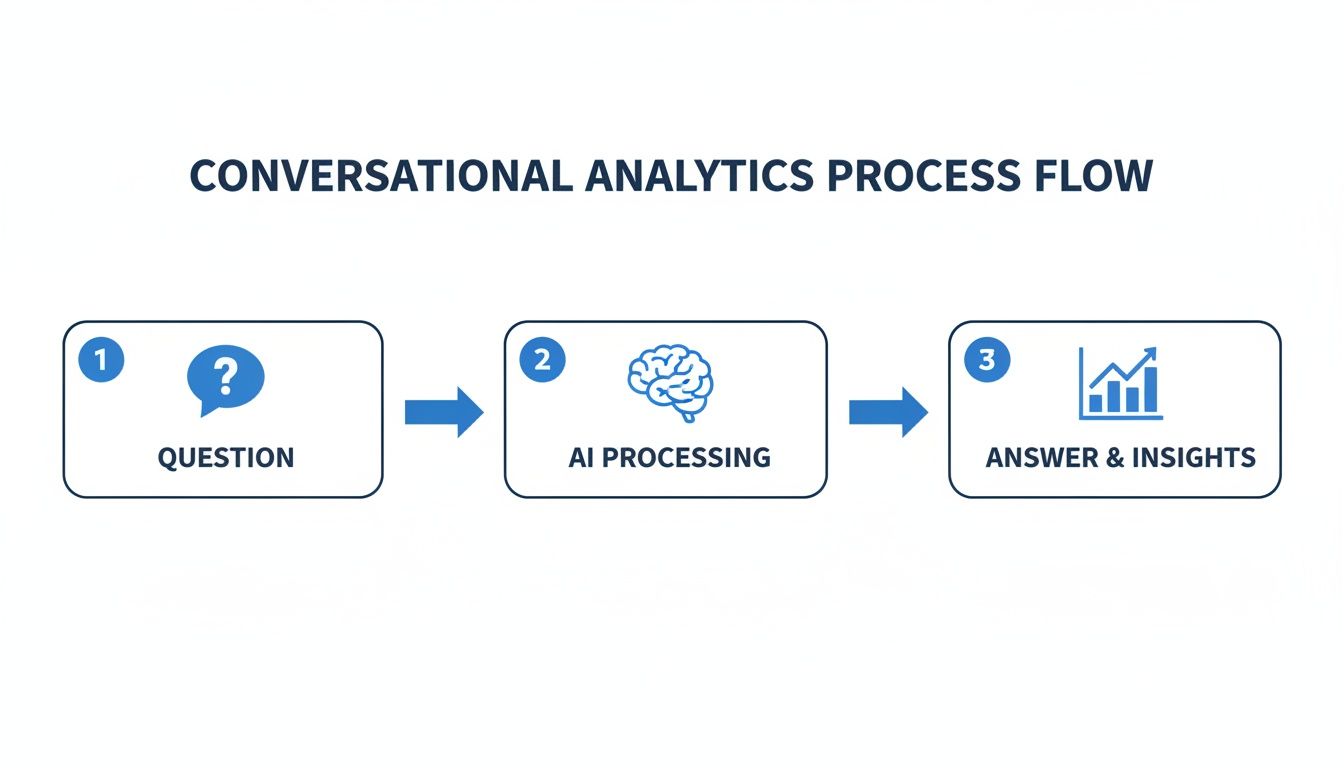
Conversational analytics process flow diagram showing steps: question, AI processing, and answer & insights.

This simple flow is where the magic happens. Automated insights mean the person with the question gets to talk directly to the data. This isn't about replacing data analysts. It’s about freeing them from ad-hoc reporting to focus on high-impact strategic work.

To grasp the difference, let’s put the two approaches side-by-side.

Old Way vs. New Way: A Quick Comparison

The table below contrasts the traditional BI slog with the speed of a conversational analytics platform.

Task

The Old Way (Manual SQL)

The New Way (Statspresso)

Time to First Answer

Days or Weeks

Seconds

Required Skillset

Expert in SQL & BI Tools

Plain English

Follow-up Questions

Starts a new, slow cycle

Instant, conversational

Cost Per Question

High (Analyst hours)

Low (Included in plan)

Accessibility

Limited to data specialists

Open to the entire team

The comparison speaks for itself. The modern approach brings a massive improvement in speed and agility. It empowers everyone to make smarter decisions, faster. You skip the SQL and get a chart in seconds.

Try asking Statspresso: "Compare customer lifetime value for users acquired through Google Ads vs. organic search."

This self-serve access means your teams can explore hunches and spot opportunities as they emerge—not weeks later. It's a fundamental shift from reactive to proactive.

Real-World Use Cases Where Generative AI Shines

It's one thing to talk about theory, but where is generative AI for business actually making a difference? The breakthrough comes from giving everyone the power to get immediate, useful answers.

Think of it like having a Conversational AI Data Analyst on call for the whole company. A tool like Statspresso becomes a resource for anyone who needs to make a data-informed decision. This isn't a niche trend. A 2026 OECD report on AI expansion found that marketing and sales are way ahead, with 42% of companies already using GenAI.

Let’s get specific.

For Marketing Teams Who Need Real-Time Insights

Marketing runs on a cycle of constant testing. Waiting a week for a report is an eternity when you're spending ad budget every hour. Generative AI lets marketers analyze results on the fly.

Instead of getting lost in a messy spreadsheet, a marketing manager can simply ask:

  • "What was our customer acquisition cost (CAC) by channel last month?"

  • "Show me the conversion rate from our latest email campaign compared to the previous one."

  • "List our top 10 landing pages by traffic and lead conversions for Q2."

This creates an immediate feedback loop. Teams can see what’s working and double down, or pull the plug on a failing campaign—instantly.

Try asking Statspresso: "Segment new customers from the last 30 days by their first-touch attribution channel as a pie chart."

A query like that once meant waiting on an analyst. Now, it's just a question away.

For Sales Leaders Tracking Pipeline Performance

Sales leaders live by their numbers, but CRM dashboards are often clunky. A conversational analytics tool cuts through that noise.

A sales manager can get a daily pulse check by asking direct questions:

  • "What’s our current pipeline velocity for deals over $10k?"

  • "Which sales rep has the highest close rate this quarter?"

  • "Show me the average deal cycle length for enterprise vs. SMB leads."

Suddenly, leaders can manage their teams with precision, offering support exactly where it's needed. You skip the SQL and get a chart in seconds.

For Product Managers Building What Customers Want

Product managers are often drowning in user data. Connecting that raw data in a Postgres database to user behavior is a huge challenge.

With automated BI, a PM can directly interrogate that data to understand how a new feature is being used.

Try asking Statspresso: "Show me the daily active users for our new 'Project Templates' feature since it launched last month as a line chart."

Better yet, a PM can keep the conversation going: "What percentage of those users are on our Pro plan?" and then, "Compare the retention rate of users who have adopted this feature versus those who haven't." This creates a fluid, investigative workflow that was impossible with old-school BI. You're turning every team member into someone who can use data to make better decisions.

Getting Started With Generative AI in Your Business

A visual workflow showing Postgres data, security, a man analyzing with a tablet, and a colorful growth chart.

Ready to bring generative AI into your business? It doesn't have to be a monumental task. The secret isn't a massive overhaul. It's starting small and scoring a quick win.

For a deeper dive, this guide on implementing AI in your business is an excellent resource.

Step 1: Identify One Key Data Source

Focus. The biggest mistake is trying to connect every data source at once. It leads to a tangled mess.

Instead, pick one. Choose the data source with answers to your most urgent questions.

  • For marketing, this might be your HubSpot or Google Analytics data.

  • For product teams, it's likely your production Postgres database.

  • For founders, it could be your Stripe account.

The goal is to prove the concept and get immediate value. Start small, show the value, then expand.

Step 2: Connect Your Data Securely

Security is not negotiable. A Conversational AI Data Analyst like Statspresso must be built with enterprise-grade security at its core. Here’s what that means:

  • Read-Only Access: The AI should only be able to read your data. It should never have permission to write, modify, or delete anything.

  • Robust Encryption: Your data must be encrypted both in transit and at rest.

  • SOC 2 Compliance: This is the industry gold standard for data security, an independent verification of strict controls.

When these measures are in place, connecting your database is a safe, simple process.

Step 3: Learn to Ask Better Questions

Once connected, the fun begins. This isn't a technical skill; it's a shift in mindset. Vague questions lead to vague answers.

Guide your team from asking "How's business?" to posing specific, measurable queries. For example, instead of asking about "user engagement," a better question is:

"Show me the average number of sessions per user for customers who signed up in the last 60 days."

The more specific your prompt, the more precise the answer. A good conversational AI tool helps you refine these questions over time.

Step 4: Weave Insights into Your Workflow

An insight on a dashboard is useless. Turn that chart or number into a business decision.

Did you spot a surprising trend? Share the chart directly into your team's Slack channel. Did you uncover a new key metric? Add it to a living dashboard. This closes the loop between data, insight, and action. To see more examples, check out our guide on using AI for data analysis.

Following these steps lets you skip the SQL queries and get clear, immediate answers.

Measuring the ROI of Your AI Data Analyst

"Is this actually worth it?" It’s the right question to ask. The return on a Conversational AI Data Analyst like Statspresso isn't fuzzy—it's measurable in dollars and cents.

Your Primary ROI: Hours Saved

The easiest metric to track is time. How many hours did your team spend digging for data? Multiply those hours by their hourly rate. That’s your direct monthly savings.

The value is simple: A tool like Statspresso automates the 80% of repetitive data work clogging your analytics pipeline. This frees up your expensive technical talent for strategic projects.

It’s not just about trimming costs; it’s about reallocating your best resources.

The More Powerful ROI: Decision Velocity

Saving time is great, but the real edge comes from Decision Velocity. How much faster can your teams act with immediate data?

If your marketing team gets a report in 30 seconds instead of three days, they can shift budget from a failing ad to a winning one today. That’s a direct impact on revenue. When your team can skip the SQL and get a chart in seconds, they have the freedom to follow their curiosity and uncover hidden opportunities.

For a structured approach, look into frameworks for AI automation ROI tracking. This helps connect every gain back to a financial outcome.

Your Quick ROI Checklist

  • How many hours does your team spend on manual reporting each week?

  • What's the average turnaround time to get a simple business question answered?

  • How many decisions are made on gut feelings because the data is too hard to get?

The answers usually reveal a massive opportunity. A generative AI tool doesn't just cut expenses; it builds a faster, smarter business.

Your Generative AI for Business Questions, Answered

A healthy dose of skepticism is a good thing. Let's tackle the big questions we hear every day.

Is My Business Data Secure with an AI Tool?

Yes—but only if you choose a platform built with security as its core principle. A secure Conversational AI Data Analyst like Statspresso proves its security with concrete safeguards.

  • Read-Only Access: The AI can read data but never write, change, or delete anything. Your original databases remain untouched.

  • End-to-End Encryption: Your data is encrypted and unreadable to anyone unauthorized.

  • SOC 2 Compliance: This is an independent verification that a company has ironclad controls to protect your information.

Your data should be treated with the same security you'd demand from your bank.

Do I Need a Data Scientist to Use This?

Absolutely not. That's the whole point. These tools are designed for people who have urgent questions but don't know SQL or Python.

Skip the SQL. Just ask your data a question and get a chart in seconds.

If you can send a Slack message, you have all the skill you need. This is true self-serve analytics.

How Is This Different from ChatGPT?

This is a critical distinction. ChatGPT is a general-purpose AI trained on the public internet. It's great for writing an email, but it knows nothing about your business.

A specialized platform like Statspresso is a Conversational AI Data Analyst built for one job: to securely connect to your live business data and give you accurate answers.

Aspect

ChatGPT (General AI)

Statspresso (Specialized AI)

Data Source

The public internet

Your private business databases

Answers

General, creative, not verifiable

Specific, factual, and backed by your data

Output

Text

Interactive charts, tables, and numbers

Security

Not built for sensitive business data

Enterprise-grade with SOC 2 compliance

ChatGPT is like a brilliant librarian. Statspresso is your company's dedicated financial controller who knows your numbers inside and out. For business insights, you need the controller.

Ready to stop waiting for answers? Connect your first data source for free and ask your first question. Visit https://www.statspresso.com to get started.

Your business is drowning in data but starving for answers. Waiting weeks for an analyst to build a simple dashboard is a relic of the past. Your competitors? They’re already using generative AI for business to get insights in seconds, not sprints. This is for the founders, product managers, and marketing leads who have the data but no time to learn SQL.

TL;DR: Key Takeaways

  • Problem: Traditional BI is slow and expensive. You have data but no easy way to get answers.

  • Solution: A Conversational AI Data Analyst like Statspresso lets you ask questions in plain English.

  • Benefit: You can skip the SQL and just ask your data a question to get a chart in seconds.

  • Who Wins: Marketing, Sales, and Product teams can now make faster, data-driven decisions without a technical bottleneck.

  • Getting Started: Connect one data source (like Postgres or your CRM) securely and ask your first question.

Your Data Is Your Biggest Untapped Asset

Businessman stands on data-filled waves of documents, reaching for a tablet with charts, a symbol of analytics solutions.

You've got a goldmine of information locked in tools like Postgres, Shopify, and your CRM. You know the answers to your most urgent questions are hiding in there, but getting to them feels impossible.

This is a frustration I hear constantly. The data is there, but who has the time to learn SQL or become a Tableau wizard just to ask a straightforward question?

The Problem With Traditional BI

The old way of doing business intelligence is broken. It’s slow, expensive, and creates a massive bottleneck where your team is stuck waiting on a single analyst.

The old process is a painful memory for many:

  • You file a ticket for a new report and get in line.

  • You wait for an analyst to write complex SQL queries.

  • You go back and forth for days, tweaking the chart.

  • By the time you get the dashboard, the data is already stale.

This cycle forces you to be reactive. Thankfully, generative AI for business has changed the game.

The Shift to Conversational Analytics

What if you could just ask your data a question, in plain English, and get an answer instantly? That's the premise behind a Conversational AI Data Analyst like Statspresso. You can skip the SQL and just ask your data a question to get a chart in seconds.

Try asking Statspresso: "Show me my monthly recurring revenue (MRR) growth over the last 12 months."

This isn't a far-off vision; it’s happening now. A recent 2026 industry report shows 62% of SMB leaders believe their business won't stay competitive without GenBI. Adopting this technology is no longer an advantage—it's essential. You can dive deeper into these generative AI statistics and trends to see the full picture.

Understanding Generative AI for Business Analytics

When most people hear "AI," they think of complex code or sci-fi robots. But for generative AI in business analytics, the reality is much more practical.

Think of traditional BI tools as a giant library. The answers are in there, but you need to know the specific "language"—like SQL or Python—to find anything.

Generative BI, on the other hand, is like having an expert researcher next to you. This is what a tool like Statspresso is—a Conversational AI Data Analyst. You don't need to know the complex filing system of your database. Just ask a question, and the researcher finds the data and presents the chart you need.

What Makes It "Generative"?

The magic is in the name: generative. Traditional AI is great at classifying or predicting. It can tell you if an email is spam.

Generative AI creates something new. It doesn't just pull up an old report. It generates a brand-new chart for your exact question. It can also produce:

  • Text summaries that explain what a chart means.

  • New dashboards built from several questions.

  • Bulleted lists of key insights you might not have spotted.

This ability to create is what separates modern tools from the static dashboards of yesterday. You can have a real, dynamic conversation with your data.

From Jargon to Actionable Insights

You'll hear terms like "GenBI" and "Conversational Analytics." They all describe the same powerful shift: translating human language into data-driven answers.

This technology closes the gap between your questions and your data. It takes analytics out of the hands of specialists and gives it to your product, marketing, and sales teams.

The system's real strength is understanding your intent. When you ask, "How did our last marketing campaign perform?" it knows you mean spend, conversions, and customer acquisition cost. It gets the business context.

This is a massive change from older tools. You can now work at the speed of your thinking.

Try asking Statspresso: "Compare customer lifetime value for users acquired through Google Ads vs. our blog last quarter."

Instead of filing a ticket and waiting days, you get an immediate chart. That's the power of generative AI for business—fewer roadblocks, more smart moves.

From Manual Queries to Automated Insights

If you've worked with data, you know the old, painful way of getting answers. It felt more like a frustrating game of telephone than a business operation.

Think about a critical question from marketing: "Which channels gave us the best ROI last quarter?" Answering that was a multi-day ordeal.

The old way meant filing a ticket, waiting for an overworked analyst, and hoping the final static dashboard was right. If you had a follow-up question? The whole agonizing cycle started again. This constant back-and-forth doesn't just slow down decisions; it means you’re acting on stale information. Conversational analytics flips that script.

The New Way: Just Ask a Question

With a tool like Statspresso, which acts as a Conversational AI Data Analyst, that entire process is replaced by a single action. The marketing manager just types their question into a chat interface.

In the background, the AI does the heavy lifting—understanding the question, writing the query, and pulling the answer in seconds.

Conversational analytics process flow diagram showing steps: question, AI processing, and answer & insights.

This simple flow is where the magic happens. Automated insights mean the person with the question gets to talk directly to the data. This isn't about replacing data analysts. It’s about freeing them from ad-hoc reporting to focus on high-impact strategic work.

To grasp the difference, let’s put the two approaches side-by-side.

Old Way vs. New Way: A Quick Comparison

The table below contrasts the traditional BI slog with the speed of a conversational analytics platform.

Task

The Old Way (Manual SQL)

The New Way (Statspresso)

Time to First Answer

Days or Weeks

Seconds

Required Skillset

Expert in SQL & BI Tools

Plain English

Follow-up Questions

Starts a new, slow cycle

Instant, conversational

Cost Per Question

High (Analyst hours)

Low (Included in plan)

Accessibility

Limited to data specialists

Open to the entire team

The comparison speaks for itself. The modern approach brings a massive improvement in speed and agility. It empowers everyone to make smarter decisions, faster. You skip the SQL and get a chart in seconds.

Try asking Statspresso: "Compare customer lifetime value for users acquired through Google Ads vs. organic search."

This self-serve access means your teams can explore hunches and spot opportunities as they emerge—not weeks later. It's a fundamental shift from reactive to proactive.

Real-World Use Cases Where Generative AI Shines

It's one thing to talk about theory, but where is generative AI for business actually making a difference? The breakthrough comes from giving everyone the power to get immediate, useful answers.

Think of it like having a Conversational AI Data Analyst on call for the whole company. A tool like Statspresso becomes a resource for anyone who needs to make a data-informed decision. This isn't a niche trend. A 2026 OECD report on AI expansion found that marketing and sales are way ahead, with 42% of companies already using GenAI.

Let’s get specific.

For Marketing Teams Who Need Real-Time Insights

Marketing runs on a cycle of constant testing. Waiting a week for a report is an eternity when you're spending ad budget every hour. Generative AI lets marketers analyze results on the fly.

Instead of getting lost in a messy spreadsheet, a marketing manager can simply ask:

  • "What was our customer acquisition cost (CAC) by channel last month?"

  • "Show me the conversion rate from our latest email campaign compared to the previous one."

  • "List our top 10 landing pages by traffic and lead conversions for Q2."

This creates an immediate feedback loop. Teams can see what’s working and double down, or pull the plug on a failing campaign—instantly.

Try asking Statspresso: "Segment new customers from the last 30 days by their first-touch attribution channel as a pie chart."

A query like that once meant waiting on an analyst. Now, it's just a question away.

For Sales Leaders Tracking Pipeline Performance

Sales leaders live by their numbers, but CRM dashboards are often clunky. A conversational analytics tool cuts through that noise.

A sales manager can get a daily pulse check by asking direct questions:

  • "What’s our current pipeline velocity for deals over $10k?"

  • "Which sales rep has the highest close rate this quarter?"

  • "Show me the average deal cycle length for enterprise vs. SMB leads."

Suddenly, leaders can manage their teams with precision, offering support exactly where it's needed. You skip the SQL and get a chart in seconds.

For Product Managers Building What Customers Want

Product managers are often drowning in user data. Connecting that raw data in a Postgres database to user behavior is a huge challenge.

With automated BI, a PM can directly interrogate that data to understand how a new feature is being used.

Try asking Statspresso: "Show me the daily active users for our new 'Project Templates' feature since it launched last month as a line chart."

Better yet, a PM can keep the conversation going: "What percentage of those users are on our Pro plan?" and then, "Compare the retention rate of users who have adopted this feature versus those who haven't." This creates a fluid, investigative workflow that was impossible with old-school BI. You're turning every team member into someone who can use data to make better decisions.

Getting Started With Generative AI in Your Business

A visual workflow showing Postgres data, security, a man analyzing with a tablet, and a colorful growth chart.

Ready to bring generative AI into your business? It doesn't have to be a monumental task. The secret isn't a massive overhaul. It's starting small and scoring a quick win.

For a deeper dive, this guide on implementing AI in your business is an excellent resource.

Step 1: Identify One Key Data Source

Focus. The biggest mistake is trying to connect every data source at once. It leads to a tangled mess.

Instead, pick one. Choose the data source with answers to your most urgent questions.

  • For marketing, this might be your HubSpot or Google Analytics data.

  • For product teams, it's likely your production Postgres database.

  • For founders, it could be your Stripe account.

The goal is to prove the concept and get immediate value. Start small, show the value, then expand.

Step 2: Connect Your Data Securely

Security is not negotiable. A Conversational AI Data Analyst like Statspresso must be built with enterprise-grade security at its core. Here’s what that means:

  • Read-Only Access: The AI should only be able to read your data. It should never have permission to write, modify, or delete anything.

  • Robust Encryption: Your data must be encrypted both in transit and at rest.

  • SOC 2 Compliance: This is the industry gold standard for data security, an independent verification of strict controls.

When these measures are in place, connecting your database is a safe, simple process.

Step 3: Learn to Ask Better Questions

Once connected, the fun begins. This isn't a technical skill; it's a shift in mindset. Vague questions lead to vague answers.

Guide your team from asking "How's business?" to posing specific, measurable queries. For example, instead of asking about "user engagement," a better question is:

"Show me the average number of sessions per user for customers who signed up in the last 60 days."

The more specific your prompt, the more precise the answer. A good conversational AI tool helps you refine these questions over time.

Step 4: Weave Insights into Your Workflow

An insight on a dashboard is useless. Turn that chart or number into a business decision.

Did you spot a surprising trend? Share the chart directly into your team's Slack channel. Did you uncover a new key metric? Add it to a living dashboard. This closes the loop between data, insight, and action. To see more examples, check out our guide on using AI for data analysis.

Following these steps lets you skip the SQL queries and get clear, immediate answers.

Measuring the ROI of Your AI Data Analyst

"Is this actually worth it?" It’s the right question to ask. The return on a Conversational AI Data Analyst like Statspresso isn't fuzzy—it's measurable in dollars and cents.

Your Primary ROI: Hours Saved

The easiest metric to track is time. How many hours did your team spend digging for data? Multiply those hours by their hourly rate. That’s your direct monthly savings.

The value is simple: A tool like Statspresso automates the 80% of repetitive data work clogging your analytics pipeline. This frees up your expensive technical talent for strategic projects.

It’s not just about trimming costs; it’s about reallocating your best resources.

The More Powerful ROI: Decision Velocity

Saving time is great, but the real edge comes from Decision Velocity. How much faster can your teams act with immediate data?

If your marketing team gets a report in 30 seconds instead of three days, they can shift budget from a failing ad to a winning one today. That’s a direct impact on revenue. When your team can skip the SQL and get a chart in seconds, they have the freedom to follow their curiosity and uncover hidden opportunities.

For a structured approach, look into frameworks for AI automation ROI tracking. This helps connect every gain back to a financial outcome.

Your Quick ROI Checklist

  • How many hours does your team spend on manual reporting each week?

  • What's the average turnaround time to get a simple business question answered?

  • How many decisions are made on gut feelings because the data is too hard to get?

The answers usually reveal a massive opportunity. A generative AI tool doesn't just cut expenses; it builds a faster, smarter business.

Your Generative AI for Business Questions, Answered

A healthy dose of skepticism is a good thing. Let's tackle the big questions we hear every day.

Is My Business Data Secure with an AI Tool?

Yes—but only if you choose a platform built with security as its core principle. A secure Conversational AI Data Analyst like Statspresso proves its security with concrete safeguards.

  • Read-Only Access: The AI can read data but never write, change, or delete anything. Your original databases remain untouched.

  • End-to-End Encryption: Your data is encrypted and unreadable to anyone unauthorized.

  • SOC 2 Compliance: This is an independent verification that a company has ironclad controls to protect your information.

Your data should be treated with the same security you'd demand from your bank.

Do I Need a Data Scientist to Use This?

Absolutely not. That's the whole point. These tools are designed for people who have urgent questions but don't know SQL or Python.

Skip the SQL. Just ask your data a question and get a chart in seconds.

If you can send a Slack message, you have all the skill you need. This is true self-serve analytics.

How Is This Different from ChatGPT?

This is a critical distinction. ChatGPT is a general-purpose AI trained on the public internet. It's great for writing an email, but it knows nothing about your business.

A specialized platform like Statspresso is a Conversational AI Data Analyst built for one job: to securely connect to your live business data and give you accurate answers.

Aspect

ChatGPT (General AI)

Statspresso (Specialized AI)

Data Source

The public internet

Your private business databases

Answers

General, creative, not verifiable

Specific, factual, and backed by your data

Output

Text

Interactive charts, tables, and numbers

Security

Not built for sensitive business data

Enterprise-grade with SOC 2 compliance

ChatGPT is like a brilliant librarian. Statspresso is your company's dedicated financial controller who knows your numbers inside and out. For business insights, you need the controller.

Ready to stop waiting for answers? Connect your first data source for free and ask your first question. Visit https://www.statspresso.com to get started.

Your business is drowning in data but starving for answers. Waiting weeks for an analyst to build a simple dashboard is a relic of the past. Your competitors? They’re already using generative AI for business to get insights in seconds, not sprints. This is for the founders, product managers, and marketing leads who have the data but no time to learn SQL.

TL;DR: Key Takeaways

  • Problem: Traditional BI is slow and expensive. You have data but no easy way to get answers.

  • Solution: A Conversational AI Data Analyst like Statspresso lets you ask questions in plain English.

  • Benefit: You can skip the SQL and just ask your data a question to get a chart in seconds.

  • Who Wins: Marketing, Sales, and Product teams can now make faster, data-driven decisions without a technical bottleneck.

  • Getting Started: Connect one data source (like Postgres or your CRM) securely and ask your first question.

Your Data Is Your Biggest Untapped Asset

Businessman stands on data-filled waves of documents, reaching for a tablet with charts, a symbol of analytics solutions.

You've got a goldmine of information locked in tools like Postgres, Shopify, and your CRM. You know the answers to your most urgent questions are hiding in there, but getting to them feels impossible.

This is a frustration I hear constantly. The data is there, but who has the time to learn SQL or become a Tableau wizard just to ask a straightforward question?

The Problem With Traditional BI

The old way of doing business intelligence is broken. It’s slow, expensive, and creates a massive bottleneck where your team is stuck waiting on a single analyst.

The old process is a painful memory for many:

  • You file a ticket for a new report and get in line.

  • You wait for an analyst to write complex SQL queries.

  • You go back and forth for days, tweaking the chart.

  • By the time you get the dashboard, the data is already stale.

This cycle forces you to be reactive. Thankfully, generative AI for business has changed the game.

The Shift to Conversational Analytics

What if you could just ask your data a question, in plain English, and get an answer instantly? That's the premise behind a Conversational AI Data Analyst like Statspresso. You can skip the SQL and just ask your data a question to get a chart in seconds.

Try asking Statspresso: "Show me my monthly recurring revenue (MRR) growth over the last 12 months."

This isn't a far-off vision; it’s happening now. A recent 2026 industry report shows 62% of SMB leaders believe their business won't stay competitive without GenBI. Adopting this technology is no longer an advantage—it's essential. You can dive deeper into these generative AI statistics and trends to see the full picture.

Understanding Generative AI for Business Analytics

When most people hear "AI," they think of complex code or sci-fi robots. But for generative AI in business analytics, the reality is much more practical.

Think of traditional BI tools as a giant library. The answers are in there, but you need to know the specific "language"—like SQL or Python—to find anything.

Generative BI, on the other hand, is like having an expert researcher next to you. This is what a tool like Statspresso is—a Conversational AI Data Analyst. You don't need to know the complex filing system of your database. Just ask a question, and the researcher finds the data and presents the chart you need.

What Makes It "Generative"?

The magic is in the name: generative. Traditional AI is great at classifying or predicting. It can tell you if an email is spam.

Generative AI creates something new. It doesn't just pull up an old report. It generates a brand-new chart for your exact question. It can also produce:

  • Text summaries that explain what a chart means.

  • New dashboards built from several questions.

  • Bulleted lists of key insights you might not have spotted.

This ability to create is what separates modern tools from the static dashboards of yesterday. You can have a real, dynamic conversation with your data.

From Jargon to Actionable Insights

You'll hear terms like "GenBI" and "Conversational Analytics." They all describe the same powerful shift: translating human language into data-driven answers.

This technology closes the gap between your questions and your data. It takes analytics out of the hands of specialists and gives it to your product, marketing, and sales teams.

The system's real strength is understanding your intent. When you ask, "How did our last marketing campaign perform?" it knows you mean spend, conversions, and customer acquisition cost. It gets the business context.

This is a massive change from older tools. You can now work at the speed of your thinking.

Try asking Statspresso: "Compare customer lifetime value for users acquired through Google Ads vs. our blog last quarter."

Instead of filing a ticket and waiting days, you get an immediate chart. That's the power of generative AI for business—fewer roadblocks, more smart moves.

From Manual Queries to Automated Insights

If you've worked with data, you know the old, painful way of getting answers. It felt more like a frustrating game of telephone than a business operation.

Think about a critical question from marketing: "Which channels gave us the best ROI last quarter?" Answering that was a multi-day ordeal.

The old way meant filing a ticket, waiting for an overworked analyst, and hoping the final static dashboard was right. If you had a follow-up question? The whole agonizing cycle started again. This constant back-and-forth doesn't just slow down decisions; it means you’re acting on stale information. Conversational analytics flips that script.

The New Way: Just Ask a Question

With a tool like Statspresso, which acts as a Conversational AI Data Analyst, that entire process is replaced by a single action. The marketing manager just types their question into a chat interface.

In the background, the AI does the heavy lifting—understanding the question, writing the query, and pulling the answer in seconds.

Conversational analytics process flow diagram showing steps: question, AI processing, and answer & insights.

This simple flow is where the magic happens. Automated insights mean the person with the question gets to talk directly to the data. This isn't about replacing data analysts. It’s about freeing them from ad-hoc reporting to focus on high-impact strategic work.

To grasp the difference, let’s put the two approaches side-by-side.

Old Way vs. New Way: A Quick Comparison

The table below contrasts the traditional BI slog with the speed of a conversational analytics platform.

Task

The Old Way (Manual SQL)

The New Way (Statspresso)

Time to First Answer

Days or Weeks

Seconds

Required Skillset

Expert in SQL & BI Tools

Plain English

Follow-up Questions

Starts a new, slow cycle

Instant, conversational

Cost Per Question

High (Analyst hours)

Low (Included in plan)

Accessibility

Limited to data specialists

Open to the entire team

The comparison speaks for itself. The modern approach brings a massive improvement in speed and agility. It empowers everyone to make smarter decisions, faster. You skip the SQL and get a chart in seconds.

Try asking Statspresso: "Compare customer lifetime value for users acquired through Google Ads vs. organic search."

This self-serve access means your teams can explore hunches and spot opportunities as they emerge—not weeks later. It's a fundamental shift from reactive to proactive.

Real-World Use Cases Where Generative AI Shines

It's one thing to talk about theory, but where is generative AI for business actually making a difference? The breakthrough comes from giving everyone the power to get immediate, useful answers.

Think of it like having a Conversational AI Data Analyst on call for the whole company. A tool like Statspresso becomes a resource for anyone who needs to make a data-informed decision. This isn't a niche trend. A 2026 OECD report on AI expansion found that marketing and sales are way ahead, with 42% of companies already using GenAI.

Let’s get specific.

For Marketing Teams Who Need Real-Time Insights

Marketing runs on a cycle of constant testing. Waiting a week for a report is an eternity when you're spending ad budget every hour. Generative AI lets marketers analyze results on the fly.

Instead of getting lost in a messy spreadsheet, a marketing manager can simply ask:

  • "What was our customer acquisition cost (CAC) by channel last month?"

  • "Show me the conversion rate from our latest email campaign compared to the previous one."

  • "List our top 10 landing pages by traffic and lead conversions for Q2."

This creates an immediate feedback loop. Teams can see what’s working and double down, or pull the plug on a failing campaign—instantly.

Try asking Statspresso: "Segment new customers from the last 30 days by their first-touch attribution channel as a pie chart."

A query like that once meant waiting on an analyst. Now, it's just a question away.

For Sales Leaders Tracking Pipeline Performance

Sales leaders live by their numbers, but CRM dashboards are often clunky. A conversational analytics tool cuts through that noise.

A sales manager can get a daily pulse check by asking direct questions:

  • "What’s our current pipeline velocity for deals over $10k?"

  • "Which sales rep has the highest close rate this quarter?"

  • "Show me the average deal cycle length for enterprise vs. SMB leads."

Suddenly, leaders can manage their teams with precision, offering support exactly where it's needed. You skip the SQL and get a chart in seconds.

For Product Managers Building What Customers Want

Product managers are often drowning in user data. Connecting that raw data in a Postgres database to user behavior is a huge challenge.

With automated BI, a PM can directly interrogate that data to understand how a new feature is being used.

Try asking Statspresso: "Show me the daily active users for our new 'Project Templates' feature since it launched last month as a line chart."

Better yet, a PM can keep the conversation going: "What percentage of those users are on our Pro plan?" and then, "Compare the retention rate of users who have adopted this feature versus those who haven't." This creates a fluid, investigative workflow that was impossible with old-school BI. You're turning every team member into someone who can use data to make better decisions.

Getting Started With Generative AI in Your Business

A visual workflow showing Postgres data, security, a man analyzing with a tablet, and a colorful growth chart.

Ready to bring generative AI into your business? It doesn't have to be a monumental task. The secret isn't a massive overhaul. It's starting small and scoring a quick win.

For a deeper dive, this guide on implementing AI in your business is an excellent resource.

Step 1: Identify One Key Data Source

Focus. The biggest mistake is trying to connect every data source at once. It leads to a tangled mess.

Instead, pick one. Choose the data source with answers to your most urgent questions.

  • For marketing, this might be your HubSpot or Google Analytics data.

  • For product teams, it's likely your production Postgres database.

  • For founders, it could be your Stripe account.

The goal is to prove the concept and get immediate value. Start small, show the value, then expand.

Step 2: Connect Your Data Securely

Security is not negotiable. A Conversational AI Data Analyst like Statspresso must be built with enterprise-grade security at its core. Here’s what that means:

  • Read-Only Access: The AI should only be able to read your data. It should never have permission to write, modify, or delete anything.

  • Robust Encryption: Your data must be encrypted both in transit and at rest.

  • SOC 2 Compliance: This is the industry gold standard for data security, an independent verification of strict controls.

When these measures are in place, connecting your database is a safe, simple process.

Step 3: Learn to Ask Better Questions

Once connected, the fun begins. This isn't a technical skill; it's a shift in mindset. Vague questions lead to vague answers.

Guide your team from asking "How's business?" to posing specific, measurable queries. For example, instead of asking about "user engagement," a better question is:

"Show me the average number of sessions per user for customers who signed up in the last 60 days."

The more specific your prompt, the more precise the answer. A good conversational AI tool helps you refine these questions over time.

Step 4: Weave Insights into Your Workflow

An insight on a dashboard is useless. Turn that chart or number into a business decision.

Did you spot a surprising trend? Share the chart directly into your team's Slack channel. Did you uncover a new key metric? Add it to a living dashboard. This closes the loop between data, insight, and action. To see more examples, check out our guide on using AI for data analysis.

Following these steps lets you skip the SQL queries and get clear, immediate answers.

Measuring the ROI of Your AI Data Analyst

"Is this actually worth it?" It’s the right question to ask. The return on a Conversational AI Data Analyst like Statspresso isn't fuzzy—it's measurable in dollars and cents.

Your Primary ROI: Hours Saved

The easiest metric to track is time. How many hours did your team spend digging for data? Multiply those hours by their hourly rate. That’s your direct monthly savings.

The value is simple: A tool like Statspresso automates the 80% of repetitive data work clogging your analytics pipeline. This frees up your expensive technical talent for strategic projects.

It’s not just about trimming costs; it’s about reallocating your best resources.

The More Powerful ROI: Decision Velocity

Saving time is great, but the real edge comes from Decision Velocity. How much faster can your teams act with immediate data?

If your marketing team gets a report in 30 seconds instead of three days, they can shift budget from a failing ad to a winning one today. That’s a direct impact on revenue. When your team can skip the SQL and get a chart in seconds, they have the freedom to follow their curiosity and uncover hidden opportunities.

For a structured approach, look into frameworks for AI automation ROI tracking. This helps connect every gain back to a financial outcome.

Your Quick ROI Checklist

  • How many hours does your team spend on manual reporting each week?

  • What's the average turnaround time to get a simple business question answered?

  • How many decisions are made on gut feelings because the data is too hard to get?

The answers usually reveal a massive opportunity. A generative AI tool doesn't just cut expenses; it builds a faster, smarter business.

Your Generative AI for Business Questions, Answered

A healthy dose of skepticism is a good thing. Let's tackle the big questions we hear every day.

Is My Business Data Secure with an AI Tool?

Yes—but only if you choose a platform built with security as its core principle. A secure Conversational AI Data Analyst like Statspresso proves its security with concrete safeguards.

  • Read-Only Access: The AI can read data but never write, change, or delete anything. Your original databases remain untouched.

  • End-to-End Encryption: Your data is encrypted and unreadable to anyone unauthorized.

  • SOC 2 Compliance: This is an independent verification that a company has ironclad controls to protect your information.

Your data should be treated with the same security you'd demand from your bank.

Do I Need a Data Scientist to Use This?

Absolutely not. That's the whole point. These tools are designed for people who have urgent questions but don't know SQL or Python.

Skip the SQL. Just ask your data a question and get a chart in seconds.

If you can send a Slack message, you have all the skill you need. This is true self-serve analytics.

How Is This Different from ChatGPT?

This is a critical distinction. ChatGPT is a general-purpose AI trained on the public internet. It's great for writing an email, but it knows nothing about your business.

A specialized platform like Statspresso is a Conversational AI Data Analyst built for one job: to securely connect to your live business data and give you accurate answers.

Aspect

ChatGPT (General AI)

Statspresso (Specialized AI)

Data Source

The public internet

Your private business databases

Answers

General, creative, not verifiable

Specific, factual, and backed by your data

Output

Text

Interactive charts, tables, and numbers

Security

Not built for sensitive business data

Enterprise-grade with SOC 2 compliance

ChatGPT is like a brilliant librarian. Statspresso is your company's dedicated financial controller who knows your numbers inside and out. For business insights, you need the controller.

Ready to stop waiting for answers? Connect your first data source for free and ask your first question. Visit https://www.statspresso.com to get started.