

Feb 19, 2026

A Guide To Using AI For Data Analysis Without The Headaches

Waiting weeks for a data analyst to build a dashboard is a relic of the past. You have urgent questions, but the answers are stuck behind complex SQL and overloaded BI queues. This is a massive bottleneck for any founder, product manager, or marketing lead who needs to act fast.

A conversational AI data analyst like Statspresso changes the game. It's about getting answers, charts, and dashboards in seconds, not next quarter. It’s time to skip the SQL. Just ask your data a question and get a chart in seconds.

TL;DR: Key Takeaways

  • Traditional data analysis is slow. It creates bottlenecks where teams wait weeks for insights from overloaded BI queues.

  • Using AI for data analysis replaces this broken process. It lets you ask questions in plain English, no code required.

  • A conversational AI data analyst like Statspresso eliminates the need for SQL, providing instant charts on demand.

  • This shift moves your team from a passive reporting cycle to an active, real-time conversation with your data.

Why You're Still Waiting for Answers from Your Data

We’ve all been there. Staring at a dashboard that’s weeks out of date, trying to make a call on something that needed an answer yesterday.

You have urgent questions about revenue, user behavior, or that new marketing campaign. But the insights are trapped behind slow-moving BI queues and complicated SQL queries. This waiting game kills momentum. It's a drag on founders, product managers, and marketers who can’t afford to be slow.

A stressed man at a desk working on a laptop, with a clock and calendars nearby.

The traditional process is broken. It forces a translation layer between your business question and the technical query needed to find the answer. This friction doesn't just create delays; it often delivers insights that are stale by the time they land on your desk.

The Old Way vs. The New Way

Let's cut to the chase. The old workflow for getting data insights is a multi-step, human-powered relay race. The new approach, driven by a conversational AI data analyst like Statspresso, is a direct sprint from question to answer.

The Old Way (Manual SQL)

The New Way (Statspresso)

File a ticket with the BI team.

Ask a question in plain English.

Wait in a queue for days or weeks.

Get an interactive chart in seconds.

Explain business context to an analyst.

The AI already understands business context.

Analyst writes and debugs SQL code.

The AI writes and runs the query instantly.

Review a static, inflexible report.

Explore data with natural follow-up questions.

This isn't a small improvement. It’s a total overhaul of how you interact with your company's data. It removes the technical gatekeepers and puts insights directly into the hands of the people who need them most.

How AI Actually Analyzes Your Data

Let's pull back the curtain on the buzzwords. At its heart, using AI for data analysis is like having a dedicated analyst on your team who works 24/7, knows your data inside and out, and answers questions in seconds. It’s not about complex theory; it's about making your data serve you.

The process comes down to two key technologies working together. You don’t need a computer science degree to get it.

The Detective and The Translator

First, think of Machine Learning (ML) as your team's super-powered detective. It tirelessly combs through millions of data points to spot trends, correlations, and anomalies a human might miss. This is the engine that uncovers hidden patterns and powers predictive insights.

Next is Natural Language Processing (NLP), which acts as the universal translator. This is what lets you ask a complicated question in simple, everyday language. NLP bridges your plain-English question and the structured code a machine needs to run a query. It’s what makes a conversational AI data analyst like Statspresso feel like magic.

Try asking Statspresso: “What were our top-selling products in Europe last quarter, and show me the trend line.”

The AI translates your request, writes the query, crunches the numbers, and hands back a chart. No SQL code, no support tickets, no waiting. This is why the AI Data Analysis Software market is projected to grow so aggressively—businesses need this kind of instant, automated insight. You can read more about the market's rapid expansion here.

Welcome to Generative BI

This new, conversational approach has a name: Generative BI (GenBI). It's a huge leap from static dashboards that often leave you with more questions than answers. Instead of a one-way street where you just look at pre-built charts, GenBI creates a two-way conversation with your data.
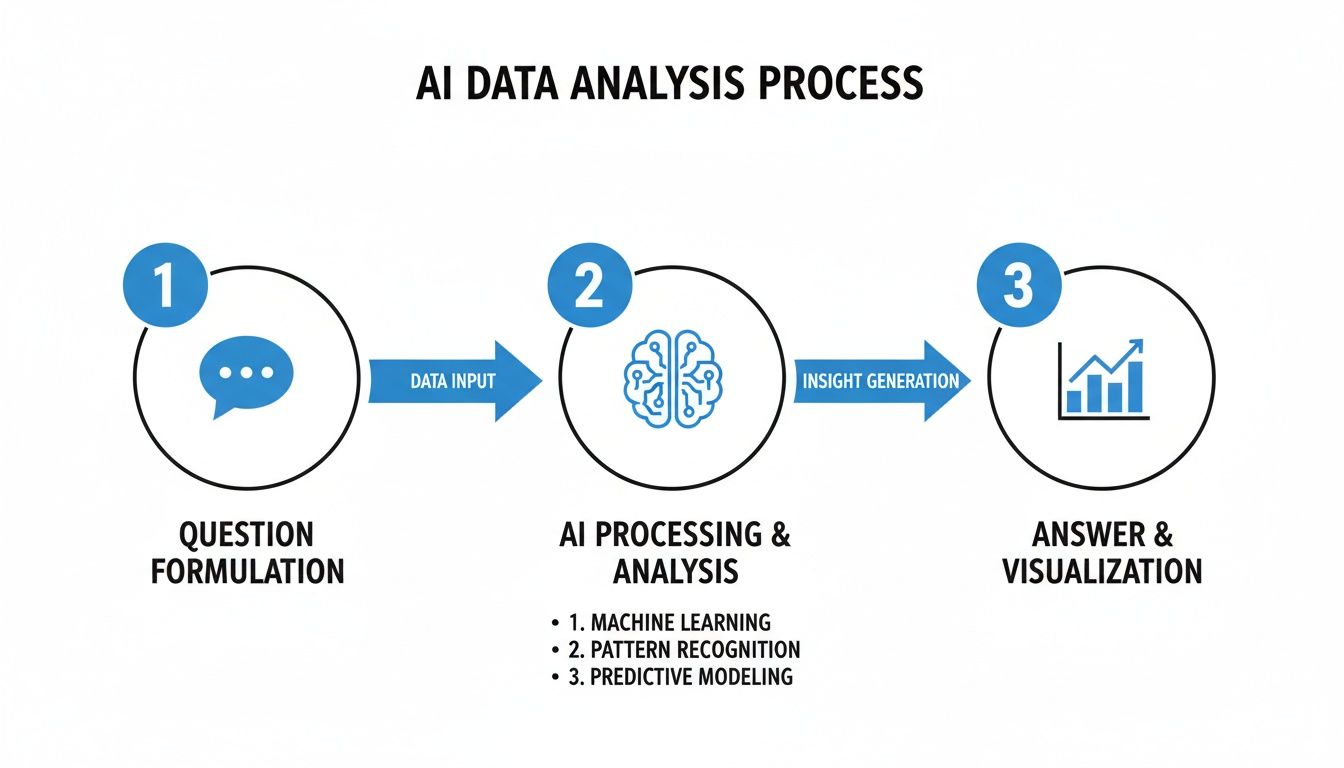
Diagram illustrating the AI data analysis process, from question formulation through AI processing to answer visualization.

Generative BI opens the door to a dynamic dialogue. You can ask follow-up questions, drill down into interesting results, and pivot your analysis on the fly—just like you would with a human expert.

Here’s what that means for your team:

  • Speed-of-thought analysis: Got a hunch? Explore it the moment it strikes, without technical roadblocks.

  • Deeper insights: Go beyond the "what" and uncover the "why." Ask follow-up questions like, "Why did sales in Germany spike in March?"

  • Data for everyone: Empowers people in marketing, ops, and sales to get their own answers, no specialized training needed. If you're curious about the old way, our article The Guide to SQL Charting shows why you won't need it anymore.

This isn’t just a faster way of getting the same old reports. It’s a change that puts curiosity back at the heart of your business strategy.

How Different Teams Use AI For Data Analysis

Theory is one thing, but results are what matter. The power of using AI for data analysis shines when it solves specific, everyday problems for different teams. This isn't about abstract tech; it's about getting the right answer to the right person, right now.

A conversational AI data analyst like Statspresso becomes an extension of each department, delivering insights on their terms. This shift is becoming non-negotiable. According to industry reports, the global AI market is projected to reach an astonishing $2.5 trillion by 2032, up from around $200 billion in 2023, cementing its place as a core part of modern business. If you're curious, you can explore the full AI market forecast.

Three individuals analyze data and charts on a desktop, laptop, smartphone, and tablet, depicting multi-device business analytics.

For Product Managers Shipping New Features

Product managers live and breathe user engagement data. After launching a new feature, the big question is always, "Is anyone actually using this?" In the past, getting an answer meant filing a ticket for a custom report that could take weeks.

Now, it's a simple conversation. A PM can ask directly about feature adoption, impact on retention, or how it correlates with upgrades. That feedback loop shrinks from weeks to seconds.

Try asking Statspresso: "Compare user retention for cohorts who used feature X last month versus those who didn't."

This kind of conversational analytics gives product teams the power to instantly validate their roadmap decisions with hard numbers.

For Marketing Leads Optimizing Spend

Marketing leads are always under pressure to prove ROI. They need to know which campaigns are bringing in not just leads, but high-value customers. The old way involved stitching together data from ad platforms, the CRM, and payment systems.

With automated BI, a marketing lead gets a clean, unified view of performance. They can finally ask the questions that link marketing dollars to business outcomes.

  • Customer Lifetime Value (LTV): Find out which ad campaigns attract customers who spend more over time.

  • Channel Performance: Instantly see which channels deliver the best return on ad spend (ROAS).

  • Funnel Analysis: Pinpoint exactly where people are dropping off in the customer journey.

Try asking Statspresso: "Show me the lifetime value of customers from our Google Ads campaign versus our Facebook campaign last quarter."

This allows marketers to confidently double down on what’s working and cut wasteful spending, all without waiting for a report.

For Founders Tracking The Business Pulse

Founders need a constant feel for the health of the business. They can't wait for a monthly board deck to check on critical metrics like Monthly Recurring Revenue (MRR), churn, and cash flow.

A founder can use a conversational AI data analyst to get an immediate snapshot of the business. They can ask for a high-level summary or drill down into the details without pulling their data team off bigger projects. It’s like having a CFO on call 24/7.

Try asking Statspresso: "What is our current MRR, and project our growth for the next three months based on the current trend?"

This immediate access to critical metrics empowers leaders to make proactive decisions. It turns data from a rearview mirror into a steering wheel. You just skip the SQL and get straight to the strategic answers.

Getting Started in Three Simple Steps

Jumping into AI-driven data analysis is much easier than it sounds. Forget massive implementation projects and endless training. We’re talking about getting your first real insight in minutes, not months.

This isn't just about plugging in a new tool; it's about changing how quickly you can work with data.

Step 1: Connect Your Data Source

First, you need to give the AI analyst something to work with. This part used to be a huge bottleneck. Today, it's a point-and-click exercise.

Modern platforms like Statspresso come with ready-made connectors for the tools you already use:

Getting connected is as simple as authorizing an app. The conversational AI data analyst securely links to your data source. No data migration is needed. The point of using AI for data analysis is that it meets you where your data already lives.

Step 2: Ask Your First Business Question

With your data connected, you don't have to learn a complicated interface. You just ask a question. In plain English. The goal is to get a quick win and feel the power of this approach immediately.

Try asking Statspresso: “Which marketing channel brought in the most new customers last month?”

This is where you see the magic. Instead of writing code, you’re having a conversation. Within seconds, you get a chart and a clear answer. This step proves one thing: you can completely skip the SQL and still get sophisticated insights.

Step 3: Explore Insights and Share Your Findings

That first answer is just the starting point. The real power of a conversational AI data analyst is how it follows your train of thought. See an interesting spike in the chart? Just ask a follow-up question.

"Okay, for that top channel, what was our average cost per acquisition?"

As you uncover these nuggets, you can save them. A single click pins a chart from your conversation directly to a live dashboard you can share with your team. This turns a one-off question into a resource for ongoing monitoring.

This workflow shifts data analysis from a static chore into a dynamic, collaborative discovery process.

What to Look For in an AI Analysis Tool

Not every platform that claims to offer AI-driven data analysis is the real deal. Many are just a slick interface wrapped around a basic keyword search. To tell a powerful platform apart from a gimmick, you need to know what to look for.

The right tool won't just show you data; it will help you understand it. It should feel less like software and more like a brilliant (and incredibly fast) colleague.

Seamless Data Connectivity

Your insights are only as good as the data you can access. A top-tier AI analysis tool must offer broad, native integrations to avoid creating new data silos.

Look for a platform that connects directly to the sources you already use:

  • Databases: Effortless connections to systems like Postgres, MySQL, and BigQuery are non-negotiable.

  • SaaS Platforms: Look for out-of-the-box connectors for HubSpot, Shopify, Stripe, and other critical apps.

  • Internal Tools: Integrations with project management tools like Linear or Jira can unlock deep operational insights.

The goal is a centralized view of your business without a massive setup headache. You should be able to connect a source and start using AI for data analysis in minutes.

True Conversational Power

This is where most tools fall flat. Genuine conversational analytics goes far beyond matching keywords. A real AI analyst needs to understand business context, handle ambiguity, and interpret follow-up questions.

A great AI analyst doesn’t just fetch data; it understands intent. It knows that "show me our best customers" might mean top spenders or most frequent buyers, and it helps you clarify.

This is powered by sophisticated Natural Language Processing that can learn your business jargon. You should be able to teach it that "ARR" means "Annual Recurring Revenue" for your company. You can get a better sense of the mechanics by exploring how Statspresso's AI data chat functions.

Proactive Insight Discovery

The most valuable insights are often the ones you weren't looking for. An intelligent platform doesn't just wait for you to ask questions; it proactively surfaces important trends, outliers, and correlations. This is where machine learning shines. Reports from 2024 show that 67% of companies are now using machine learning, but 59% of practitioners still point to data quality as a major challenge. A great tool must handle this. You can review the full machine learning statistics report for a deeper look.

A great tool will have an "insight gallery" that automatically flags findings like:

  • A sudden drop in user engagement from a specific region.

  • A marketing campaign that is unexpectedly driving high-value customers.

  • A product feature that is highly correlated with user churn.

This moves you from reactive reporting to proactive, strategic decision-making.

Common Questions About Using AI For Data Analysis

Jumping into any new tech brings up valid questions. You've seen the potential for how using AI for data analysis can make things faster, but you probably have some "what ifs." Let's tackle the big ones.

Handing over the keys to your company's data requires a lot of trust. These are the real-world concerns we hear from leaders every day.

How Secure Is My Data With an AI Analytics Platform?

This is always question number one. Any platform worth its salt builds its entire architecture around security.

Here are the non-negotiables:

  • SOC 2 Compliance: This is the gold standard, an independent audit proving rigorous controls are in place to protect customer data.

  • End-to-End Encryption: Your data needs to be scrambled both in transit and at rest.

  • Data Masking: The ability to automatically hide personally identifiable information (PII) is critical.

A platform like Statspresso is designed to never store a copy of your database. It securely sends queries to your data warehouse in real-time, holding on to only the metadata required to understand your questions.

How Does The AI Understand Our Company's Unique Metrics?

Every business has its own language. You might track "Monthly Recurring Revenue" while another calls it "MRR." So how does an AI learn your specific dialect? The answer is a semantic layer.

Think of the semantic layer as a translation guide you create for the AI. You only have to define your key business terms once. For instance, you can teach it that an "Engaged Customer" is a "user who has placed an order in the last 60 days."

Once that definition is in place, the AI understands your business context forever. This empowers anyone on your team to ask questions using your own company jargon and get the right answer.

Can I Actually Trust The Answers It Provides?

Trust is built on transparency. An AI that just gives you a number with no explanation is a "black box"—useless for high-stakes decisions. For an insight to be actionable, you must be able to verify it.

This is why a tool like Statspresso shows its work. Underneath every chart, you can see the exact SQL query it wrote. This means you can skip writing the SQL yourself, but it's always there for you or your data team to inspect.

This "show your work" approach demystifies the process. It replaces "magic" with accountable, trustworthy analysis, giving you the confidence to act on the answers.

Ready to stop wondering and start asking? Connect your first data source for free and ask your first question.

Waiting weeks for a data analyst to build a dashboard is a relic of the past. You have urgent questions, but the answers are stuck behind complex SQL and overloaded BI queues. This is a massive bottleneck for any founder, product manager, or marketing lead who needs to act fast.

A conversational AI data analyst like Statspresso changes the game. It's about getting answers, charts, and dashboards in seconds, not next quarter. It’s time to skip the SQL. Just ask your data a question and get a chart in seconds.

TL;DR: Key Takeaways

  • Traditional data analysis is slow. It creates bottlenecks where teams wait weeks for insights from overloaded BI queues.

  • Using AI for data analysis replaces this broken process. It lets you ask questions in plain English, no code required.

  • A conversational AI data analyst like Statspresso eliminates the need for SQL, providing instant charts on demand.

  • This shift moves your team from a passive reporting cycle to an active, real-time conversation with your data.

Why You're Still Waiting for Answers from Your Data

We’ve all been there. Staring at a dashboard that’s weeks out of date, trying to make a call on something that needed an answer yesterday.

You have urgent questions about revenue, user behavior, or that new marketing campaign. But the insights are trapped behind slow-moving BI queues and complicated SQL queries. This waiting game kills momentum. It's a drag on founders, product managers, and marketers who can’t afford to be slow.

A stressed man at a desk working on a laptop, with a clock and calendars nearby.

The traditional process is broken. It forces a translation layer between your business question and the technical query needed to find the answer. This friction doesn't just create delays; it often delivers insights that are stale by the time they land on your desk.

The Old Way vs. The New Way

Let's cut to the chase. The old workflow for getting data insights is a multi-step, human-powered relay race. The new approach, driven by a conversational AI data analyst like Statspresso, is a direct sprint from question to answer.

The Old Way (Manual SQL)

The New Way (Statspresso)

File a ticket with the BI team.

Ask a question in plain English.

Wait in a queue for days or weeks.

Get an interactive chart in seconds.

Explain business context to an analyst.

The AI already understands business context.

Analyst writes and debugs SQL code.

The AI writes and runs the query instantly.

Review a static, inflexible report.

Explore data with natural follow-up questions.

This isn't a small improvement. It’s a total overhaul of how you interact with your company's data. It removes the technical gatekeepers and puts insights directly into the hands of the people who need them most.

How AI Actually Analyzes Your Data

Let's pull back the curtain on the buzzwords. At its heart, using AI for data analysis is like having a dedicated analyst on your team who works 24/7, knows your data inside and out, and answers questions in seconds. It’s not about complex theory; it's about making your data serve you.

The process comes down to two key technologies working together. You don’t need a computer science degree to get it.

The Detective and The Translator

First, think of Machine Learning (ML) as your team's super-powered detective. It tirelessly combs through millions of data points to spot trends, correlations, and anomalies a human might miss. This is the engine that uncovers hidden patterns and powers predictive insights.

Next is Natural Language Processing (NLP), which acts as the universal translator. This is what lets you ask a complicated question in simple, everyday language. NLP bridges your plain-English question and the structured code a machine needs to run a query. It’s what makes a conversational AI data analyst like Statspresso feel like magic.

Try asking Statspresso: “What were our top-selling products in Europe last quarter, and show me the trend line.”

The AI translates your request, writes the query, crunches the numbers, and hands back a chart. No SQL code, no support tickets, no waiting. This is why the AI Data Analysis Software market is projected to grow so aggressively—businesses need this kind of instant, automated insight. You can read more about the market's rapid expansion here.

Welcome to Generative BI

This new, conversational approach has a name: Generative BI (GenBI). It's a huge leap from static dashboards that often leave you with more questions than answers. Instead of a one-way street where you just look at pre-built charts, GenBI creates a two-way conversation with your data.

Diagram illustrating the AI data analysis process, from question formulation through AI processing to answer visualization.

Generative BI opens the door to a dynamic dialogue. You can ask follow-up questions, drill down into interesting results, and pivot your analysis on the fly—just like you would with a human expert.

Here’s what that means for your team:

  • Speed-of-thought analysis: Got a hunch? Explore it the moment it strikes, without technical roadblocks.

  • Deeper insights: Go beyond the "what" and uncover the "why." Ask follow-up questions like, "Why did sales in Germany spike in March?"

  • Data for everyone: Empowers people in marketing, ops, and sales to get their own answers, no specialized training needed. If you're curious about the old way, our article The Guide to SQL Charting shows why you won't need it anymore.

This isn’t just a faster way of getting the same old reports. It’s a change that puts curiosity back at the heart of your business strategy.

How Different Teams Use AI For Data Analysis

Theory is one thing, but results are what matter. The power of using AI for data analysis shines when it solves specific, everyday problems for different teams. This isn't about abstract tech; it's about getting the right answer to the right person, right now.

A conversational AI data analyst like Statspresso becomes an extension of each department, delivering insights on their terms. This shift is becoming non-negotiable. According to industry reports, the global AI market is projected to reach an astonishing $2.5 trillion by 2032, up from around $200 billion in 2023, cementing its place as a core part of modern business. If you're curious, you can explore the full AI market forecast.

Three individuals analyze data and charts on a desktop, laptop, smartphone, and tablet, depicting multi-device business analytics.

For Product Managers Shipping New Features

Product managers live and breathe user engagement data. After launching a new feature, the big question is always, "Is anyone actually using this?" In the past, getting an answer meant filing a ticket for a custom report that could take weeks.

Now, it's a simple conversation. A PM can ask directly about feature adoption, impact on retention, or how it correlates with upgrades. That feedback loop shrinks from weeks to seconds.

Try asking Statspresso: "Compare user retention for cohorts who used feature X last month versus those who didn't."

This kind of conversational analytics gives product teams the power to instantly validate their roadmap decisions with hard numbers.

For Marketing Leads Optimizing Spend

Marketing leads are always under pressure to prove ROI. They need to know which campaigns are bringing in not just leads, but high-value customers. The old way involved stitching together data from ad platforms, the CRM, and payment systems.

With automated BI, a marketing lead gets a clean, unified view of performance. They can finally ask the questions that link marketing dollars to business outcomes.

  • Customer Lifetime Value (LTV): Find out which ad campaigns attract customers who spend more over time.

  • Channel Performance: Instantly see which channels deliver the best return on ad spend (ROAS).

  • Funnel Analysis: Pinpoint exactly where people are dropping off in the customer journey.

Try asking Statspresso: "Show me the lifetime value of customers from our Google Ads campaign versus our Facebook campaign last quarter."

This allows marketers to confidently double down on what’s working and cut wasteful spending, all without waiting for a report.

For Founders Tracking The Business Pulse

Founders need a constant feel for the health of the business. They can't wait for a monthly board deck to check on critical metrics like Monthly Recurring Revenue (MRR), churn, and cash flow.

A founder can use a conversational AI data analyst to get an immediate snapshot of the business. They can ask for a high-level summary or drill down into the details without pulling their data team off bigger projects. It’s like having a CFO on call 24/7.

Try asking Statspresso: "What is our current MRR, and project our growth for the next three months based on the current trend?"

This immediate access to critical metrics empowers leaders to make proactive decisions. It turns data from a rearview mirror into a steering wheel. You just skip the SQL and get straight to the strategic answers.

Getting Started in Three Simple Steps

Jumping into AI-driven data analysis is much easier than it sounds. Forget massive implementation projects and endless training. We’re talking about getting your first real insight in minutes, not months.

This isn't just about plugging in a new tool; it's about changing how quickly you can work with data.

Step 1: Connect Your Data Source

First, you need to give the AI analyst something to work with. This part used to be a huge bottleneck. Today, it's a point-and-click exercise.

Modern platforms like Statspresso come with ready-made connectors for the tools you already use:

Getting connected is as simple as authorizing an app. The conversational AI data analyst securely links to your data source. No data migration is needed. The point of using AI for data analysis is that it meets you where your data already lives.

Step 2: Ask Your First Business Question

With your data connected, you don't have to learn a complicated interface. You just ask a question. In plain English. The goal is to get a quick win and feel the power of this approach immediately.

Try asking Statspresso: “Which marketing channel brought in the most new customers last month?”

This is where you see the magic. Instead of writing code, you’re having a conversation. Within seconds, you get a chart and a clear answer. This step proves one thing: you can completely skip the SQL and still get sophisticated insights.

Step 3: Explore Insights and Share Your Findings

That first answer is just the starting point. The real power of a conversational AI data analyst is how it follows your train of thought. See an interesting spike in the chart? Just ask a follow-up question.

"Okay, for that top channel, what was our average cost per acquisition?"

As you uncover these nuggets, you can save them. A single click pins a chart from your conversation directly to a live dashboard you can share with your team. This turns a one-off question into a resource for ongoing monitoring.

This workflow shifts data analysis from a static chore into a dynamic, collaborative discovery process.

What to Look For in an AI Analysis Tool

Not every platform that claims to offer AI-driven data analysis is the real deal. Many are just a slick interface wrapped around a basic keyword search. To tell a powerful platform apart from a gimmick, you need to know what to look for.

The right tool won't just show you data; it will help you understand it. It should feel less like software and more like a brilliant (and incredibly fast) colleague.

Seamless Data Connectivity

Your insights are only as good as the data you can access. A top-tier AI analysis tool must offer broad, native integrations to avoid creating new data silos.

Look for a platform that connects directly to the sources you already use:

  • Databases: Effortless connections to systems like Postgres, MySQL, and BigQuery are non-negotiable.

  • SaaS Platforms: Look for out-of-the-box connectors for HubSpot, Shopify, Stripe, and other critical apps.

  • Internal Tools: Integrations with project management tools like Linear or Jira can unlock deep operational insights.

The goal is a centralized view of your business without a massive setup headache. You should be able to connect a source and start using AI for data analysis in minutes.

True Conversational Power

This is where most tools fall flat. Genuine conversational analytics goes far beyond matching keywords. A real AI analyst needs to understand business context, handle ambiguity, and interpret follow-up questions.

A great AI analyst doesn’t just fetch data; it understands intent. It knows that "show me our best customers" might mean top spenders or most frequent buyers, and it helps you clarify.

This is powered by sophisticated Natural Language Processing that can learn your business jargon. You should be able to teach it that "ARR" means "Annual Recurring Revenue" for your company. You can get a better sense of the mechanics by exploring how Statspresso's AI data chat functions.

Proactive Insight Discovery

The most valuable insights are often the ones you weren't looking for. An intelligent platform doesn't just wait for you to ask questions; it proactively surfaces important trends, outliers, and correlations. This is where machine learning shines. Reports from 2024 show that 67% of companies are now using machine learning, but 59% of practitioners still point to data quality as a major challenge. A great tool must handle this. You can review the full machine learning statistics report for a deeper look.

A great tool will have an "insight gallery" that automatically flags findings like:

  • A sudden drop in user engagement from a specific region.

  • A marketing campaign that is unexpectedly driving high-value customers.

  • A product feature that is highly correlated with user churn.

This moves you from reactive reporting to proactive, strategic decision-making.

Common Questions About Using AI For Data Analysis

Jumping into any new tech brings up valid questions. You've seen the potential for how using AI for data analysis can make things faster, but you probably have some "what ifs." Let's tackle the big ones.

Handing over the keys to your company's data requires a lot of trust. These are the real-world concerns we hear from leaders every day.

How Secure Is My Data With an AI Analytics Platform?

This is always question number one. Any platform worth its salt builds its entire architecture around security.

Here are the non-negotiables:

  • SOC 2 Compliance: This is the gold standard, an independent audit proving rigorous controls are in place to protect customer data.

  • End-to-End Encryption: Your data needs to be scrambled both in transit and at rest.

  • Data Masking: The ability to automatically hide personally identifiable information (PII) is critical.

A platform like Statspresso is designed to never store a copy of your database. It securely sends queries to your data warehouse in real-time, holding on to only the metadata required to understand your questions.

How Does The AI Understand Our Company's Unique Metrics?

Every business has its own language. You might track "Monthly Recurring Revenue" while another calls it "MRR." So how does an AI learn your specific dialect? The answer is a semantic layer.

Think of the semantic layer as a translation guide you create for the AI. You only have to define your key business terms once. For instance, you can teach it that an "Engaged Customer" is a "user who has placed an order in the last 60 days."

Once that definition is in place, the AI understands your business context forever. This empowers anyone on your team to ask questions using your own company jargon and get the right answer.

Can I Actually Trust The Answers It Provides?

Trust is built on transparency. An AI that just gives you a number with no explanation is a "black box"—useless for high-stakes decisions. For an insight to be actionable, you must be able to verify it.

This is why a tool like Statspresso shows its work. Underneath every chart, you can see the exact SQL query it wrote. This means you can skip writing the SQL yourself, but it's always there for you or your data team to inspect.

This "show your work" approach demystifies the process. It replaces "magic" with accountable, trustworthy analysis, giving you the confidence to act on the answers.

Ready to stop wondering and start asking? Connect your first data source for free and ask your first question.

Waiting weeks for a data analyst to build a dashboard is a relic of the past. You have urgent questions, but the answers are stuck behind complex SQL and overloaded BI queues. This is a massive bottleneck for any founder, product manager, or marketing lead who needs to act fast.

A conversational AI data analyst like Statspresso changes the game. It's about getting answers, charts, and dashboards in seconds, not next quarter. It’s time to skip the SQL. Just ask your data a question and get a chart in seconds.

TL;DR: Key Takeaways

  • Traditional data analysis is slow. It creates bottlenecks where teams wait weeks for insights from overloaded BI queues.

  • Using AI for data analysis replaces this broken process. It lets you ask questions in plain English, no code required.

  • A conversational AI data analyst like Statspresso eliminates the need for SQL, providing instant charts on demand.

  • This shift moves your team from a passive reporting cycle to an active, real-time conversation with your data.

Why You're Still Waiting for Answers from Your Data

We’ve all been there. Staring at a dashboard that’s weeks out of date, trying to make a call on something that needed an answer yesterday.

You have urgent questions about revenue, user behavior, or that new marketing campaign. But the insights are trapped behind slow-moving BI queues and complicated SQL queries. This waiting game kills momentum. It's a drag on founders, product managers, and marketers who can’t afford to be slow.

A stressed man at a desk working on a laptop, with a clock and calendars nearby.

The traditional process is broken. It forces a translation layer between your business question and the technical query needed to find the answer. This friction doesn't just create delays; it often delivers insights that are stale by the time they land on your desk.

The Old Way vs. The New Way

Let's cut to the chase. The old workflow for getting data insights is a multi-step, human-powered relay race. The new approach, driven by a conversational AI data analyst like Statspresso, is a direct sprint from question to answer.

The Old Way (Manual SQL)

The New Way (Statspresso)

File a ticket with the BI team.

Ask a question in plain English.

Wait in a queue for days or weeks.

Get an interactive chart in seconds.

Explain business context to an analyst.

The AI already understands business context.

Analyst writes and debugs SQL code.

The AI writes and runs the query instantly.

Review a static, inflexible report.

Explore data with natural follow-up questions.

This isn't a small improvement. It’s a total overhaul of how you interact with your company's data. It removes the technical gatekeepers and puts insights directly into the hands of the people who need them most.

How AI Actually Analyzes Your Data

Let's pull back the curtain on the buzzwords. At its heart, using AI for data analysis is like having a dedicated analyst on your team who works 24/7, knows your data inside and out, and answers questions in seconds. It’s not about complex theory; it's about making your data serve you.

The process comes down to two key technologies working together. You don’t need a computer science degree to get it.

The Detective and The Translator

First, think of Machine Learning (ML) as your team's super-powered detective. It tirelessly combs through millions of data points to spot trends, correlations, and anomalies a human might miss. This is the engine that uncovers hidden patterns and powers predictive insights.

Next is Natural Language Processing (NLP), which acts as the universal translator. This is what lets you ask a complicated question in simple, everyday language. NLP bridges your plain-English question and the structured code a machine needs to run a query. It’s what makes a conversational AI data analyst like Statspresso feel like magic.

Try asking Statspresso: “What were our top-selling products in Europe last quarter, and show me the trend line.”

The AI translates your request, writes the query, crunches the numbers, and hands back a chart. No SQL code, no support tickets, no waiting. This is why the AI Data Analysis Software market is projected to grow so aggressively—businesses need this kind of instant, automated insight. You can read more about the market's rapid expansion here.

Welcome to Generative BI

This new, conversational approach has a name: Generative BI (GenBI). It's a huge leap from static dashboards that often leave you with more questions than answers. Instead of a one-way street where you just look at pre-built charts, GenBI creates a two-way conversation with your data.

Diagram illustrating the AI data analysis process, from question formulation through AI processing to answer visualization.

Generative BI opens the door to a dynamic dialogue. You can ask follow-up questions, drill down into interesting results, and pivot your analysis on the fly—just like you would with a human expert.

Here’s what that means for your team:

  • Speed-of-thought analysis: Got a hunch? Explore it the moment it strikes, without technical roadblocks.

  • Deeper insights: Go beyond the "what" and uncover the "why." Ask follow-up questions like, "Why did sales in Germany spike in March?"

  • Data for everyone: Empowers people in marketing, ops, and sales to get their own answers, no specialized training needed. If you're curious about the old way, our article The Guide to SQL Charting shows why you won't need it anymore.

This isn’t just a faster way of getting the same old reports. It’s a change that puts curiosity back at the heart of your business strategy.

How Different Teams Use AI For Data Analysis

Theory is one thing, but results are what matter. The power of using AI for data analysis shines when it solves specific, everyday problems for different teams. This isn't about abstract tech; it's about getting the right answer to the right person, right now.

A conversational AI data analyst like Statspresso becomes an extension of each department, delivering insights on their terms. This shift is becoming non-negotiable. According to industry reports, the global AI market is projected to reach an astonishing $2.5 trillion by 2032, up from around $200 billion in 2023, cementing its place as a core part of modern business. If you're curious, you can explore the full AI market forecast.

Three individuals analyze data and charts on a desktop, laptop, smartphone, and tablet, depicting multi-device business analytics.

For Product Managers Shipping New Features

Product managers live and breathe user engagement data. After launching a new feature, the big question is always, "Is anyone actually using this?" In the past, getting an answer meant filing a ticket for a custom report that could take weeks.

Now, it's a simple conversation. A PM can ask directly about feature adoption, impact on retention, or how it correlates with upgrades. That feedback loop shrinks from weeks to seconds.

Try asking Statspresso: "Compare user retention for cohorts who used feature X last month versus those who didn't."

This kind of conversational analytics gives product teams the power to instantly validate their roadmap decisions with hard numbers.

For Marketing Leads Optimizing Spend

Marketing leads are always under pressure to prove ROI. They need to know which campaigns are bringing in not just leads, but high-value customers. The old way involved stitching together data from ad platforms, the CRM, and payment systems.

With automated BI, a marketing lead gets a clean, unified view of performance. They can finally ask the questions that link marketing dollars to business outcomes.

  • Customer Lifetime Value (LTV): Find out which ad campaigns attract customers who spend more over time.

  • Channel Performance: Instantly see which channels deliver the best return on ad spend (ROAS).

  • Funnel Analysis: Pinpoint exactly where people are dropping off in the customer journey.

Try asking Statspresso: "Show me the lifetime value of customers from our Google Ads campaign versus our Facebook campaign last quarter."

This allows marketers to confidently double down on what’s working and cut wasteful spending, all without waiting for a report.

For Founders Tracking The Business Pulse

Founders need a constant feel for the health of the business. They can't wait for a monthly board deck to check on critical metrics like Monthly Recurring Revenue (MRR), churn, and cash flow.

A founder can use a conversational AI data analyst to get an immediate snapshot of the business. They can ask for a high-level summary or drill down into the details without pulling their data team off bigger projects. It’s like having a CFO on call 24/7.

Try asking Statspresso: "What is our current MRR, and project our growth for the next three months based on the current trend?"

This immediate access to critical metrics empowers leaders to make proactive decisions. It turns data from a rearview mirror into a steering wheel. You just skip the SQL and get straight to the strategic answers.

Getting Started in Three Simple Steps

Jumping into AI-driven data analysis is much easier than it sounds. Forget massive implementation projects and endless training. We’re talking about getting your first real insight in minutes, not months.

This isn't just about plugging in a new tool; it's about changing how quickly you can work with data.

Step 1: Connect Your Data Source

First, you need to give the AI analyst something to work with. This part used to be a huge bottleneck. Today, it's a point-and-click exercise.

Modern platforms like Statspresso come with ready-made connectors for the tools you already use:

Getting connected is as simple as authorizing an app. The conversational AI data analyst securely links to your data source. No data migration is needed. The point of using AI for data analysis is that it meets you where your data already lives.

Step 2: Ask Your First Business Question

With your data connected, you don't have to learn a complicated interface. You just ask a question. In plain English. The goal is to get a quick win and feel the power of this approach immediately.

Try asking Statspresso: “Which marketing channel brought in the most new customers last month?”

This is where you see the magic. Instead of writing code, you’re having a conversation. Within seconds, you get a chart and a clear answer. This step proves one thing: you can completely skip the SQL and still get sophisticated insights.

Step 3: Explore Insights and Share Your Findings

That first answer is just the starting point. The real power of a conversational AI data analyst is how it follows your train of thought. See an interesting spike in the chart? Just ask a follow-up question.

"Okay, for that top channel, what was our average cost per acquisition?"

As you uncover these nuggets, you can save them. A single click pins a chart from your conversation directly to a live dashboard you can share with your team. This turns a one-off question into a resource for ongoing monitoring.

This workflow shifts data analysis from a static chore into a dynamic, collaborative discovery process.

What to Look For in an AI Analysis Tool

Not every platform that claims to offer AI-driven data analysis is the real deal. Many are just a slick interface wrapped around a basic keyword search. To tell a powerful platform apart from a gimmick, you need to know what to look for.

The right tool won't just show you data; it will help you understand it. It should feel less like software and more like a brilliant (and incredibly fast) colleague.

Seamless Data Connectivity

Your insights are only as good as the data you can access. A top-tier AI analysis tool must offer broad, native integrations to avoid creating new data silos.

Look for a platform that connects directly to the sources you already use:

  • Databases: Effortless connections to systems like Postgres, MySQL, and BigQuery are non-negotiable.

  • SaaS Platforms: Look for out-of-the-box connectors for HubSpot, Shopify, Stripe, and other critical apps.

  • Internal Tools: Integrations with project management tools like Linear or Jira can unlock deep operational insights.

The goal is a centralized view of your business without a massive setup headache. You should be able to connect a source and start using AI for data analysis in minutes.

True Conversational Power

This is where most tools fall flat. Genuine conversational analytics goes far beyond matching keywords. A real AI analyst needs to understand business context, handle ambiguity, and interpret follow-up questions.

A great AI analyst doesn’t just fetch data; it understands intent. It knows that "show me our best customers" might mean top spenders or most frequent buyers, and it helps you clarify.

This is powered by sophisticated Natural Language Processing that can learn your business jargon. You should be able to teach it that "ARR" means "Annual Recurring Revenue" for your company. You can get a better sense of the mechanics by exploring how Statspresso's AI data chat functions.

Proactive Insight Discovery

The most valuable insights are often the ones you weren't looking for. An intelligent platform doesn't just wait for you to ask questions; it proactively surfaces important trends, outliers, and correlations. This is where machine learning shines. Reports from 2024 show that 67% of companies are now using machine learning, but 59% of practitioners still point to data quality as a major challenge. A great tool must handle this. You can review the full machine learning statistics report for a deeper look.

A great tool will have an "insight gallery" that automatically flags findings like:

  • A sudden drop in user engagement from a specific region.

  • A marketing campaign that is unexpectedly driving high-value customers.

  • A product feature that is highly correlated with user churn.

This moves you from reactive reporting to proactive, strategic decision-making.

Common Questions About Using AI For Data Analysis

Jumping into any new tech brings up valid questions. You've seen the potential for how using AI for data analysis can make things faster, but you probably have some "what ifs." Let's tackle the big ones.

Handing over the keys to your company's data requires a lot of trust. These are the real-world concerns we hear from leaders every day.

How Secure Is My Data With an AI Analytics Platform?

This is always question number one. Any platform worth its salt builds its entire architecture around security.

Here are the non-negotiables:

  • SOC 2 Compliance: This is the gold standard, an independent audit proving rigorous controls are in place to protect customer data.

  • End-to-End Encryption: Your data needs to be scrambled both in transit and at rest.

  • Data Masking: The ability to automatically hide personally identifiable information (PII) is critical.

A platform like Statspresso is designed to never store a copy of your database. It securely sends queries to your data warehouse in real-time, holding on to only the metadata required to understand your questions.

How Does The AI Understand Our Company's Unique Metrics?

Every business has its own language. You might track "Monthly Recurring Revenue" while another calls it "MRR." So how does an AI learn your specific dialect? The answer is a semantic layer.

Think of the semantic layer as a translation guide you create for the AI. You only have to define your key business terms once. For instance, you can teach it that an "Engaged Customer" is a "user who has placed an order in the last 60 days."

Once that definition is in place, the AI understands your business context forever. This empowers anyone on your team to ask questions using your own company jargon and get the right answer.

Can I Actually Trust The Answers It Provides?

Trust is built on transparency. An AI that just gives you a number with no explanation is a "black box"—useless for high-stakes decisions. For an insight to be actionable, you must be able to verify it.

This is why a tool like Statspresso shows its work. Underneath every chart, you can see the exact SQL query it wrote. This means you can skip writing the SQL yourself, but it's always there for you or your data team to inspect.

This "show your work" approach demystifies the process. It replaces "magic" with accountable, trustworthy analysis, giving you the confidence to act on the answers.

Ready to stop wondering and start asking? Connect your first data source for free and ask your first question.