
Mar 11, 2026

A Guide to Cross Channel Marketing That Drives Growth

Your customers see one brand. Your marketing teams, however, often operate in different solar systems. Social media, email, and advertising efforts aren't talking to each other, creating a disjointed experience that wastes your budget. Waiting weeks for a data analyst to build a dashboard is a relic of the past. A successful cross channel marketing strategy isn’t about being everywhere; it's about making every channel work together as a single, cohesive unit.

TL;DR: Your Key Takeaways

  • Cross-Channel vs. Multichannel: Multichannel is just being on many platforms. Cross-channel is making them work together to create one seamless customer journey.

  • Data is Everything: You can't orchestrate a strategy without a unified view of your data. Siloed analytics lead to wasted ad spend and confused customers.

  • Ask, Don't Analyze: The fastest way to get insights is to ask your data a direct question. A tool like Statspresso, a Conversational AI Data Analyst, lets you skip the SQL and get a chart in seconds.

  • Start Small, Connect Deep: You don't need to be on every channel. Pick two high-impact channels (like email and social) and make them work together perfectly first.

  • Measure What Matters: Ditch last-click attribution. Focus on metrics like Customer Lifetime Value (CLV) and multi-touch attribution to see what's really driving growth.

Your Marketing Is Disconnected And It’s Costing You

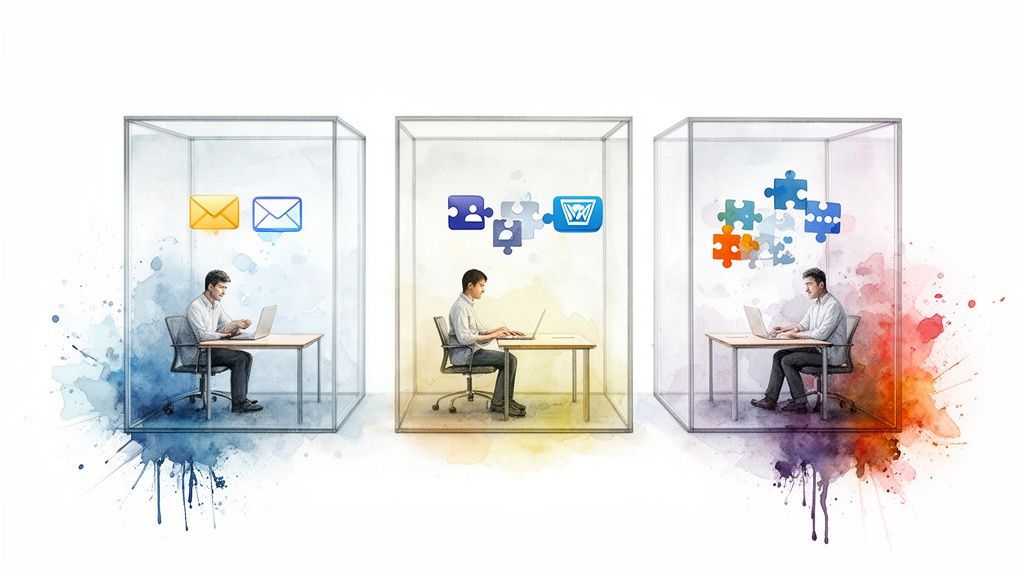
Digital illustration showing men in cubicles, representing evolving strategies from single to cross-channel marketing.

Think about this. A customer adds items to their cart but leaves. Your social media team serves them a perfect retargeting ad. So far, so good. But then, your email team blasts out a generic weekly newsletter. The seamless journey just shattered.

This isn't a rare mishap. It's the daily reality for countless businesses. Your marketing is loud, but it isn't in sync. Each channel is its own tiny kingdom with separate goals, siloed data, and no shared script. The result is a chaotic customer experience and a gaping hole where your marketing ROI should be.

The Old Way Is Broken

For years, the "solution" was to dump all your channel data into a spreadsheet and hand it to a data analyst. Weeks later, you’d get a report that was already out of date. This manual, reactive process is a relic.

Waiting for an analyst to stitch together channel data is like navigating a highway by looking in the rearview mirror. You see where you’ve been, but you have no idea where you’re going.

This legacy approach to marketing analytics is painfully slow and surprisingly expensive. It fails to provide the real-time insights you need to make smart decisions. You can't orchestrate a cohesive cross channel marketing campaign when you're looking at data that's weeks old.

The Shift to Intelligent Orchestration

The good news? There's a much smarter way to operate. Instead of just adding more channels (multichannel), the goal is to integrate them. This is the heart of a modern cross channel marketing strategy—turning a bunch of separate instruments into a symphony.

To do this, you need a single, unified view of your data. You have to know which touchpoints drive conversions and which ones are just noise. This is where a Conversational AI Data Analyst like Statspresso changes the game. Forget wrestling with complex BI tools or writing SQL queries.

Instead, just ask a direct question.

  • Try asking Statspresso: "Which marketing channel had the highest conversion rate last month?"

A simple query like this cuts through the noise. It lets you skip the SQL and get a chart in seconds, turning a mess of disconnected data into a clear, actionable answer. This is how you move from fragmented efforts to a unified strategy that grows your business.

Cross Channel vs. Multichannel Marketing Explained

You’ve heard "multichannel" and "cross-channel" thrown around like they’re the same thing. They’re not. While both use more than one platform, the underlying strategy is worlds apart. Getting this right is the first step toward building a marketing engine that connects with people.

Multichannel marketing is just about being present. You have an email list, a Facebook page, and a blog. The problem is, they act like separate businesses that have never met. Each channel team chases its own goals, creating a disjointed experience for the very people you're trying to reach.

Ever bought new shoes at full price, only to get an email the next day offering a 20% discount on that exact pair? That’s a classic multichannel fumble. It’s a clear signal your marketing channels aren't communicating.

The Shift to a Unified Customer View

Cross-channel marketing, on the other hand, is about orchestration. It makes those separate channels work in concert to create one seamless customer journey. Think of it less like a bunch of solo acts and more like a symphony. The focus shifts from the channel to the customer moving between them.

A great cross-channel experience feels effortless. A potential customer sees a targeted ad on Instagram, clicks to a landing page, and later gets a follow-up email referencing their interest. Each step feels like a natural continuation, guiding them smoothly toward a purchase. This approach understands that people don't live in marketing silos; they float between apps, email, and websites.

The goal isn't just to be on multiple channels. It's to make the entire experience feel like a single, intelligent conversation.

To pull this off, you need to see the whole picture. You can't conduct a symphony if you can only see one musician's sheet music. Teams get stuck here, swimming in data from different sources but unable to piece it together. Instead of spending days manually stitching reports, a tool like Statspresso, your Conversational AI Data Analyst, gives you that unified view in seconds.

  • Try asking Statspresso: "Show me the customer journey for users who converted from our latest email campaign, broken down by their previous touchpoints."

A simple question like that gives you the insight needed to see how your channels are really working together. You skip the SQL and get a chart in seconds, turning a mess of data points into a clear map of your customer's path.

Multichannel vs. Cross-Channel: The Key Differences

Let's put these two approaches side-by-side. This table highlights the strategic shift from a channel-first mindset to a customer-first one.

Attribute

Multichannel Marketing (The Old Way)

Cross Channel Marketing (The Smart Way)

Strategy Focus

Channel-centric; optimizing each platform independently.

Customer-centric; creating a single, unified journey.

Customer Experience

Disjointed and often repetitive or contradictory.

Seamless, contextual, and consistent across all touchpoints.

Data & Analytics

Siloed by channel; impossible to see the full picture.

Unified and integrated; provides a complete view of the customer.

Primary Goal

Maximize reach by being on many channels.

Deepen engagement and increase conversions through orchestration.

Ultimately, one is a collection of siloed tactics, while the other is a cohesive strategy built entirely around the customer's real-world behavior.

How To Build Your Cross Channel Marketing Strategy

A powerful cross-channel marketing strategy isn't built by accident. It comes down to three core steps: unifying your customer data, mapping the real customer journey, and orchestrating how your channels communicate. Nail these, and you’ll go from making noise to creating a genuine symphony for your customers.

It starts with your data. Your Shopify data probably doesn’t talk to your HubSpot data, and neither connects to your Postgres database. This creates a fractured view of your customer. The goal is to bring every touchpoint together into a single, reliable source of truth.

This is where most teams get overwhelmed, imagining a massive, expensive data engineering project. It doesn't have to be that complicated. A Conversational AI Data Analyst like Statspresso connects directly to these different sources, pulling everything into one place without you writing a single line of SQL.

The difference between a siloed approach and a connected one is night and day.
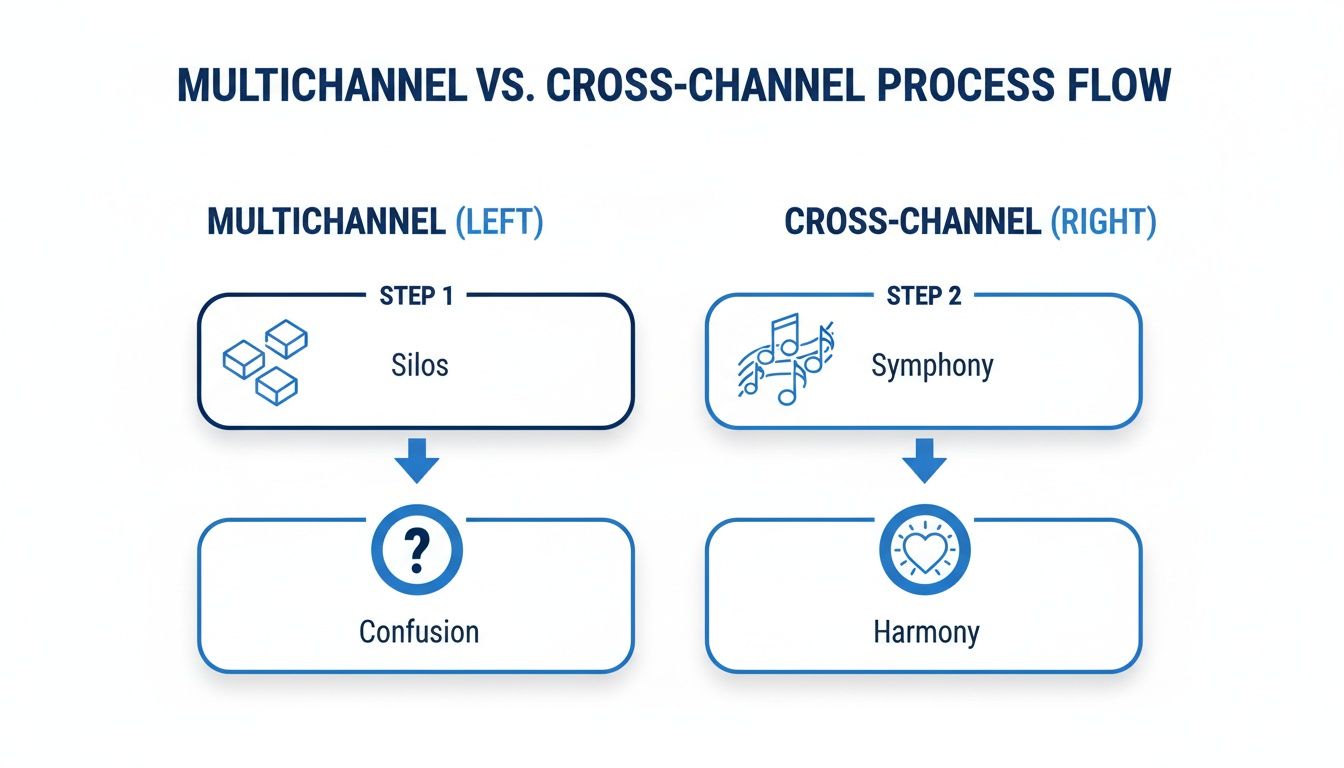
A diagram comparing multichannel and cross-channel process flows, showing silos leading to confusion versus symphony leading to harmony.

When your channels don't talk, you get customer confusion. When they work together, you get harmony and a much better experience.

Map the Actual Customer Journey

Once your data is in one place, you can finally map the customer journey. I’m not talking about a neat funnel you draw on a whiteboard. I mean digging into your unified data to uncover the real, messy paths your customers actually take.

  • Identify Key Touchpoints: Which emails, ads, or blog posts do people consistently engage with before they buy?

  • Find Friction Points: Where are people dropping off? Is it a clunky checkout page or a poorly timed SMS notification?

  • Discover Winning Paths: What specific sequence of interactions produces your most valuable customers?

Trying to piece this together manually is a nightmare of spreadsheets and VLOOKUPs. A smarter way is to simply ask your data.

Try asking Statspresso: "Which marketing channel has the highest customer lifetime value for users acquired last quarter?"

A question like this cuts through the noise to give you an answer you can act on. You skip the SQL and get a chart in seconds, showing you which channels aren't just driving clicks, but creating long-term value.

Orchestrate Your Channel Communication

With a clear journey map, you can orchestrate your communication. Now, you can sequence your messaging to tell a cohesive story. Your social media and email teams are no longer operating in their own worlds; their efforts become part of a coordinated plan.

This is how you ensure the ad a user sees on Facebook is directly related to the email they get the next day. This level of coordination builds trust and makes the customer feel understood.

The need for this is urgent. With the digital ad market projected to hit $786.2 billion globally by 2026, the pressure is on for the 88% of consumer marketers who know they need to radically improve customer engagement. As you plan, looking into advanced tools like dedicated cross-channel AI marketing solutions can give you a serious edge. This connected approach is why cross-channel planning drives better results. You can read more about these 2026 marketing strategy trends to see where things are headed.

Ultimately, a great strategy isn't about having more data. It's about getting faster, clearer answers.

How To Weave Your Key Channels Together

Moving from theory to practice is where the real work begins. A winning strategy is about making specific channels like email, social media, and your blog work in concert. Instead of treating each as its own island, build bridges so the customer’s journey feels seamless.

Think of it this way: your social campaigns shouldn't just exist for likes. They should be a primary engine for growing your email list. That list, in turn, is a tool for nurturing leads with valuable content that also happens to rank on Google.

When every channel supports and amplifies the others, you've moved beyond random tactics and created an effective marketing engine.

Start With Your Powerhouse Email

For all the buzz around new platforms, email continues to deliver unmatched ROI. It’s the reliable hub that connects all your other marketing spokes. But simply having an email list isn't the goal—its value comes alive when it’s intelligently fed by your other channels.

Email’s dominance in a cross-channel strategy is hard to overstate. It generates an incredible $36 in revenue for every $1 spent. With 4.37 billion people sending 347.3 billion emails daily in 2024, its reach is immense. The data also confirms that cross-channel email campaigns outperform standalone efforts by 22% in revenue per recipient. We see this synergy when emails preceded by social media exposure get 37% higher click-throughs. You can explore more of these digital marketing statistics to see the full picture.

The goal is to use other channels to make your email marketing smarter. Here’s how:

  1. Paid Social: Run a targeted Facebook ad promoting a high-value guide. The call to action is "Download the Guide," which requires an email address.

  2. Email Automation: The moment someone signs up, they enter a welcome sequence. The first email delivers the guide. The next few offer related content, like a case study or a blog post.

  3. Content & SEO: That blog post is optimized for search engines, attracting its own organic traffic and including calls-to-action to subscribe, creating a self-perpetuating cycle.

This isn’t a list of separate tasks; it's a single, orchestrated journey.

Prioritize Channels with Data Not Hype

So, which channels deserve your focus? The answer isn't chasing trends—it’s hidden in your data. You need to know which channels deliver results, not just attention. This is where most teams hit a wall, drowning in disconnected analytics from Google Ads, Facebook, and their email platform.

Trying to piece together performance insights manually is a slow, error-prone process. By the time an analyst pulls a report, the opportunity is gone. This is the exact problem Statspresso, your Conversational AI Data Analyst, was built to solve.

Try asking Statspresso: "Compare conversion rates from our Facebook ads vs. our Google ads last month as a bar chart."

A simple question gives you an instant, visual answer. You skip the SQL and get a chart in seconds, empowering you to double down on what’s working and cut what isn’t. This turns data-driven decisions into a simple daily habit, not a dreaded quarterly review.

Unifying Your Analytics to Measure Success
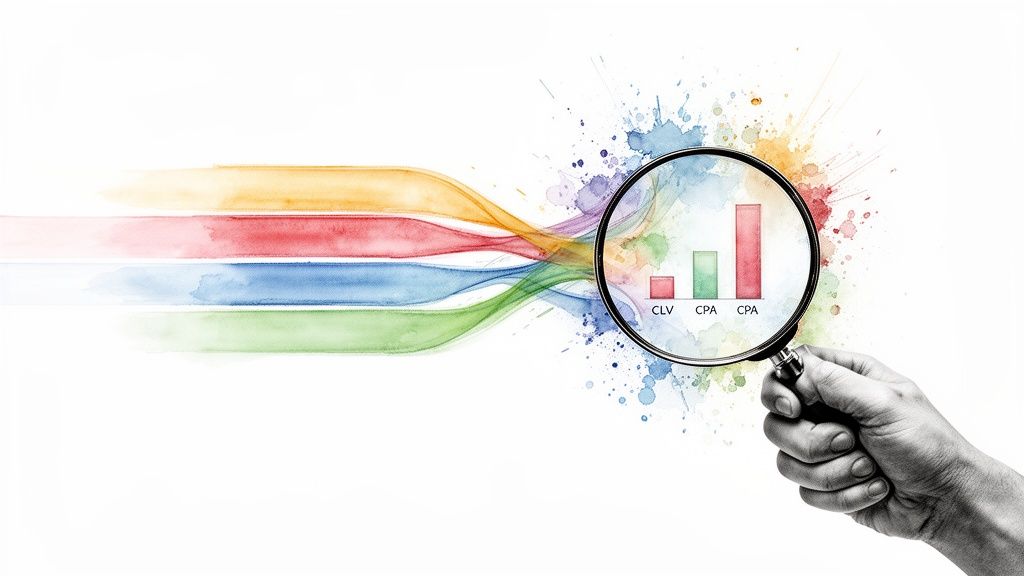
Hand analyzing marketing metrics (CLV, CPA) in a bar chart with a magnifying glass, fed by colorful streams.

If you’ve tried to prove the ROI of a marketing campaign, you know the feeling. You’re staring at a dozen reports, trying to stitch together a story that makes sense. This is the single biggest challenge in any cross‑channel marketing strategy. For years, we’ve leaned on last-click attribution, a model that gives 100% of the credit to the final touchpoint. It’s simple, but dangerously incomplete.

Relying on last-click is like giving a film's director all the credit for a movie while ignoring the writers and actors. A customer might see a social ad, read a blog post, and get a retargeting email before clicking a search ad to buy. Last-click ignores the first three interactions, tricking you into undervaluing the channels that build trust.

Moving Beyond Flawed Metrics

To get a true picture, you have to move to multi-touch attribution. This distributes credit across the different touchpoints that influence a conversion, giving you a far more honest look at what’s driving growth.

Of course, this is only possible if you have a unified view of your data. You can't track a complete journey when your data lives in walled-off platforms. This is why a Conversational AI Data Analyst like Statspresso exists—to break down those walls and let you see the whole picture.

It’s also about focusing on the right KPIs, not vanity metrics:

  • Customer Lifetime Value (CLV) by Channel: Which channels bring in customers who stick around and spend more?

  • Cost Per Acquisition (CPA) by Journey: What does it really cost to acquire a customer when you factor in every touchpoint?

  • Channel-Assist Metrics: How often did your email campaign "assist" a conversion that was credited to paid search?

Answering these questions used to involve a data team and weeks of waiting. Now, you can just ask.

Try asking Statspresso: "Show me the top 5 customer paths that lead to a purchase, and which channels appear most often."

The Old Way vs. The New Way

The difference between wrestling with siloed data and getting immediate answers is night and day. According to Listrak's 2026 Cross-Channel Benchmark Report, which analyzed 130 billion messages, brands that coordinate channels see much higher engagement. Yet, 40% of marketers still say proving cross-channel ROI is their biggest challenge. You can discover more insights from the 2026 report here.

This struggle is what modern analytics tools solve.

Task

The Old Way (Manual SQL)

The New Way (Statspresso)

Measuring CLV by Channel

Export data from 3+ systems, write complex SQL joins, and wait for a dashboard to be built.

Ask: "What's our customer lifetime value broken down by the first channel they came from?"

Understanding Journeys

Manually trace user paths in spreadsheets—a slow, error-prone process.

Ask: "Show me a funnel of users who visited the blog, then got an email, then purchased."

Calculating True CPA

Try to stitch together ad spend from different platforms with sales data, getting inaccurate results.

Get an instant, unified view of CPA across all your marketing efforts.

This isn't just about a faster workflow; it's about gaining the clarity needed to make smarter, quicker decisions. When you can connect the customer journey, you stop guessing and start investing. This is what collaborative business intelligence brings to modern teams. You skip the SQL and get a chart in seconds, turning measurement from a roadblock into a strategic advantage.

Common Cross-Channel Marketing Pitfalls to Avoid

A great cross-channel marketing strategy isn't just about what you do—it's also about what you don't do. It's easy to fall into common traps that waste your budget and damage the trust you’re trying to build.

Let's walk through the three most common mistakes and how to sidestep them.

Pitfall 1: Technology Overload

This is painfully familiar. In an effort to cover all bases, teams end up with a messy pile of disconnected tools—one for email, another for social, a third for SMS. Each platform operates in its own world, creating a fragmented mess.

  • What it looks like: Your team spends more time exporting CSV files and stitching data together than analyzing performance. The email team has no idea what the mobile team just sent, leading to conflicting messages.

  • How to fix it: The solution isn't another shiny tool. It’s about choosing platforms that unify your data. To get a single, coherent view of the customer journey, consider tools like Customer Data Platforms (CDPs). The goal is one source of truth, not a dozen apps that don't talk to each other.

Pitfall 2: Data Paralysis

This is the flip side of the coin. You have all your data in one place, but you're drowning in it. You have endless dashboards but can’t get a simple answer to a basic business question.

  • What it looks like: Someone spent six weeks building a beautiful, complex dashboard, but nobody knows what to do with it. When a manager asks, "Did our last campaign actually make money?" all they get are blank stares.

  • How to fix it: You don't need another dashboard; you need faster answers. This is why we built Statspresso, a Conversational AI Data Analyst. You can skip the SQL and get a chart in seconds, turning a mountain of data into a single, actionable insight.

Try asking Statspresso: "Which marketing channels are underperforming on conversion rate this quarter?"

This direct approach cuts through the complexity and empowers your team to act instead of getting stuck in an endless cycle of analysis.

Pitfall 3: Inconsistent Messaging

This pitfall is a direct symptom of the first two. When your tech is a patchwork and your data is siloed, your messaging becomes a chaotic mess. It’s how one channel offers a 50% discount while another promotes a full-price item to the same customer.

  • What it looks like: A loyal customer who just bought something at full price gets hit with a retargeting ad for the same item. Even worse, they get an email with a "new customer" discount code. This isn't just sloppy—it erodes brand trust.

  • How to fix it: Unify your customer view to orchestrate your campaigns properly. When you map the entire customer journey with a single data source, your messaging will always be relevant and timely. A customer's interaction on one channel should immediately inform the communication they see on the next.

Your Cross-Channel Marketing Questions, Answered

Getting started with cross-channel marketing always brings up a few key questions. We hear these from founders and marketers all the time, so let's clear them up with straightforward answers.

How Do I Start Cross-Channel Marketing With a Small Team and Budget?

The biggest mistake is trying to be everywhere at once. The goal isn’t to conquer every platform; it's to make a couple of key channels work together seamlessly.

Start by figuring out where your customers spend their time. For most, this is email and one social platform, like Instagram or LinkedIn. Focus on creating one simple, connected experience. For example, run a social campaign that drives email sign-ups, then follow up with a welcome sequence. Prove a single connected journey works before adding more layers. You don't need a dozen new tools—just connect your highest-impact channels first.

What Is the Difference Between Cross-Channel and Omnichannel Marketing?

Think about scope. Cross-channel marketing connects a few channels to guide a customer through a specific campaign. A user sees your social ad, clicks to your site, and gets a follow-up email. You’re making those specific touchpoints talk to each other.

Omnichannel marketing is the grand vision. It’s about creating one unified experience across every single interaction—your website, mobile app, in-store visits, and customer support calls. Think of cross-channel as a practical, powerful first step. Omnichannel is the ultimate goal where everything is perfectly in sync.

How Can AI Help Analyze My Cross-Channel Data?

This is the secret to making sense of your data without hiring a data science team. Waiting weeks for an analyst to build a report doesn't cut it anymore. AI gives you answers now.

A Conversational AI Data Analyst like Statspresso plugs into all your marketing tools (Shopify, Google Ads, HubSpot, you name it) and lets you get insights in seconds. Instead of getting tangled up in spreadsheets or writing SQL, you just ask a question in plain English. This is how you find out what’s actually driving results.

Try asking Statspresso: "What is our customer acquisition cost by channel for the last 90 days?"

Just like that, you get a clear chart with your answer. You skip the SQL and get the clarity to make smarter budget decisions on the fly. It turns data analysis from a painful bottleneck into a quick, daily habit.

Ready to stop guessing and start knowing what’s working? With Statspresso, your Conversational AI Data Analyst, you can connect your data sources for free and get answers in seconds.

Connect your first data source for free and ask your first question.

Your customers see one brand. Your marketing teams, however, often operate in different solar systems. Social media, email, and advertising efforts aren't talking to each other, creating a disjointed experience that wastes your budget. Waiting weeks for a data analyst to build a dashboard is a relic of the past. A successful cross channel marketing strategy isn’t about being everywhere; it's about making every channel work together as a single, cohesive unit.

TL;DR: Your Key Takeaways

  • Cross-Channel vs. Multichannel: Multichannel is just being on many platforms. Cross-channel is making them work together to create one seamless customer journey.

  • Data is Everything: You can't orchestrate a strategy without a unified view of your data. Siloed analytics lead to wasted ad spend and confused customers.

  • Ask, Don't Analyze: The fastest way to get insights is to ask your data a direct question. A tool like Statspresso, a Conversational AI Data Analyst, lets you skip the SQL and get a chart in seconds.

  • Start Small, Connect Deep: You don't need to be on every channel. Pick two high-impact channels (like email and social) and make them work together perfectly first.

  • Measure What Matters: Ditch last-click attribution. Focus on metrics like Customer Lifetime Value (CLV) and multi-touch attribution to see what's really driving growth.

Your Marketing Is Disconnected And It’s Costing You

Digital illustration showing men in cubicles, representing evolving strategies from single to cross-channel marketing.

Think about this. A customer adds items to their cart but leaves. Your social media team serves them a perfect retargeting ad. So far, so good. But then, your email team blasts out a generic weekly newsletter. The seamless journey just shattered.

This isn't a rare mishap. It's the daily reality for countless businesses. Your marketing is loud, but it isn't in sync. Each channel is its own tiny kingdom with separate goals, siloed data, and no shared script. The result is a chaotic customer experience and a gaping hole where your marketing ROI should be.

The Old Way Is Broken

For years, the "solution" was to dump all your channel data into a spreadsheet and hand it to a data analyst. Weeks later, you’d get a report that was already out of date. This manual, reactive process is a relic.

Waiting for an analyst to stitch together channel data is like navigating a highway by looking in the rearview mirror. You see where you’ve been, but you have no idea where you’re going.

This legacy approach to marketing analytics is painfully slow and surprisingly expensive. It fails to provide the real-time insights you need to make smart decisions. You can't orchestrate a cohesive cross channel marketing campaign when you're looking at data that's weeks old.

The Shift to Intelligent Orchestration

The good news? There's a much smarter way to operate. Instead of just adding more channels (multichannel), the goal is to integrate them. This is the heart of a modern cross channel marketing strategy—turning a bunch of separate instruments into a symphony.

To do this, you need a single, unified view of your data. You have to know which touchpoints drive conversions and which ones are just noise. This is where a Conversational AI Data Analyst like Statspresso changes the game. Forget wrestling with complex BI tools or writing SQL queries.

Instead, just ask a direct question.

  • Try asking Statspresso: "Which marketing channel had the highest conversion rate last month?"

A simple query like this cuts through the noise. It lets you skip the SQL and get a chart in seconds, turning a mess of disconnected data into a clear, actionable answer. This is how you move from fragmented efforts to a unified strategy that grows your business.

Cross Channel vs. Multichannel Marketing Explained

You’ve heard "multichannel" and "cross-channel" thrown around like they’re the same thing. They’re not. While both use more than one platform, the underlying strategy is worlds apart. Getting this right is the first step toward building a marketing engine that connects with people.

Multichannel marketing is just about being present. You have an email list, a Facebook page, and a blog. The problem is, they act like separate businesses that have never met. Each channel team chases its own goals, creating a disjointed experience for the very people you're trying to reach.

Ever bought new shoes at full price, only to get an email the next day offering a 20% discount on that exact pair? That’s a classic multichannel fumble. It’s a clear signal your marketing channels aren't communicating.

The Shift to a Unified Customer View

Cross-channel marketing, on the other hand, is about orchestration. It makes those separate channels work in concert to create one seamless customer journey. Think of it less like a bunch of solo acts and more like a symphony. The focus shifts from the channel to the customer moving between them.

A great cross-channel experience feels effortless. A potential customer sees a targeted ad on Instagram, clicks to a landing page, and later gets a follow-up email referencing their interest. Each step feels like a natural continuation, guiding them smoothly toward a purchase. This approach understands that people don't live in marketing silos; they float between apps, email, and websites.

The goal isn't just to be on multiple channels. It's to make the entire experience feel like a single, intelligent conversation.

To pull this off, you need to see the whole picture. You can't conduct a symphony if you can only see one musician's sheet music. Teams get stuck here, swimming in data from different sources but unable to piece it together. Instead of spending days manually stitching reports, a tool like Statspresso, your Conversational AI Data Analyst, gives you that unified view in seconds.

  • Try asking Statspresso: "Show me the customer journey for users who converted from our latest email campaign, broken down by their previous touchpoints."

A simple question like that gives you the insight needed to see how your channels are really working together. You skip the SQL and get a chart in seconds, turning a mess of data points into a clear map of your customer's path.

Multichannel vs. Cross-Channel: The Key Differences

Let's put these two approaches side-by-side. This table highlights the strategic shift from a channel-first mindset to a customer-first one.

Attribute

Multichannel Marketing (The Old Way)

Cross Channel Marketing (The Smart Way)

Strategy Focus

Channel-centric; optimizing each platform independently.

Customer-centric; creating a single, unified journey.

Customer Experience

Disjointed and often repetitive or contradictory.

Seamless, contextual, and consistent across all touchpoints.

Data & Analytics

Siloed by channel; impossible to see the full picture.

Unified and integrated; provides a complete view of the customer.

Primary Goal

Maximize reach by being on many channels.

Deepen engagement and increase conversions through orchestration.

Ultimately, one is a collection of siloed tactics, while the other is a cohesive strategy built entirely around the customer's real-world behavior.

How To Build Your Cross Channel Marketing Strategy

A powerful cross-channel marketing strategy isn't built by accident. It comes down to three core steps: unifying your customer data, mapping the real customer journey, and orchestrating how your channels communicate. Nail these, and you’ll go from making noise to creating a genuine symphony for your customers.

It starts with your data. Your Shopify data probably doesn’t talk to your HubSpot data, and neither connects to your Postgres database. This creates a fractured view of your customer. The goal is to bring every touchpoint together into a single, reliable source of truth.

This is where most teams get overwhelmed, imagining a massive, expensive data engineering project. It doesn't have to be that complicated. A Conversational AI Data Analyst like Statspresso connects directly to these different sources, pulling everything into one place without you writing a single line of SQL.

The difference between a siloed approach and a connected one is night and day.

A diagram comparing multichannel and cross-channel process flows, showing silos leading to confusion versus symphony leading to harmony.

When your channels don't talk, you get customer confusion. When they work together, you get harmony and a much better experience.

Map the Actual Customer Journey

Once your data is in one place, you can finally map the customer journey. I’m not talking about a neat funnel you draw on a whiteboard. I mean digging into your unified data to uncover the real, messy paths your customers actually take.

  • Identify Key Touchpoints: Which emails, ads, or blog posts do people consistently engage with before they buy?

  • Find Friction Points: Where are people dropping off? Is it a clunky checkout page or a poorly timed SMS notification?

  • Discover Winning Paths: What specific sequence of interactions produces your most valuable customers?

Trying to piece this together manually is a nightmare of spreadsheets and VLOOKUPs. A smarter way is to simply ask your data.

Try asking Statspresso: "Which marketing channel has the highest customer lifetime value for users acquired last quarter?"

A question like this cuts through the noise to give you an answer you can act on. You skip the SQL and get a chart in seconds, showing you which channels aren't just driving clicks, but creating long-term value.

Orchestrate Your Channel Communication

With a clear journey map, you can orchestrate your communication. Now, you can sequence your messaging to tell a cohesive story. Your social media and email teams are no longer operating in their own worlds; their efforts become part of a coordinated plan.

This is how you ensure the ad a user sees on Facebook is directly related to the email they get the next day. This level of coordination builds trust and makes the customer feel understood.

The need for this is urgent. With the digital ad market projected to hit $786.2 billion globally by 2026, the pressure is on for the 88% of consumer marketers who know they need to radically improve customer engagement. As you plan, looking into advanced tools like dedicated cross-channel AI marketing solutions can give you a serious edge. This connected approach is why cross-channel planning drives better results. You can read more about these 2026 marketing strategy trends to see where things are headed.

Ultimately, a great strategy isn't about having more data. It's about getting faster, clearer answers.

How To Weave Your Key Channels Together

Moving from theory to practice is where the real work begins. A winning strategy is about making specific channels like email, social media, and your blog work in concert. Instead of treating each as its own island, build bridges so the customer’s journey feels seamless.

Think of it this way: your social campaigns shouldn't just exist for likes. They should be a primary engine for growing your email list. That list, in turn, is a tool for nurturing leads with valuable content that also happens to rank on Google.

When every channel supports and amplifies the others, you've moved beyond random tactics and created an effective marketing engine.

Start With Your Powerhouse Email

For all the buzz around new platforms, email continues to deliver unmatched ROI. It’s the reliable hub that connects all your other marketing spokes. But simply having an email list isn't the goal—its value comes alive when it’s intelligently fed by your other channels.

Email’s dominance in a cross-channel strategy is hard to overstate. It generates an incredible $36 in revenue for every $1 spent. With 4.37 billion people sending 347.3 billion emails daily in 2024, its reach is immense. The data also confirms that cross-channel email campaigns outperform standalone efforts by 22% in revenue per recipient. We see this synergy when emails preceded by social media exposure get 37% higher click-throughs. You can explore more of these digital marketing statistics to see the full picture.

The goal is to use other channels to make your email marketing smarter. Here’s how:

  1. Paid Social: Run a targeted Facebook ad promoting a high-value guide. The call to action is "Download the Guide," which requires an email address.

  2. Email Automation: The moment someone signs up, they enter a welcome sequence. The first email delivers the guide. The next few offer related content, like a case study or a blog post.

  3. Content & SEO: That blog post is optimized for search engines, attracting its own organic traffic and including calls-to-action to subscribe, creating a self-perpetuating cycle.

This isn’t a list of separate tasks; it's a single, orchestrated journey.

Prioritize Channels with Data Not Hype

So, which channels deserve your focus? The answer isn't chasing trends—it’s hidden in your data. You need to know which channels deliver results, not just attention. This is where most teams hit a wall, drowning in disconnected analytics from Google Ads, Facebook, and their email platform.

Trying to piece together performance insights manually is a slow, error-prone process. By the time an analyst pulls a report, the opportunity is gone. This is the exact problem Statspresso, your Conversational AI Data Analyst, was built to solve.

Try asking Statspresso: "Compare conversion rates from our Facebook ads vs. our Google ads last month as a bar chart."

A simple question gives you an instant, visual answer. You skip the SQL and get a chart in seconds, empowering you to double down on what’s working and cut what isn’t. This turns data-driven decisions into a simple daily habit, not a dreaded quarterly review.

Unifying Your Analytics to Measure Success

Hand analyzing marketing metrics (CLV, CPA) in a bar chart with a magnifying glass, fed by colorful streams.

If you’ve tried to prove the ROI of a marketing campaign, you know the feeling. You’re staring at a dozen reports, trying to stitch together a story that makes sense. This is the single biggest challenge in any cross‑channel marketing strategy. For years, we’ve leaned on last-click attribution, a model that gives 100% of the credit to the final touchpoint. It’s simple, but dangerously incomplete.

Relying on last-click is like giving a film's director all the credit for a movie while ignoring the writers and actors. A customer might see a social ad, read a blog post, and get a retargeting email before clicking a search ad to buy. Last-click ignores the first three interactions, tricking you into undervaluing the channels that build trust.

Moving Beyond Flawed Metrics

To get a true picture, you have to move to multi-touch attribution. This distributes credit across the different touchpoints that influence a conversion, giving you a far more honest look at what’s driving growth.

Of course, this is only possible if you have a unified view of your data. You can't track a complete journey when your data lives in walled-off platforms. This is why a Conversational AI Data Analyst like Statspresso exists—to break down those walls and let you see the whole picture.

It’s also about focusing on the right KPIs, not vanity metrics:

  • Customer Lifetime Value (CLV) by Channel: Which channels bring in customers who stick around and spend more?

  • Cost Per Acquisition (CPA) by Journey: What does it really cost to acquire a customer when you factor in every touchpoint?

  • Channel-Assist Metrics: How often did your email campaign "assist" a conversion that was credited to paid search?

Answering these questions used to involve a data team and weeks of waiting. Now, you can just ask.

Try asking Statspresso: "Show me the top 5 customer paths that lead to a purchase, and which channels appear most often."

The Old Way vs. The New Way

The difference between wrestling with siloed data and getting immediate answers is night and day. According to Listrak's 2026 Cross-Channel Benchmark Report, which analyzed 130 billion messages, brands that coordinate channels see much higher engagement. Yet, 40% of marketers still say proving cross-channel ROI is their biggest challenge. You can discover more insights from the 2026 report here.

This struggle is what modern analytics tools solve.

Task

The Old Way (Manual SQL)

The New Way (Statspresso)

Measuring CLV by Channel

Export data from 3+ systems, write complex SQL joins, and wait for a dashboard to be built.

Ask: "What's our customer lifetime value broken down by the first channel they came from?"

Understanding Journeys

Manually trace user paths in spreadsheets—a slow, error-prone process.

Ask: "Show me a funnel of users who visited the blog, then got an email, then purchased."

Calculating True CPA

Try to stitch together ad spend from different platforms with sales data, getting inaccurate results.

Get an instant, unified view of CPA across all your marketing efforts.

This isn't just about a faster workflow; it's about gaining the clarity needed to make smarter, quicker decisions. When you can connect the customer journey, you stop guessing and start investing. This is what collaborative business intelligence brings to modern teams. You skip the SQL and get a chart in seconds, turning measurement from a roadblock into a strategic advantage.

Common Cross-Channel Marketing Pitfalls to Avoid

A great cross-channel marketing strategy isn't just about what you do—it's also about what you don't do. It's easy to fall into common traps that waste your budget and damage the trust you’re trying to build.

Let's walk through the three most common mistakes and how to sidestep them.

Pitfall 1: Technology Overload

This is painfully familiar. In an effort to cover all bases, teams end up with a messy pile of disconnected tools—one for email, another for social, a third for SMS. Each platform operates in its own world, creating a fragmented mess.

  • What it looks like: Your team spends more time exporting CSV files and stitching data together than analyzing performance. The email team has no idea what the mobile team just sent, leading to conflicting messages.

  • How to fix it: The solution isn't another shiny tool. It’s about choosing platforms that unify your data. To get a single, coherent view of the customer journey, consider tools like Customer Data Platforms (CDPs). The goal is one source of truth, not a dozen apps that don't talk to each other.

Pitfall 2: Data Paralysis

This is the flip side of the coin. You have all your data in one place, but you're drowning in it. You have endless dashboards but can’t get a simple answer to a basic business question.

  • What it looks like: Someone spent six weeks building a beautiful, complex dashboard, but nobody knows what to do with it. When a manager asks, "Did our last campaign actually make money?" all they get are blank stares.

  • How to fix it: You don't need another dashboard; you need faster answers. This is why we built Statspresso, a Conversational AI Data Analyst. You can skip the SQL and get a chart in seconds, turning a mountain of data into a single, actionable insight.

Try asking Statspresso: "Which marketing channels are underperforming on conversion rate this quarter?"

This direct approach cuts through the complexity and empowers your team to act instead of getting stuck in an endless cycle of analysis.

Pitfall 3: Inconsistent Messaging

This pitfall is a direct symptom of the first two. When your tech is a patchwork and your data is siloed, your messaging becomes a chaotic mess. It’s how one channel offers a 50% discount while another promotes a full-price item to the same customer.

  • What it looks like: A loyal customer who just bought something at full price gets hit with a retargeting ad for the same item. Even worse, they get an email with a "new customer" discount code. This isn't just sloppy—it erodes brand trust.

  • How to fix it: Unify your customer view to orchestrate your campaigns properly. When you map the entire customer journey with a single data source, your messaging will always be relevant and timely. A customer's interaction on one channel should immediately inform the communication they see on the next.

Your Cross-Channel Marketing Questions, Answered

Getting started with cross-channel marketing always brings up a few key questions. We hear these from founders and marketers all the time, so let's clear them up with straightforward answers.

How Do I Start Cross-Channel Marketing With a Small Team and Budget?

The biggest mistake is trying to be everywhere at once. The goal isn’t to conquer every platform; it's to make a couple of key channels work together seamlessly.

Start by figuring out where your customers spend their time. For most, this is email and one social platform, like Instagram or LinkedIn. Focus on creating one simple, connected experience. For example, run a social campaign that drives email sign-ups, then follow up with a welcome sequence. Prove a single connected journey works before adding more layers. You don't need a dozen new tools—just connect your highest-impact channels first.

What Is the Difference Between Cross-Channel and Omnichannel Marketing?

Think about scope. Cross-channel marketing connects a few channels to guide a customer through a specific campaign. A user sees your social ad, clicks to your site, and gets a follow-up email. You’re making those specific touchpoints talk to each other.

Omnichannel marketing is the grand vision. It’s about creating one unified experience across every single interaction—your website, mobile app, in-store visits, and customer support calls. Think of cross-channel as a practical, powerful first step. Omnichannel is the ultimate goal where everything is perfectly in sync.

How Can AI Help Analyze My Cross-Channel Data?

This is the secret to making sense of your data without hiring a data science team. Waiting weeks for an analyst to build a report doesn't cut it anymore. AI gives you answers now.

A Conversational AI Data Analyst like Statspresso plugs into all your marketing tools (Shopify, Google Ads, HubSpot, you name it) and lets you get insights in seconds. Instead of getting tangled up in spreadsheets or writing SQL, you just ask a question in plain English. This is how you find out what’s actually driving results.

Try asking Statspresso: "What is our customer acquisition cost by channel for the last 90 days?"

Just like that, you get a clear chart with your answer. You skip the SQL and get the clarity to make smarter budget decisions on the fly. It turns data analysis from a painful bottleneck into a quick, daily habit.

Ready to stop guessing and start knowing what’s working? With Statspresso, your Conversational AI Data Analyst, you can connect your data sources for free and get answers in seconds.

Connect your first data source for free and ask your first question.

Your customers see one brand. Your marketing teams, however, often operate in different solar systems. Social media, email, and advertising efforts aren't talking to each other, creating a disjointed experience that wastes your budget. Waiting weeks for a data analyst to build a dashboard is a relic of the past. A successful cross channel marketing strategy isn’t about being everywhere; it's about making every channel work together as a single, cohesive unit.

TL;DR: Your Key Takeaways

  • Cross-Channel vs. Multichannel: Multichannel is just being on many platforms. Cross-channel is making them work together to create one seamless customer journey.

  • Data is Everything: You can't orchestrate a strategy without a unified view of your data. Siloed analytics lead to wasted ad spend and confused customers.

  • Ask, Don't Analyze: The fastest way to get insights is to ask your data a direct question. A tool like Statspresso, a Conversational AI Data Analyst, lets you skip the SQL and get a chart in seconds.

  • Start Small, Connect Deep: You don't need to be on every channel. Pick two high-impact channels (like email and social) and make them work together perfectly first.

  • Measure What Matters: Ditch last-click attribution. Focus on metrics like Customer Lifetime Value (CLV) and multi-touch attribution to see what's really driving growth.

Your Marketing Is Disconnected And It’s Costing You

Digital illustration showing men in cubicles, representing evolving strategies from single to cross-channel marketing.

Think about this. A customer adds items to their cart but leaves. Your social media team serves them a perfect retargeting ad. So far, so good. But then, your email team blasts out a generic weekly newsletter. The seamless journey just shattered.

This isn't a rare mishap. It's the daily reality for countless businesses. Your marketing is loud, but it isn't in sync. Each channel is its own tiny kingdom with separate goals, siloed data, and no shared script. The result is a chaotic customer experience and a gaping hole where your marketing ROI should be.

The Old Way Is Broken

For years, the "solution" was to dump all your channel data into a spreadsheet and hand it to a data analyst. Weeks later, you’d get a report that was already out of date. This manual, reactive process is a relic.

Waiting for an analyst to stitch together channel data is like navigating a highway by looking in the rearview mirror. You see where you’ve been, but you have no idea where you’re going.

This legacy approach to marketing analytics is painfully slow and surprisingly expensive. It fails to provide the real-time insights you need to make smart decisions. You can't orchestrate a cohesive cross channel marketing campaign when you're looking at data that's weeks old.

The Shift to Intelligent Orchestration

The good news? There's a much smarter way to operate. Instead of just adding more channels (multichannel), the goal is to integrate them. This is the heart of a modern cross channel marketing strategy—turning a bunch of separate instruments into a symphony.

To do this, you need a single, unified view of your data. You have to know which touchpoints drive conversions and which ones are just noise. This is where a Conversational AI Data Analyst like Statspresso changes the game. Forget wrestling with complex BI tools or writing SQL queries.

Instead, just ask a direct question.

  • Try asking Statspresso: "Which marketing channel had the highest conversion rate last month?"

A simple query like this cuts through the noise. It lets you skip the SQL and get a chart in seconds, turning a mess of disconnected data into a clear, actionable answer. This is how you move from fragmented efforts to a unified strategy that grows your business.

Cross Channel vs. Multichannel Marketing Explained

You’ve heard "multichannel" and "cross-channel" thrown around like they’re the same thing. They’re not. While both use more than one platform, the underlying strategy is worlds apart. Getting this right is the first step toward building a marketing engine that connects with people.

Multichannel marketing is just about being present. You have an email list, a Facebook page, and a blog. The problem is, they act like separate businesses that have never met. Each channel team chases its own goals, creating a disjointed experience for the very people you're trying to reach.

Ever bought new shoes at full price, only to get an email the next day offering a 20% discount on that exact pair? That’s a classic multichannel fumble. It’s a clear signal your marketing channels aren't communicating.

The Shift to a Unified Customer View

Cross-channel marketing, on the other hand, is about orchestration. It makes those separate channels work in concert to create one seamless customer journey. Think of it less like a bunch of solo acts and more like a symphony. The focus shifts from the channel to the customer moving between them.

A great cross-channel experience feels effortless. A potential customer sees a targeted ad on Instagram, clicks to a landing page, and later gets a follow-up email referencing their interest. Each step feels like a natural continuation, guiding them smoothly toward a purchase. This approach understands that people don't live in marketing silos; they float between apps, email, and websites.

The goal isn't just to be on multiple channels. It's to make the entire experience feel like a single, intelligent conversation.

To pull this off, you need to see the whole picture. You can't conduct a symphony if you can only see one musician's sheet music. Teams get stuck here, swimming in data from different sources but unable to piece it together. Instead of spending days manually stitching reports, a tool like Statspresso, your Conversational AI Data Analyst, gives you that unified view in seconds.

  • Try asking Statspresso: "Show me the customer journey for users who converted from our latest email campaign, broken down by their previous touchpoints."

A simple question like that gives you the insight needed to see how your channels are really working together. You skip the SQL and get a chart in seconds, turning a mess of data points into a clear map of your customer's path.

Multichannel vs. Cross-Channel: The Key Differences

Let's put these two approaches side-by-side. This table highlights the strategic shift from a channel-first mindset to a customer-first one.

Attribute

Multichannel Marketing (The Old Way)

Cross Channel Marketing (The Smart Way)

Strategy Focus

Channel-centric; optimizing each platform independently.

Customer-centric; creating a single, unified journey.

Customer Experience

Disjointed and often repetitive or contradictory.

Seamless, contextual, and consistent across all touchpoints.

Data & Analytics

Siloed by channel; impossible to see the full picture.

Unified and integrated; provides a complete view of the customer.

Primary Goal

Maximize reach by being on many channels.

Deepen engagement and increase conversions through orchestration.

Ultimately, one is a collection of siloed tactics, while the other is a cohesive strategy built entirely around the customer's real-world behavior.

How To Build Your Cross Channel Marketing Strategy

A powerful cross-channel marketing strategy isn't built by accident. It comes down to three core steps: unifying your customer data, mapping the real customer journey, and orchestrating how your channels communicate. Nail these, and you’ll go from making noise to creating a genuine symphony for your customers.

It starts with your data. Your Shopify data probably doesn’t talk to your HubSpot data, and neither connects to your Postgres database. This creates a fractured view of your customer. The goal is to bring every touchpoint together into a single, reliable source of truth.

This is where most teams get overwhelmed, imagining a massive, expensive data engineering project. It doesn't have to be that complicated. A Conversational AI Data Analyst like Statspresso connects directly to these different sources, pulling everything into one place without you writing a single line of SQL.

The difference between a siloed approach and a connected one is night and day.

A diagram comparing multichannel and cross-channel process flows, showing silos leading to confusion versus symphony leading to harmony.

When your channels don't talk, you get customer confusion. When they work together, you get harmony and a much better experience.

Map the Actual Customer Journey

Once your data is in one place, you can finally map the customer journey. I’m not talking about a neat funnel you draw on a whiteboard. I mean digging into your unified data to uncover the real, messy paths your customers actually take.

  • Identify Key Touchpoints: Which emails, ads, or blog posts do people consistently engage with before they buy?

  • Find Friction Points: Where are people dropping off? Is it a clunky checkout page or a poorly timed SMS notification?

  • Discover Winning Paths: What specific sequence of interactions produces your most valuable customers?

Trying to piece this together manually is a nightmare of spreadsheets and VLOOKUPs. A smarter way is to simply ask your data.

Try asking Statspresso: "Which marketing channel has the highest customer lifetime value for users acquired last quarter?"

A question like this cuts through the noise to give you an answer you can act on. You skip the SQL and get a chart in seconds, showing you which channels aren't just driving clicks, but creating long-term value.

Orchestrate Your Channel Communication

With a clear journey map, you can orchestrate your communication. Now, you can sequence your messaging to tell a cohesive story. Your social media and email teams are no longer operating in their own worlds; their efforts become part of a coordinated plan.

This is how you ensure the ad a user sees on Facebook is directly related to the email they get the next day. This level of coordination builds trust and makes the customer feel understood.

The need for this is urgent. With the digital ad market projected to hit $786.2 billion globally by 2026, the pressure is on for the 88% of consumer marketers who know they need to radically improve customer engagement. As you plan, looking into advanced tools like dedicated cross-channel AI marketing solutions can give you a serious edge. This connected approach is why cross-channel planning drives better results. You can read more about these 2026 marketing strategy trends to see where things are headed.

Ultimately, a great strategy isn't about having more data. It's about getting faster, clearer answers.

How To Weave Your Key Channels Together

Moving from theory to practice is where the real work begins. A winning strategy is about making specific channels like email, social media, and your blog work in concert. Instead of treating each as its own island, build bridges so the customer’s journey feels seamless.

Think of it this way: your social campaigns shouldn't just exist for likes. They should be a primary engine for growing your email list. That list, in turn, is a tool for nurturing leads with valuable content that also happens to rank on Google.

When every channel supports and amplifies the others, you've moved beyond random tactics and created an effective marketing engine.

Start With Your Powerhouse Email

For all the buzz around new platforms, email continues to deliver unmatched ROI. It’s the reliable hub that connects all your other marketing spokes. But simply having an email list isn't the goal—its value comes alive when it’s intelligently fed by your other channels.

Email’s dominance in a cross-channel strategy is hard to overstate. It generates an incredible $36 in revenue for every $1 spent. With 4.37 billion people sending 347.3 billion emails daily in 2024, its reach is immense. The data also confirms that cross-channel email campaigns outperform standalone efforts by 22% in revenue per recipient. We see this synergy when emails preceded by social media exposure get 37% higher click-throughs. You can explore more of these digital marketing statistics to see the full picture.

The goal is to use other channels to make your email marketing smarter. Here’s how:

  1. Paid Social: Run a targeted Facebook ad promoting a high-value guide. The call to action is "Download the Guide," which requires an email address.

  2. Email Automation: The moment someone signs up, they enter a welcome sequence. The first email delivers the guide. The next few offer related content, like a case study or a blog post.

  3. Content & SEO: That blog post is optimized for search engines, attracting its own organic traffic and including calls-to-action to subscribe, creating a self-perpetuating cycle.

This isn’t a list of separate tasks; it's a single, orchestrated journey.

Prioritize Channels with Data Not Hype

So, which channels deserve your focus? The answer isn't chasing trends—it’s hidden in your data. You need to know which channels deliver results, not just attention. This is where most teams hit a wall, drowning in disconnected analytics from Google Ads, Facebook, and their email platform.

Trying to piece together performance insights manually is a slow, error-prone process. By the time an analyst pulls a report, the opportunity is gone. This is the exact problem Statspresso, your Conversational AI Data Analyst, was built to solve.

Try asking Statspresso: "Compare conversion rates from our Facebook ads vs. our Google ads last month as a bar chart."

A simple question gives you an instant, visual answer. You skip the SQL and get a chart in seconds, empowering you to double down on what’s working and cut what isn’t. This turns data-driven decisions into a simple daily habit, not a dreaded quarterly review.

Unifying Your Analytics to Measure Success

Hand analyzing marketing metrics (CLV, CPA) in a bar chart with a magnifying glass, fed by colorful streams.

If you’ve tried to prove the ROI of a marketing campaign, you know the feeling. You’re staring at a dozen reports, trying to stitch together a story that makes sense. This is the single biggest challenge in any cross‑channel marketing strategy. For years, we’ve leaned on last-click attribution, a model that gives 100% of the credit to the final touchpoint. It’s simple, but dangerously incomplete.

Relying on last-click is like giving a film's director all the credit for a movie while ignoring the writers and actors. A customer might see a social ad, read a blog post, and get a retargeting email before clicking a search ad to buy. Last-click ignores the first three interactions, tricking you into undervaluing the channels that build trust.

Moving Beyond Flawed Metrics

To get a true picture, you have to move to multi-touch attribution. This distributes credit across the different touchpoints that influence a conversion, giving you a far more honest look at what’s driving growth.

Of course, this is only possible if you have a unified view of your data. You can't track a complete journey when your data lives in walled-off platforms. This is why a Conversational AI Data Analyst like Statspresso exists—to break down those walls and let you see the whole picture.

It’s also about focusing on the right KPIs, not vanity metrics:

  • Customer Lifetime Value (CLV) by Channel: Which channels bring in customers who stick around and spend more?

  • Cost Per Acquisition (CPA) by Journey: What does it really cost to acquire a customer when you factor in every touchpoint?

  • Channel-Assist Metrics: How often did your email campaign "assist" a conversion that was credited to paid search?

Answering these questions used to involve a data team and weeks of waiting. Now, you can just ask.

Try asking Statspresso: "Show me the top 5 customer paths that lead to a purchase, and which channels appear most often."

The Old Way vs. The New Way

The difference between wrestling with siloed data and getting immediate answers is night and day. According to Listrak's 2026 Cross-Channel Benchmark Report, which analyzed 130 billion messages, brands that coordinate channels see much higher engagement. Yet, 40% of marketers still say proving cross-channel ROI is their biggest challenge. You can discover more insights from the 2026 report here.

This struggle is what modern analytics tools solve.

Task

The Old Way (Manual SQL)

The New Way (Statspresso)

Measuring CLV by Channel

Export data from 3+ systems, write complex SQL joins, and wait for a dashboard to be built.

Ask: "What's our customer lifetime value broken down by the first channel they came from?"

Understanding Journeys

Manually trace user paths in spreadsheets—a slow, error-prone process.

Ask: "Show me a funnel of users who visited the blog, then got an email, then purchased."

Calculating True CPA

Try to stitch together ad spend from different platforms with sales data, getting inaccurate results.

Get an instant, unified view of CPA across all your marketing efforts.

This isn't just about a faster workflow; it's about gaining the clarity needed to make smarter, quicker decisions. When you can connect the customer journey, you stop guessing and start investing. This is what collaborative business intelligence brings to modern teams. You skip the SQL and get a chart in seconds, turning measurement from a roadblock into a strategic advantage.

Common Cross-Channel Marketing Pitfalls to Avoid

A great cross-channel marketing strategy isn't just about what you do—it's also about what you don't do. It's easy to fall into common traps that waste your budget and damage the trust you’re trying to build.

Let's walk through the three most common mistakes and how to sidestep them.

Pitfall 1: Technology Overload

This is painfully familiar. In an effort to cover all bases, teams end up with a messy pile of disconnected tools—one for email, another for social, a third for SMS. Each platform operates in its own world, creating a fragmented mess.

  • What it looks like: Your team spends more time exporting CSV files and stitching data together than analyzing performance. The email team has no idea what the mobile team just sent, leading to conflicting messages.

  • How to fix it: The solution isn't another shiny tool. It’s about choosing platforms that unify your data. To get a single, coherent view of the customer journey, consider tools like Customer Data Platforms (CDPs). The goal is one source of truth, not a dozen apps that don't talk to each other.

Pitfall 2: Data Paralysis

This is the flip side of the coin. You have all your data in one place, but you're drowning in it. You have endless dashboards but can’t get a simple answer to a basic business question.

  • What it looks like: Someone spent six weeks building a beautiful, complex dashboard, but nobody knows what to do with it. When a manager asks, "Did our last campaign actually make money?" all they get are blank stares.

  • How to fix it: You don't need another dashboard; you need faster answers. This is why we built Statspresso, a Conversational AI Data Analyst. You can skip the SQL and get a chart in seconds, turning a mountain of data into a single, actionable insight.

Try asking Statspresso: "Which marketing channels are underperforming on conversion rate this quarter?"

This direct approach cuts through the complexity and empowers your team to act instead of getting stuck in an endless cycle of analysis.

Pitfall 3: Inconsistent Messaging

This pitfall is a direct symptom of the first two. When your tech is a patchwork and your data is siloed, your messaging becomes a chaotic mess. It’s how one channel offers a 50% discount while another promotes a full-price item to the same customer.

  • What it looks like: A loyal customer who just bought something at full price gets hit with a retargeting ad for the same item. Even worse, they get an email with a "new customer" discount code. This isn't just sloppy—it erodes brand trust.

  • How to fix it: Unify your customer view to orchestrate your campaigns properly. When you map the entire customer journey with a single data source, your messaging will always be relevant and timely. A customer's interaction on one channel should immediately inform the communication they see on the next.

Your Cross-Channel Marketing Questions, Answered

Getting started with cross-channel marketing always brings up a few key questions. We hear these from founders and marketers all the time, so let's clear them up with straightforward answers.

How Do I Start Cross-Channel Marketing With a Small Team and Budget?

The biggest mistake is trying to be everywhere at once. The goal isn’t to conquer every platform; it's to make a couple of key channels work together seamlessly.

Start by figuring out where your customers spend their time. For most, this is email and one social platform, like Instagram or LinkedIn. Focus on creating one simple, connected experience. For example, run a social campaign that drives email sign-ups, then follow up with a welcome sequence. Prove a single connected journey works before adding more layers. You don't need a dozen new tools—just connect your highest-impact channels first.

What Is the Difference Between Cross-Channel and Omnichannel Marketing?

Think about scope. Cross-channel marketing connects a few channels to guide a customer through a specific campaign. A user sees your social ad, clicks to your site, and gets a follow-up email. You’re making those specific touchpoints talk to each other.

Omnichannel marketing is the grand vision. It’s about creating one unified experience across every single interaction—your website, mobile app, in-store visits, and customer support calls. Think of cross-channel as a practical, powerful first step. Omnichannel is the ultimate goal where everything is perfectly in sync.

How Can AI Help Analyze My Cross-Channel Data?

This is the secret to making sense of your data without hiring a data science team. Waiting weeks for an analyst to build a report doesn't cut it anymore. AI gives you answers now.

A Conversational AI Data Analyst like Statspresso plugs into all your marketing tools (Shopify, Google Ads, HubSpot, you name it) and lets you get insights in seconds. Instead of getting tangled up in spreadsheets or writing SQL, you just ask a question in plain English. This is how you find out what’s actually driving results.

Try asking Statspresso: "What is our customer acquisition cost by channel for the last 90 days?"

Just like that, you get a clear chart with your answer. You skip the SQL and get the clarity to make smarter budget decisions on the fly. It turns data analysis from a painful bottleneck into a quick, daily habit.

Ready to stop guessing and start knowing what’s working? With Statspresso, your Conversational AI Data Analyst, you can connect your data sources for free and get answers in seconds.

Connect your first data source for free and ask your first question.