

Mar 3, 2026
What Is an AI Data Agent? Your On-Call Data Analyst

Waiting weeks for a data analyst to build a dashboard is a relic of the past. So, what's an AI data agent? Think of it as your personal data analyst, on call 24/7. It's a tool that lets you ask questions about your business in plain English. In return, it instantly digs into your databases, finds the answers, and serves them up as clear charts and insights. No more wrestling with SQL or getting lost in complex BI tools. This is about getting answers, now.
TL;DR: Key Takeaways
What it is: An AI data agent is an autonomous tool that understands your questions, queries your data, and provides answers as charts or text in seconds.
The Pain It Solves: It eliminates the classic data bottleneck where business teams wait days or weeks for analysts to answer simple questions.
How it Works: It combines a Large Language Model (to understand your question), secure data connectors (to access your data), and a query engine (to get the answer).
The Main Benefit: You skip the SQL. Just ask your data a question and get a chart in seconds. This makes data accessible to everyone, not just technical experts.
The New Way: This marks a shift from static dashboards to dynamic, conversational analytics, empowering teams to make faster, data-driven decisions.
Stop Waiting for Answers Your Data Already Has
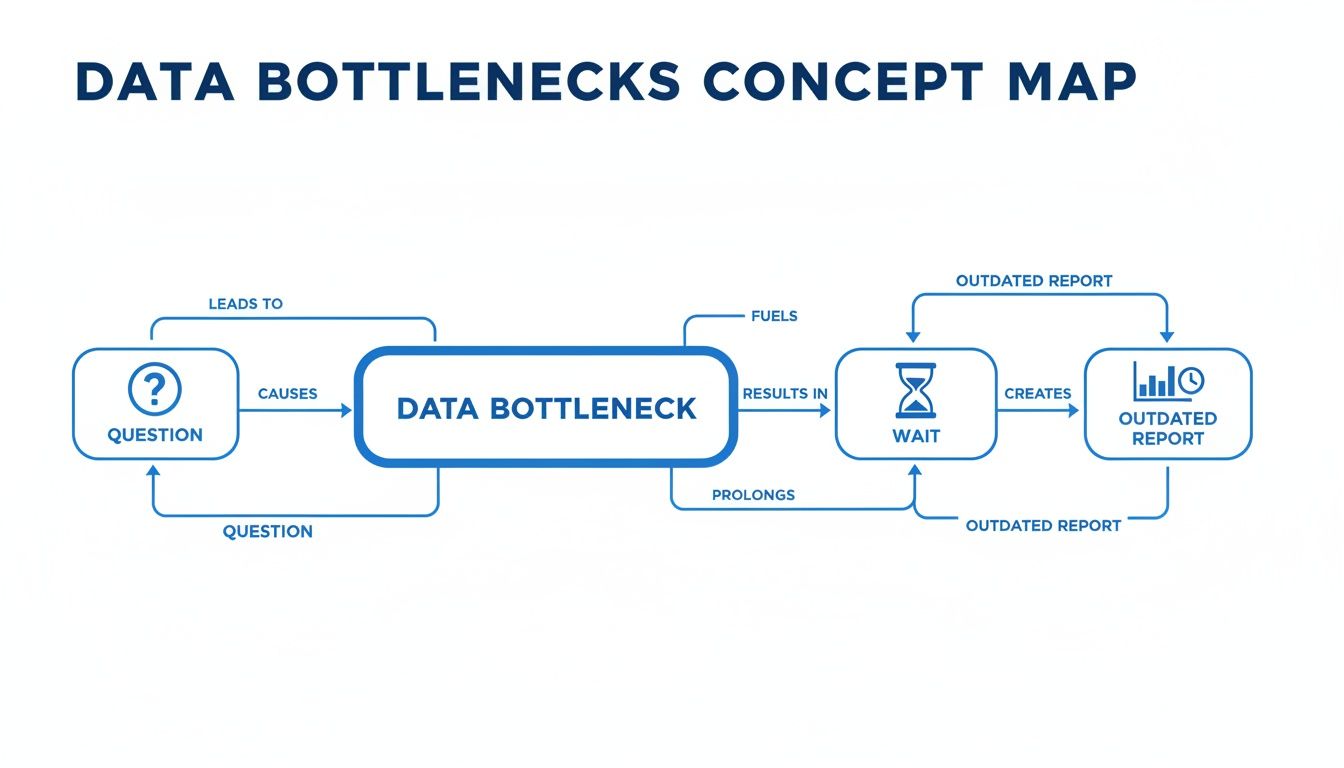
We’ve all been there. You have a critical business question, but the answer is locked away in your company’s data. You file a ticket with the data team, wait for an analyst to free up, and by the time a dashboard finally gets built weeks later, the moment has passed. The opportunity is gone.
This frustrating cycle is a massive bottleneck. Your company is sitting on a goldmine of information in platforms like Shopify, Postgres, and HubSpot, but you can't get to it quickly. Important decisions end up being based on guesswork instead of facts.
From Bottleneck to Conversation
An AI data agent shatters this old, slow model. Instead of waiting, you just ask. Imagine typing, "What was our customer acquisition cost by channel last quarter?" and getting a perfect chart back in seconds.
This isn't sci-fi; it's the new standard for business intelligence. And the industry is catching on, fast. Agentic AI is set for explosive growth, with projections showing that by 2028, 33% of enterprise software applications will feature it—a huge leap from less than 1% in 2024. You can read more on this 33-fold increase in AI agent adoption here.
Tools like Statspresso are built for this new reality. As a Conversational AI Data Analyst, it lets you skip the SQL and get straight to the insights.
Try asking Statspresso: "Show me my revenue by month for the last year as a bar chart."
How Does an AI Data Agent Actually Work?
Let's pop the hood, but without the confusing jargon. An AI data agent is a sophisticated system made of three key parts working in sync. Think of it as a small, specialized team: a translator, a gatekeeper, and a craftsman.
1. The Large Language Model (LLM): The Translator
This is the conversational brain of the operation. The LLM is responsible for understanding what you actually mean when you ask a question. It deciphers intent and context from your natural language. When you ask, "How did our new user signups do last month compared to the month before?" the LLM figures out the precise data points and timeframes needed. It translates your casual question into a clear set of instructions. Understanding the nuance of these systems often means looking at the top AI models that power them.
2. Secure Data Connectors: The Gatekeeper
Once the LLM knows what to look for, the agent needs a way to get to your data. Secure connectors act as the trusted gatekeepers, creating a safe, read-only pipeline between the agent and your databases. Whether your data lives in a Postgres warehouse, Google Sheets, or your HubSpot account, these connectors ensure the agent can retrieve information without ever putting your data security at risk.
3. The Query and Charting Engine: The Craftsman
This is where the heavy lifting happens. The engine takes the translated request from the LLM and writes the necessary code (like SQL) to pull the correct information. But it doesn't just hand you a raw data table. A great agent’s engine is also a smart designer, automatically visualizing the result in the most intuitive format—a bar chart, a trendline, or just a single, important number.
Statspresso, a dedicated Conversational AI Data Analyst, brings all these pieces together to close the gap between your questions and real-time, data-backed answers.
The Old Way vs. The New Way
When you put them side-by-side, the difference is stark. It’s a move from a rigid, specialist-driven process to a flexible, on-demand conversation with your data.
Feature | The Old Way (Manual SQL & BI) | The New Way (Statspresso's AI Agent) |
|---|---|---|
Workflow | File a ticket, wait for an analyst, get a static report. | Ask a question in plain English, get an instant chart. |
Speed | Days or weeks. | Seconds. |
Accessibility | Limited to technical users (SQL, Tableau experts). | Accessible to anyone on the team. |
Outcome | An outdated dashboard you have to interpret yourself. | A clear answer to a specific, timely question. |
This shift empowers everyone on the team, not just the data experts, to finally get their own answers. That's the real promise of building a data-driven culture.
How AI Data Agents Reinvent Business Intelligence
Let’s be direct: for most companies, traditional business intelligence is broken. It’s a system built on bottlenecks, where every question gets stuck in a queue. Waiting days for a simple chart isn't just frustrating; it's a surefire way to let opportunities slip by.
An AI data agent flips that script. Instead of funneling all requests through a human backlog, it opens up data access to everyone. This marks a massive shift from stale, static reports toward dynamic, conversational analytics.
From Dashboard Sprawl to On-Demand Answers
Think about your company's BI setup. Chances are you’re dealing with dozens of dashboards. Many are outdated, some are irrelevant, and finding the one chart you need is a hopeless digital scavenger hunt. This "dashboard sprawl" just creates more noise.
An AI data agent cuts through that noise. It delivers ‘just-in-time’ analytics, generating insights the moment you need them. You no longer hunt for a pre-built report; you create the perfect visualization in seconds, just by asking a question. This move toward automated BI is a real competitive advantage. For a closer look at this paradigm, explore the fundamentals of modern AI-powered business intelligence.
Real-World Wins for Your Team
This isn't just theory. For a busy team, a Conversational AI Data Analyst like Statspresso solves real problems.
For Marketing Leads: Marketing moves fast. Instead of waiting a week for a performance report, you can optimize campaigns on the fly.
Try asking Statspresso: "Compare the conversion rates of our Google Ads vs. Facebook Ads campaigns this month as a bar chart."
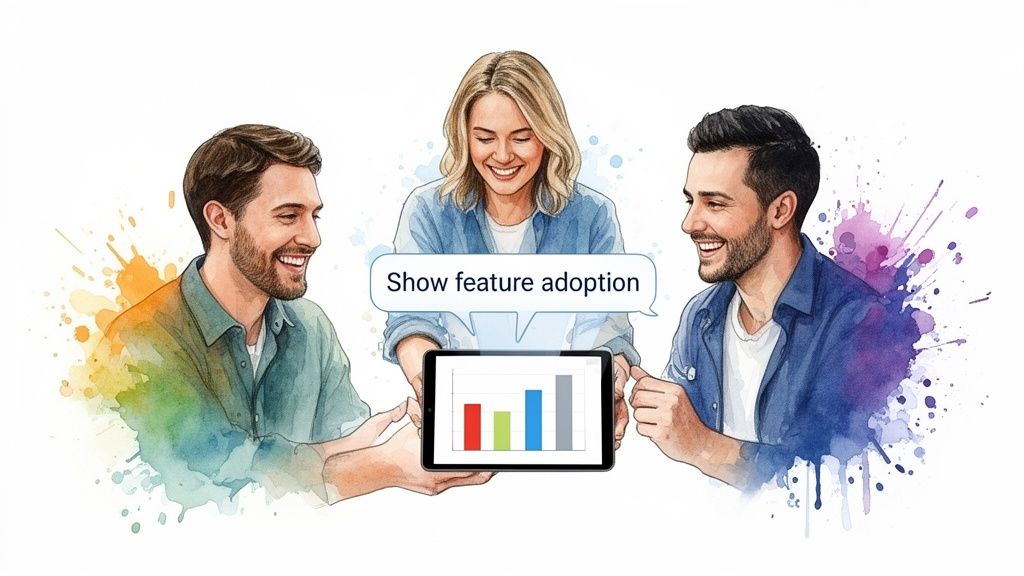
For Product Managers: Understanding user behavior is everything. But tracking feature adoption or churn has historically meant waiting for an analyst. Now, you get answers instantly.
Try asking Statspresso: "Show me feature adoption rates for users who signed up in the last 30 days."
For Founders: Your time is your most precious resource. An AI data agent is your direct line to critical KPIs, giving you a high-level view without getting lost in spreadsheets.
Try asking Statspresso: "What is our monthly recurring revenue trend for the last year?"
No matter the use case, the goal is the same: skip the SQL and just ask your data a question. This frees up countless hours and helps you find the growth opportunities locked in your data. The AI handles routine ad-hoc questions, freeing your data team to focus on deeper, more strategic work.
Implementing an AI Data Agent You Can Trust

Bringing an AI data agent into your workflow isn’t like flipping a switch and hoping for the best. For your team to rely on it, you have to trust its answers completely. That trust is built on rock-solid security, accuracy, and performance.
The market for these tools is exploding for a reason. Projections show the overall AI market swelling to over $1.8 trillion by 2030, with conversational AI becoming a fundamental part of business. You can explore the full projections on this massive market expansion. Getting the implementation right is what separates a game-changing tool from a frustrating gimmick.
Start with Secure, Read-Only Connections
Your data lives everywhere. You might have a Postgres database, HubSpot for CRM, and a few critical spreadsheets. A dependable AI data agent must connect to all these sources securely.
The gold standard here is a direct, read-only connection. This is non-negotiable. It means the AI can query your data but has absolutely no power to change or delete your original information. Platforms like Statspresso are built on this principle, ensuring your production databases and SaaS tools remain untouched and safe.
A solid tool should connect to:
SQL Databases: Like Postgres, MySQL, or BigQuery.
Simple Files: Like CSVs or Google Sheets.
Eliminate AI Hallucinations with Strong Grounding
Let's be blunt: the biggest fear with any AI is that it will just make things up. That’s a real risk with general-purpose chatbots, but a true AI data agent is different. Its knowledge must be "grounded" exclusively in your business data.
Grounding is the critical process of forcing an AI to base every answer on the specific data it has access to. If the information isn't in your database, the agent should say so—not invent a plausible-sounding lie.
This is the bedrock of trust. When a Conversational AI Data Analyst like Statspresso gives you an insight, it’s not guessing. It’s writing and running a real query against your real-time data. You can even see the SQL it generated, so your technical team can verify the logic. That's how you build confidence.
Frequently Asked Questions About AI Data Agents
Skepticism is healthy. You're right to ask if any new tool is secure, accurate, and won't just create more headaches. Let's tackle the questions we hear most often.
How is an AI data agent different from Tableau?
Traditional BI tools like Tableau are a manual toolkit. You drag and drop fields, configure charts, and build every dashboard yourself. You are the analyst.
An AI data agent flips that model. You get a conversational interface, not a blank canvas. You just ask a question, and the agent does the heavy lifting: figuring out the logic, writing the code, and building the right chart in seconds. It's the difference between building a car from parts and just telling your driver where to go.
How can I trust the answers from an AI?
Trust comes down to two things: grounding and transparency. A trustworthy AI data agent like Statspresso won't just give you a number; it shows its work. You can always see the exact SQL query it generated, allowing your technical team to verify the logic. Most importantly, it grounds every response in your connected data sources. It can't "hallucinate" or make things up, because its entire world is defined by your data.
What data sources can an AI data agent connect to?
A good AI data agent meets you where you are. It needs to plug right into the tools you already use, without a massive data migration project.
This typically includes:
SQL Databases: The classics like Postgres, MySQL, and BigQuery.
Simple Data Files: Even basic files like CSVs or Google Sheets.
With Statspresso, our Conversational AI Data Analyst, you can connect your production database and your CRM at the same time to ask much deeper questions.
Is it difficult to set up?
Not at all—and that’s by design. Modern AI data agents are built for quick, self-serve setup. With a platform like Statspresso, you can connect your first data source in minutes. Once connected, the agent automatically learns your data schema, and you can start asking questions right away. The goal is to help you skip the SQL and get your first insight in minutes.
Ready to stop waiting for answers? With Statspresso, you can move from questions to clarity in seconds. Connect your first data source for free and ask your first question.
Waiting weeks for a data analyst to build a dashboard is a relic of the past. So, what's an AI data agent? Think of it as your personal data analyst, on call 24/7. It's a tool that lets you ask questions about your business in plain English. In return, it instantly digs into your databases, finds the answers, and serves them up as clear charts and insights. No more wrestling with SQL or getting lost in complex BI tools. This is about getting answers, now.
TL;DR: Key Takeaways
What it is: An AI data agent is an autonomous tool that understands your questions, queries your data, and provides answers as charts or text in seconds.
The Pain It Solves: It eliminates the classic data bottleneck where business teams wait days or weeks for analysts to answer simple questions.
How it Works: It combines a Large Language Model (to understand your question), secure data connectors (to access your data), and a query engine (to get the answer).
The Main Benefit: You skip the SQL. Just ask your data a question and get a chart in seconds. This makes data accessible to everyone, not just technical experts.
The New Way: This marks a shift from static dashboards to dynamic, conversational analytics, empowering teams to make faster, data-driven decisions.
Stop Waiting for Answers Your Data Already Has
We’ve all been there. You have a critical business question, but the answer is locked away in your company’s data. You file a ticket with the data team, wait for an analyst to free up, and by the time a dashboard finally gets built weeks later, the moment has passed. The opportunity is gone.
This frustrating cycle is a massive bottleneck. Your company is sitting on a goldmine of information in platforms like Shopify, Postgres, and HubSpot, but you can't get to it quickly. Important decisions end up being based on guesswork instead of facts.

From Bottleneck to Conversation
An AI data agent shatters this old, slow model. Instead of waiting, you just ask. Imagine typing, "What was our customer acquisition cost by channel last quarter?" and getting a perfect chart back in seconds.
This isn't sci-fi; it's the new standard for business intelligence. And the industry is catching on, fast. Agentic AI is set for explosive growth, with projections showing that by 2028, 33% of enterprise software applications will feature it—a huge leap from less than 1% in 2024. You can read more on this 33-fold increase in AI agent adoption here.
Tools like Statspresso are built for this new reality. As a Conversational AI Data Analyst, it lets you skip the SQL and get straight to the insights.
Try asking Statspresso: "Show me my revenue by month for the last year as a bar chart."
How Does an AI Data Agent Actually Work?
Let's pop the hood, but without the confusing jargon. An AI data agent is a sophisticated system made of three key parts working in sync. Think of it as a small, specialized team: a translator, a gatekeeper, and a craftsman.
1. The Large Language Model (LLM): The Translator
This is the conversational brain of the operation. The LLM is responsible for understanding what you actually mean when you ask a question. It deciphers intent and context from your natural language. When you ask, "How did our new user signups do last month compared to the month before?" the LLM figures out the precise data points and timeframes needed. It translates your casual question into a clear set of instructions. Understanding the nuance of these systems often means looking at the top AI models that power them.
2. Secure Data Connectors: The Gatekeeper
Once the LLM knows what to look for, the agent needs a way to get to your data. Secure connectors act as the trusted gatekeepers, creating a safe, read-only pipeline between the agent and your databases. Whether your data lives in a Postgres warehouse, Google Sheets, or your HubSpot account, these connectors ensure the agent can retrieve information without ever putting your data security at risk.
3. The Query and Charting Engine: The Craftsman
This is where the heavy lifting happens. The engine takes the translated request from the LLM and writes the necessary code (like SQL) to pull the correct information. But it doesn't just hand you a raw data table. A great agent’s engine is also a smart designer, automatically visualizing the result in the most intuitive format—a bar chart, a trendline, or just a single, important number.
Statspresso, a dedicated Conversational AI Data Analyst, brings all these pieces together to close the gap between your questions and real-time, data-backed answers.
The Old Way vs. The New Way
When you put them side-by-side, the difference is stark. It’s a move from a rigid, specialist-driven process to a flexible, on-demand conversation with your data.
Feature | The Old Way (Manual SQL & BI) | The New Way (Statspresso's AI Agent) |
|---|---|---|
Workflow | File a ticket, wait for an analyst, get a static report. | Ask a question in plain English, get an instant chart. |
Speed | Days or weeks. | Seconds. |
Accessibility | Limited to technical users (SQL, Tableau experts). | Accessible to anyone on the team. |
Outcome | An outdated dashboard you have to interpret yourself. | A clear answer to a specific, timely question. |
This shift empowers everyone on the team, not just the data experts, to finally get their own answers. That's the real promise of building a data-driven culture.
How AI Data Agents Reinvent Business Intelligence
Let’s be direct: for most companies, traditional business intelligence is broken. It’s a system built on bottlenecks, where every question gets stuck in a queue. Waiting days for a simple chart isn't just frustrating; it's a surefire way to let opportunities slip by.
An AI data agent flips that script. Instead of funneling all requests through a human backlog, it opens up data access to everyone. This marks a massive shift from stale, static reports toward dynamic, conversational analytics.

From Dashboard Sprawl to On-Demand Answers
Think about your company's BI setup. Chances are you’re dealing with dozens of dashboards. Many are outdated, some are irrelevant, and finding the one chart you need is a hopeless digital scavenger hunt. This "dashboard sprawl" just creates more noise.
An AI data agent cuts through that noise. It delivers ‘just-in-time’ analytics, generating insights the moment you need them. You no longer hunt for a pre-built report; you create the perfect visualization in seconds, just by asking a question. This move toward automated BI is a real competitive advantage. For a closer look at this paradigm, explore the fundamentals of modern AI-powered business intelligence.
Real-World Wins for Your Team
This isn't just theory. For a busy team, a Conversational AI Data Analyst like Statspresso solves real problems.
For Marketing Leads: Marketing moves fast. Instead of waiting a week for a performance report, you can optimize campaigns on the fly.
Try asking Statspresso: "Compare the conversion rates of our Google Ads vs. Facebook Ads campaigns this month as a bar chart."
For Product Managers: Understanding user behavior is everything. But tracking feature adoption or churn has historically meant waiting for an analyst. Now, you get answers instantly.
Try asking Statspresso: "Show me feature adoption rates for users who signed up in the last 30 days."
For Founders: Your time is your most precious resource. An AI data agent is your direct line to critical KPIs, giving you a high-level view without getting lost in spreadsheets.
Try asking Statspresso: "What is our monthly recurring revenue trend for the last year?"
No matter the use case, the goal is the same: skip the SQL and just ask your data a question. This frees up countless hours and helps you find the growth opportunities locked in your data. The AI handles routine ad-hoc questions, freeing your data team to focus on deeper, more strategic work.
Implementing an AI Data Agent You Can Trust

Bringing an AI data agent into your workflow isn’t like flipping a switch and hoping for the best. For your team to rely on it, you have to trust its answers completely. That trust is built on rock-solid security, accuracy, and performance.
The market for these tools is exploding for a reason. Projections show the overall AI market swelling to over $1.8 trillion by 2030, with conversational AI becoming a fundamental part of business. You can explore the full projections on this massive market expansion. Getting the implementation right is what separates a game-changing tool from a frustrating gimmick.
Start with Secure, Read-Only Connections
Your data lives everywhere. You might have a Postgres database, HubSpot for CRM, and a few critical spreadsheets. A dependable AI data agent must connect to all these sources securely.
The gold standard here is a direct, read-only connection. This is non-negotiable. It means the AI can query your data but has absolutely no power to change or delete your original information. Platforms like Statspresso are built on this principle, ensuring your production databases and SaaS tools remain untouched and safe.
A solid tool should connect to:
SQL Databases: Like Postgres, MySQL, or BigQuery.
Simple Files: Like CSVs or Google Sheets.
Eliminate AI Hallucinations with Strong Grounding
Let's be blunt: the biggest fear with any AI is that it will just make things up. That’s a real risk with general-purpose chatbots, but a true AI data agent is different. Its knowledge must be "grounded" exclusively in your business data.
Grounding is the critical process of forcing an AI to base every answer on the specific data it has access to. If the information isn't in your database, the agent should say so—not invent a plausible-sounding lie.
This is the bedrock of trust. When a Conversational AI Data Analyst like Statspresso gives you an insight, it’s not guessing. It’s writing and running a real query against your real-time data. You can even see the SQL it generated, so your technical team can verify the logic. That's how you build confidence.
Frequently Asked Questions About AI Data Agents
Skepticism is healthy. You're right to ask if any new tool is secure, accurate, and won't just create more headaches. Let's tackle the questions we hear most often.
How is an AI data agent different from Tableau?
Traditional BI tools like Tableau are a manual toolkit. You drag and drop fields, configure charts, and build every dashboard yourself. You are the analyst.
An AI data agent flips that model. You get a conversational interface, not a blank canvas. You just ask a question, and the agent does the heavy lifting: figuring out the logic, writing the code, and building the right chart in seconds. It's the difference between building a car from parts and just telling your driver where to go.
How can I trust the answers from an AI?
Trust comes down to two things: grounding and transparency. A trustworthy AI data agent like Statspresso won't just give you a number; it shows its work. You can always see the exact SQL query it generated, allowing your technical team to verify the logic. Most importantly, it grounds every response in your connected data sources. It can't "hallucinate" or make things up, because its entire world is defined by your data.
What data sources can an AI data agent connect to?
A good AI data agent meets you where you are. It needs to plug right into the tools you already use, without a massive data migration project.
This typically includes:
SQL Databases: The classics like Postgres, MySQL, and BigQuery.
Simple Data Files: Even basic files like CSVs or Google Sheets.
With Statspresso, our Conversational AI Data Analyst, you can connect your production database and your CRM at the same time to ask much deeper questions.
Is it difficult to set up?
Not at all—and that’s by design. Modern AI data agents are built for quick, self-serve setup. With a platform like Statspresso, you can connect your first data source in minutes. Once connected, the agent automatically learns your data schema, and you can start asking questions right away. The goal is to help you skip the SQL and get your first insight in minutes.
Ready to stop waiting for answers? With Statspresso, you can move from questions to clarity in seconds. Connect your first data source for free and ask your first question.
Waiting weeks for a data analyst to build a dashboard is a relic of the past. So, what's an AI data agent? Think of it as your personal data analyst, on call 24/7. It's a tool that lets you ask questions about your business in plain English. In return, it instantly digs into your databases, finds the answers, and serves them up as clear charts and insights. No more wrestling with SQL or getting lost in complex BI tools. This is about getting answers, now.
TL;DR: Key Takeaways
What it is: An AI data agent is an autonomous tool that understands your questions, queries your data, and provides answers as charts or text in seconds.
The Pain It Solves: It eliminates the classic data bottleneck where business teams wait days or weeks for analysts to answer simple questions.
How it Works: It combines a Large Language Model (to understand your question), secure data connectors (to access your data), and a query engine (to get the answer).
The Main Benefit: You skip the SQL. Just ask your data a question and get a chart in seconds. This makes data accessible to everyone, not just technical experts.
The New Way: This marks a shift from static dashboards to dynamic, conversational analytics, empowering teams to make faster, data-driven decisions.
Stop Waiting for Answers Your Data Already Has
We’ve all been there. You have a critical business question, but the answer is locked away in your company’s data. You file a ticket with the data team, wait for an analyst to free up, and by the time a dashboard finally gets built weeks later, the moment has passed. The opportunity is gone.
This frustrating cycle is a massive bottleneck. Your company is sitting on a goldmine of information in platforms like Shopify, Postgres, and HubSpot, but you can't get to it quickly. Important decisions end up being based on guesswork instead of facts.

From Bottleneck to Conversation
An AI data agent shatters this old, slow model. Instead of waiting, you just ask. Imagine typing, "What was our customer acquisition cost by channel last quarter?" and getting a perfect chart back in seconds.
This isn't sci-fi; it's the new standard for business intelligence. And the industry is catching on, fast. Agentic AI is set for explosive growth, with projections showing that by 2028, 33% of enterprise software applications will feature it—a huge leap from less than 1% in 2024. You can read more on this 33-fold increase in AI agent adoption here.
Tools like Statspresso are built for this new reality. As a Conversational AI Data Analyst, it lets you skip the SQL and get straight to the insights.
Try asking Statspresso: "Show me my revenue by month for the last year as a bar chart."
How Does an AI Data Agent Actually Work?
Let's pop the hood, but without the confusing jargon. An AI data agent is a sophisticated system made of three key parts working in sync. Think of it as a small, specialized team: a translator, a gatekeeper, and a craftsman.
1. The Large Language Model (LLM): The Translator
This is the conversational brain of the operation. The LLM is responsible for understanding what you actually mean when you ask a question. It deciphers intent and context from your natural language. When you ask, "How did our new user signups do last month compared to the month before?" the LLM figures out the precise data points and timeframes needed. It translates your casual question into a clear set of instructions. Understanding the nuance of these systems often means looking at the top AI models that power them.
2. Secure Data Connectors: The Gatekeeper
Once the LLM knows what to look for, the agent needs a way to get to your data. Secure connectors act as the trusted gatekeepers, creating a safe, read-only pipeline between the agent and your databases. Whether your data lives in a Postgres warehouse, Google Sheets, or your HubSpot account, these connectors ensure the agent can retrieve information without ever putting your data security at risk.
3. The Query and Charting Engine: The Craftsman
This is where the heavy lifting happens. The engine takes the translated request from the LLM and writes the necessary code (like SQL) to pull the correct information. But it doesn't just hand you a raw data table. A great agent’s engine is also a smart designer, automatically visualizing the result in the most intuitive format—a bar chart, a trendline, or just a single, important number.
Statspresso, a dedicated Conversational AI Data Analyst, brings all these pieces together to close the gap between your questions and real-time, data-backed answers.
The Old Way vs. The New Way
When you put them side-by-side, the difference is stark. It’s a move from a rigid, specialist-driven process to a flexible, on-demand conversation with your data.
Feature | The Old Way (Manual SQL & BI) | The New Way (Statspresso's AI Agent) |
|---|---|---|
Workflow | File a ticket, wait for an analyst, get a static report. | Ask a question in plain English, get an instant chart. |
Speed | Days or weeks. | Seconds. |
Accessibility | Limited to technical users (SQL, Tableau experts). | Accessible to anyone on the team. |
Outcome | An outdated dashboard you have to interpret yourself. | A clear answer to a specific, timely question. |
This shift empowers everyone on the team, not just the data experts, to finally get their own answers. That's the real promise of building a data-driven culture.
How AI Data Agents Reinvent Business Intelligence
Let’s be direct: for most companies, traditional business intelligence is broken. It’s a system built on bottlenecks, where every question gets stuck in a queue. Waiting days for a simple chart isn't just frustrating; it's a surefire way to let opportunities slip by.
An AI data agent flips that script. Instead of funneling all requests through a human backlog, it opens up data access to everyone. This marks a massive shift from stale, static reports toward dynamic, conversational analytics.

From Dashboard Sprawl to On-Demand Answers
Think about your company's BI setup. Chances are you’re dealing with dozens of dashboards. Many are outdated, some are irrelevant, and finding the one chart you need is a hopeless digital scavenger hunt. This "dashboard sprawl" just creates more noise.
An AI data agent cuts through that noise. It delivers ‘just-in-time’ analytics, generating insights the moment you need them. You no longer hunt for a pre-built report; you create the perfect visualization in seconds, just by asking a question. This move toward automated BI is a real competitive advantage. For a closer look at this paradigm, explore the fundamentals of modern AI-powered business intelligence.
Real-World Wins for Your Team
This isn't just theory. For a busy team, a Conversational AI Data Analyst like Statspresso solves real problems.
For Marketing Leads: Marketing moves fast. Instead of waiting a week for a performance report, you can optimize campaigns on the fly.
Try asking Statspresso: "Compare the conversion rates of our Google Ads vs. Facebook Ads campaigns this month as a bar chart."
For Product Managers: Understanding user behavior is everything. But tracking feature adoption or churn has historically meant waiting for an analyst. Now, you get answers instantly.
Try asking Statspresso: "Show me feature adoption rates for users who signed up in the last 30 days."
For Founders: Your time is your most precious resource. An AI data agent is your direct line to critical KPIs, giving you a high-level view without getting lost in spreadsheets.
Try asking Statspresso: "What is our monthly recurring revenue trend for the last year?"
No matter the use case, the goal is the same: skip the SQL and just ask your data a question. This frees up countless hours and helps you find the growth opportunities locked in your data. The AI handles routine ad-hoc questions, freeing your data team to focus on deeper, more strategic work.
Implementing an AI Data Agent You Can Trust

Bringing an AI data agent into your workflow isn’t like flipping a switch and hoping for the best. For your team to rely on it, you have to trust its answers completely. That trust is built on rock-solid security, accuracy, and performance.
The market for these tools is exploding for a reason. Projections show the overall AI market swelling to over $1.8 trillion by 2030, with conversational AI becoming a fundamental part of business. You can explore the full projections on this massive market expansion. Getting the implementation right is what separates a game-changing tool from a frustrating gimmick.
Start with Secure, Read-Only Connections
Your data lives everywhere. You might have a Postgres database, HubSpot for CRM, and a few critical spreadsheets. A dependable AI data agent must connect to all these sources securely.
The gold standard here is a direct, read-only connection. This is non-negotiable. It means the AI can query your data but has absolutely no power to change or delete your original information. Platforms like Statspresso are built on this principle, ensuring your production databases and SaaS tools remain untouched and safe.
A solid tool should connect to:
SQL Databases: Like Postgres, MySQL, or BigQuery.
Simple Files: Like CSVs or Google Sheets.
Eliminate AI Hallucinations with Strong Grounding
Let's be blunt: the biggest fear with any AI is that it will just make things up. That’s a real risk with general-purpose chatbots, but a true AI data agent is different. Its knowledge must be "grounded" exclusively in your business data.
Grounding is the critical process of forcing an AI to base every answer on the specific data it has access to. If the information isn't in your database, the agent should say so—not invent a plausible-sounding lie.
This is the bedrock of trust. When a Conversational AI Data Analyst like Statspresso gives you an insight, it’s not guessing. It’s writing and running a real query against your real-time data. You can even see the SQL it generated, so your technical team can verify the logic. That's how you build confidence.
Frequently Asked Questions About AI Data Agents
Skepticism is healthy. You're right to ask if any new tool is secure, accurate, and won't just create more headaches. Let's tackle the questions we hear most often.
How is an AI data agent different from Tableau?
Traditional BI tools like Tableau are a manual toolkit. You drag and drop fields, configure charts, and build every dashboard yourself. You are the analyst.
An AI data agent flips that model. You get a conversational interface, not a blank canvas. You just ask a question, and the agent does the heavy lifting: figuring out the logic, writing the code, and building the right chart in seconds. It's the difference between building a car from parts and just telling your driver where to go.
How can I trust the answers from an AI?
Trust comes down to two things: grounding and transparency. A trustworthy AI data agent like Statspresso won't just give you a number; it shows its work. You can always see the exact SQL query it generated, allowing your technical team to verify the logic. Most importantly, it grounds every response in your connected data sources. It can't "hallucinate" or make things up, because its entire world is defined by your data.
What data sources can an AI data agent connect to?
A good AI data agent meets you where you are. It needs to plug right into the tools you already use, without a massive data migration project.
This typically includes:
SQL Databases: The classics like Postgres, MySQL, and BigQuery.
Simple Data Files: Even basic files like CSVs or Google Sheets.
With Statspresso, our Conversational AI Data Analyst, you can connect your production database and your CRM at the same time to ask much deeper questions.
Is it difficult to set up?
Not at all—and that’s by design. Modern AI data agents are built for quick, self-serve setup. With a platform like Statspresso, you can connect your first data source in minutes. Once connected, the agent automatically learns your data schema, and you can start asking questions right away. The goal is to help you skip the SQL and get your first insight in minutes.
Ready to stop waiting for answers? With Statspresso, you can move from questions to clarity in seconds. Connect your first data source for free and ask your first question.