

Feb 21, 2026
AI Powered Business Intelligence: Your Guide to Instant Answers


You're sitting on a goldmine of data, but getting a straight answer feels like pulling teeth. Waiting weeks for a data analyst to build a dashboard is a relic of the past. That old-school process isn't just slow; it's a bottleneck forcing you to make critical decisions with stale information. This guide shows you how AI-powered business intelligence ends the waiting game and gets you answers, now.
Your Data Holds Answers, But You're Stuck Waiting

You know the answers you need are hiding in your databases. The problem? Getting them out is a painful waiting game. The report for this afternoon’s meeting is probably buried in a ticket queue, sitting behind five other "urgent" requests.
This isn't just frustrating; it's a business risk. When you can’t get data on time, you're forced to rely on gut feelings or outdated reports. That’s no way to run a company, especially when your competitors are moving faster.
The Real Cost of the Data Bottleneck
The problem isn't your data or your team. It's the process. Depending on a small group of technical experts to write SQL creates a chokepoint that grinds momentum to a halt.
This is exactly why the market for AI-powered business intelligence is exploding. It's not just hype; it's a direct response to a desperate need for tools that deliver instant clarity. You can explore the full business intelligence statistics for 2024 to see just how strong these market trends are. This new way of working is here right now.
Think of it like having a Conversational AI Data Analyst on call 24/7. You can finally skip the SQL. Just ask your data a question and get a chart in seconds.
With a tool like Statspresso, you just connect your data sources and start asking questions in plain English. No more waiting.
Try asking Statspresso: "Show me our top 5 revenue-generating customers last quarter."
Or try this: "What's the month-over-month growth rate for new signups?"
This guide will show you exactly how to stop waiting on reports and start getting answers.
What Is AI-Powered Business Intelligence?

So, what are we really talking about with "AI-powered BI"? Let's ditch the jargon.
Think of traditional BI as a huge library. To find anything, you need a specialized librarian (your data analyst) who knows the system inside and out. You hand them a reference code (an SQL query), and after some time, they come back with a book. It works, but it’s slow and requires an expert.
AI-powered business intelligence, by contrast, is like a genius research assistant who knows the entire library by heart and speaks plain English. You just ask, "What were our top-selling products last month?" and bam—they hand you the exact page with a clean summary and a chart.
The Three Engines of AI BI
This isn’t magic, though it can feel like it. It's really just three key technologies working together. We'll skip the deep technical dive because what matters is the outcome: getting data into the hands of people who need it, instantly.
Three core components make this new wave of automated BI a reality:
Natural Language Processing (NLP): This is the AI's "ears." NLP lets the system understand your questions in normal language, just like you're messaging a colleague.
Machine Learning (ML): This is the "brain." ML algorithms dig through your data, looking for hidden patterns, trends, and outliers a human might miss.
Generative AI (GenBI): This is the AI's "hands." After understanding your question and finding the answer, GenBI builds the response—writing the summary, generating the chart, and visualizing the data for you on the fly.
When these three work together, the experience is simple. You ask a question, and a clean, accurate visualization appears in seconds. This is the essence of what a Conversational AI Data Analyst like Statspresso delivers.
Try asking Statspresso: "Show me my revenue by month for the last year as a bar chart."
That simple command kicks all three engines into gear, giving you a perfect chart without you ever having to see, write, or even think about a single line of code.
From Static Reports to Dynamic Conversations
The biggest change with AI-powered business intelligence is the move away from rigid, pre-built dashboards. Traditional dashboards are great for tracking metrics you already know are important, but they fall flat when you have a spontaneous "what if" question—which is where the real insights often hide. This is where conversational analytics shines.
Instead of being a passive viewer, you become an active participant in a conversation with your data. You can drill down, pivot, and follow new lines of questioning as they come to you.
It’s the difference between looking at a printed map and using a live GPS. This interactivity is what truly helps founders and product managers make faster, smarter decisions without getting stuck in a report queue. You can learn more about the future of Postgres analytics and how AI is fundamentally changing how we interact with databases.
Comparing The Old Way Versus The New Way
Let's be blunt. The gap between old-school BI and AI-powered business intelligence isn't a minor upgrade. It’s a completely different way of working. One approach leaves you stuck in a queue; the other delivers answers on demand.
Think about your own reporting process. Does it feel fast and fluid, or slow and clunky? The answer usually boils down to how long it takes to get an answer, who has the power to get it, and what happens when the first answer leads to more questions.
The BI Showdown: Manual SQL vs. Conversational AI
The old method is a relic, weighed down by manual queries and ticket queues. The new way, powered by conversational analytics, is built for how fast business actually moves.
This table lays out the differences starkly. We're not being subtle, because the advantages aren't subtle.
Metric | The Old Way (Manual SQL) | The New Way (Statspresso) |
|---|---|---|
Time to Insight | Days or weeks. File a ticket and get in line. | Seconds. Ask a question and get a chart instantly. |
Skills Required | Deep technical expertise (SQL, Python, Tableau). | Curiosity. If you can type, you can get data. |
Cost of Delay | High. Decisions get made on stale data. Opportunities are missed. | Zero. Get real-time answers to make smart calls on the spot. |
Follow-up Questions | Back to the end of the line. A new question means a new ticket. | Effortless. Immediately drill down or ask something new to dig deeper. |
The story this table tells is simple. The old way creates bottlenecks. The new way fosters independence and speed.
The entire point of a Conversational AI Data Analyst like Statspresso is to tear down the walls in the "Old Way" column. Skip the SQL. Just ask your data a question and get a chart in seconds.
From Static Reports to Dynamic Exploration
The real magic is how this shift changes your entire relationship with data. You stop being a passive consumer of a static dashboard. Instead, you become an active explorer, free to follow your curiosity.
Spot a weird spike in last month's sales? You don't file another ticket. You just ask.
Try asking Statspresso: "Show me that sales spike broken down by product category."
This ability to have a genuine "conversation" with your data is what AI-powered business intelligence is all about. It shrinks the time between question and insight from weeks to seconds, empowering everyone to make smarter decisions.
How AI Supercharges Your BI Workflow
Let's get practical. How does AI-powered business intelligence actually inject speed into your daily workflow? This isn't about replacing people; it's about automating the mind-numbing, repetitive parts of the job no one likes doing.
This is a big deal. The global AI market is on track to explode, and according to a 2024 report from Grandview Research, the enterprise AI segment is a major driver. You can dig deeper into the trends driving the AI market's growth. This growth happens when companies see tangible value, and applying AI to core operations like BI is a perfect example.
Automated Data Preparation
Before you can pull a single insight, your data needs to be clean. This is where the real grind is, often sucking up 80% of a data analyst's time with manual tasks like fixing messy spreadsheets and joining tables.
AI flips the script. Modern automated BI tools can:
Spot and fix errors automatically, correcting typos or filling in missing values.
Figure out relationships between different data tables on its own, suggesting the right joins.
Standardize data formats across all your sources, making sure "New York," "NY," and "N.Y." are all treated as the same thing.
This automation means you can connect a new data source and have it ready for analysis in minutes, not days.
Smarter Data Discovery
Once your data is clean, the hunt for insights begins. The old way involved an analyst manually slicing data, hoping to stumble upon a trend. This is slow and biased.
AI-powered business intelligence works differently. Machine learning algorithms constantly scan your data for statistically significant patterns—the kinds of things a human might miss.
Think of it like having a team of tireless junior analysts working 24/7. The AI will proactively surface insights like, "Customers from this campaign have a 30% higher lifetime value," and bring them right to you.
Instead of starting from a blank dashboard, you begin with AI-generated discoveries that point you in the right direction. A Conversational AI Data Analyst like Statspresso takes it a step further, letting you instantly ask follow-up questions about these findings.
This diagram perfectly captures the difference between the clunky, manual BI workflow of the past and the new, AI-driven process.
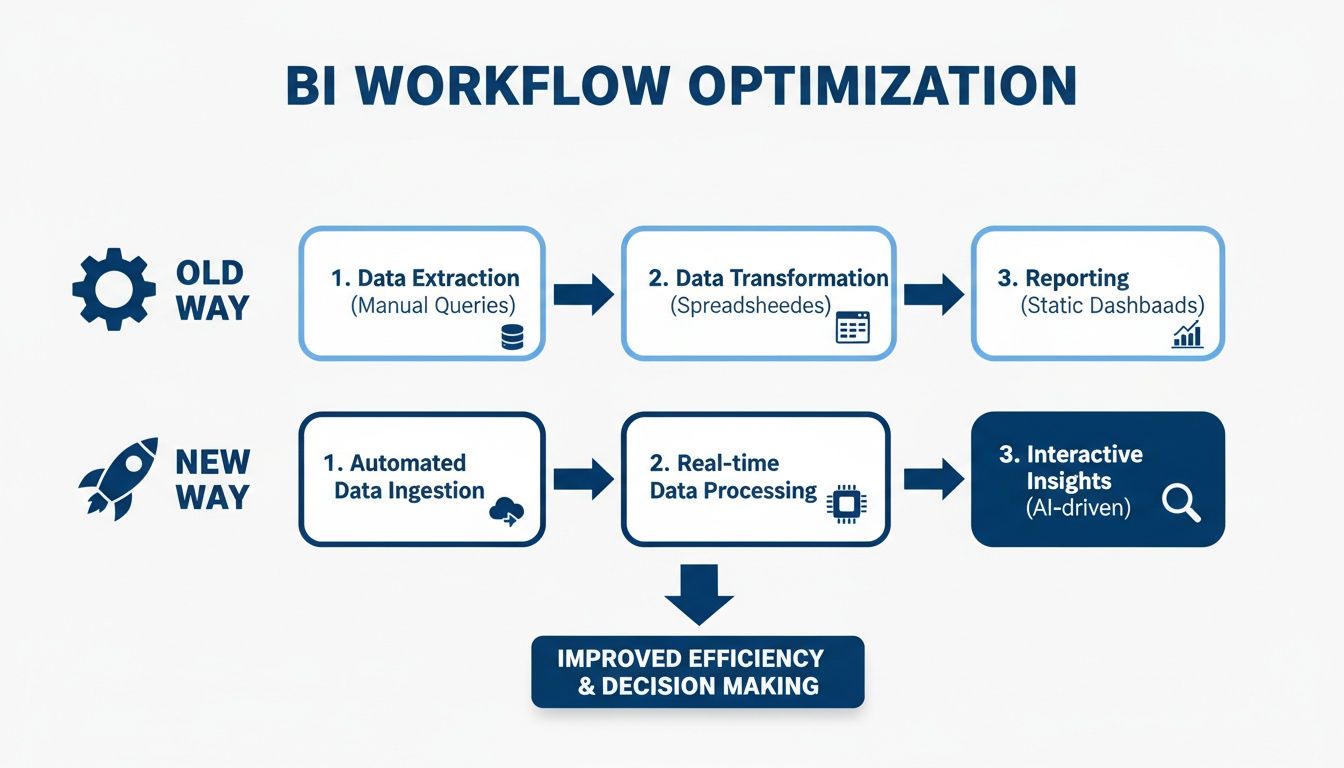
It’s easy to see how the modern approach removes friction at every step.
Conversational Analytics and Visualization
Now for the part that changes the game. The final step in any BI workflow is turning numbers into a clear answer. Traditionally, this meant filing a ticket and waiting.
Conversational analytics shatters that bottleneck.
With a tool like Statspresso, you just ask a question in plain English. The AI translates your request into the right query, pulls the data, and generates a clean visualization on the spot. No waiting, no middlemen.
Try asking Statspresso: "Compare our revenue by city for last quarter as a pie chart."
You get the chart in seconds. You don't need SQL. You don't need to master a complicated dashboard. You just need to ask. This self-service approach empowers everyone to get their own answers, freeing up your data experts for big strategic challenges.
Where the Rubber Meets the Road: AI-Powered BI in Action
Theory is one thing, but what does AI-powered business intelligence look like on a Tuesday afternoon? This is where it stops being a buzzword and becomes a must-have tool.
The magic of conversational analytics is that it directly answers the real-world questions your team is already asking. Instead of Slacking an analyst and waiting, they just ask the AI and get an answer instantly.
For The Scrappy Marketing Lead
Marketing teams live and breathe data, but getting timely insights is a constant battle. Waiting for a report on last month's numbers is like driving while only looking in the rearview mirror.
With a Conversational AI Data Analyst like Statspresso, you get performance metrics in real-time.
Try asking Statspresso: “What was the customer acquisition cost for our latest Google Ads campaign versus our Facebook campaign?”
That simple question can kick off a whole line of inquiry:
"Break down the Facebook campaign's CPA by ad creative."
"Which landing page had the highest conversion rate last week?"
"Show me the lifetime value of customers from organic search versus paid social."
This speed means you can double down on a winning campaign or kill a wasteful one on the same day, not next quarter. You skip the SQL and get straight to insights that boost ROI.
For The Overloaded Product Manager
Product managers succeed or fail based on user behavior data. Figuring out how customers are using a new feature is essential, but getting that data often means waiting for a developer to write a query.
AI-powered business intelligence clears that roadblock. A PM can directly ask questions of the production database to see how adoption is trending in real-time.
Try asking Statspresso: “Show me a weekly trend of active users for the new checkout flow since we launched it.”
Suddenly, a product manager can get a quick pulse on a feature's health without technical help.
"What percentage of users who started the new checkout flow completed a purchase?"
"Compare retention for users who tried the new feature versus those who didn't."
"Which user segment has the highest adoption rate for our new integration?"
This direct line to data tightens the feedback loop, resulting in better products, built faster.
For The Time-Crunched Founder
Founders need the 30,000-foot view but also the power to zoom in on tiny details. They don’t have time to master a complicated BI tool or wait for a board deck. They just need critical business metrics, right now.
An AI BI tool becomes a founder's command center.
Try asking Statspresso: “What's our monthly recurring revenue growth rate, and which customer segments are driving it?”
From there, the conversation can branch out:
"Show me our cash burn rate for the last six months."
"What is our current customer churn rate?"
"Which salesperson closed the most deals last quarter?"
Each answer bypasses the reporting bottleneck, putting mission-critical data directly into the hands of the person steering the ship.
How to Get Started with AI BI—Without the Headaches
Thinking about implementing AI-powered business intelligence can bring on a cold sweat. It sounds like a massive IT project, right? Visions of six-month projects and eye-watering budgets are enough to make anyone stick with spreadsheets.
But that’s the old way. The modern approach is surprisingly straightforward.
You don’t need to boil the ocean. The goal is a quick, tangible win. This means shelving the idea of a massive, company-wide rollout and focusing on a targeted pilot program.
Start Small, Win Fast
The smartest way forward is to pick one single, high-value data source to begin. Choose the dataset that holds the answers to your most urgent questions.
For marketing: Start with Google Analytics or your ad platform data.
For product: Hook up your production Postgres or MySQL database (with read-only access).
For founders: Your Stripe financial data or HubSpot CRM data is a perfect start.
This focused strategy makes setup simple. Give a small pilot team the keys and let them start asking questions. They’ll become your biggest advocates after that first "aha!" moment.
A successful implementation isn't measured by the number of connected data sources. It's measured by the time saved and the quality of decisions made.
The last step is to measure the impact. How many manual report requests were replaced? This gives you a concrete ROI—hours of your data team’s time freed up. That's the power of having a Conversational AI Data Analyst on your team.
Security and Trust Are Non-Negotiable
Handing over data access is a big leap of faith, which is why choosing a secure, transparent platform is critical. You need an AI that's a secure window into your data, not a black box that hallucinates answers.
There's a reason the AI governance market is projected to grow significantly by 2026. As AI investments are driving a focus on compliance, making sure your tools are trustworthy is a top priority. A reliable tool must ground every answer in your verified data.
Look for a solution that:
Respects your existing database permissions without forcing a security reconfiguration.
Uses end-to-end encryption to protect your data in transit and at rest.
Never, ever uses your private business data to train its public AI models.
This commitment to security means you get powerful insights without compromising on data integrity. You can find more practical advice in our guide on using AI for data analysis.
The barrier to entry has never been lower. You can connect a data source and ask your first question in minutes.
Try asking Statspresso: “How many new users did we sign up last month from our Postgres database?”
The proof is in that first chart. It's the moment you realize you can finally skip the SQL and get an answer in seconds.
Your Questions, Answered
Let's tackle the common questions we hear from founders and product leaders. No fluff, just straight answers.
Is my data secure with an AI analytics tool?
Yes—if you pick the right partner. Professional AI-powered business intelligence platforms like Statspresso are built with enterprise-grade security from day one.
Here’s what that means:
Your data is protected by end-to-end encryption.
The system automatically respects all your existing database permissions.
Most importantly, your confidential business data is never used to train public AI models. The answers are generated exclusively from your secure data.
Do I still need my data analyst?
Yes, absolutely. But their job is about to get a lot more interesting. A Conversational AI Data Analyst doesn’t make your human experts obsolete; it makes them more powerful. It's a force multiplier that handles all the repetitive reporting requests that bog them down.
This frees up your analyst to focus on high-impact work—uncovering hidden trends and becoming the proactive business partner you hired them to be.
How is this different from just using ChatGPT?
Great question. The conversational feel is similar, but what's happening behind the curtain is fundamentally different. A general-purpose AI like ChatGPT is a master of language, trained on the public internet. It's fantastic for drafting an email, but it has no idea how to accurately query your private database.
AI BI tools are specialists, purpose-built to analyze structured data. They connect directly to your data, translate your questions into precise SQL code, and deliver back factual answers. You're getting verifiable insights from your numbers, not just a convincing-sounding sentence.
TL;DR (Key Takeaways)
Waiting for manual reports is a major business bottleneck. It's slow, expensive, and forces you to work with stale data.
AI-powered business intelligence provides immediate answers. It lets anyone on your team ask questions in plain English and get instant charts.
This new way works. Tools like Statspresso act as a "Conversational AI Data Analyst," using NLP, ML, and Generative AI to turn your questions into insights.
Get started small and win fast. Connect one data source, empower a small team, and see the value in hours, not months.
Ready to stop waiting and start asking?
Connect your first data source for free and ask your first question.
You're sitting on a goldmine of data, but getting a straight answer feels like pulling teeth. Waiting weeks for a data analyst to build a dashboard is a relic of the past. That old-school process isn't just slow; it's a bottleneck forcing you to make critical decisions with stale information. This guide shows you how AI-powered business intelligence ends the waiting game and gets you answers, now.
Your Data Holds Answers, But You're Stuck Waiting

You know the answers you need are hiding in your databases. The problem? Getting them out is a painful waiting game. The report for this afternoon’s meeting is probably buried in a ticket queue, sitting behind five other "urgent" requests.
This isn't just frustrating; it's a business risk. When you can’t get data on time, you're forced to rely on gut feelings or outdated reports. That’s no way to run a company, especially when your competitors are moving faster.
The Real Cost of the Data Bottleneck
The problem isn't your data or your team. It's the process. Depending on a small group of technical experts to write SQL creates a chokepoint that grinds momentum to a halt.
This is exactly why the market for AI-powered business intelligence is exploding. It's not just hype; it's a direct response to a desperate need for tools that deliver instant clarity. You can explore the full business intelligence statistics for 2024 to see just how strong these market trends are. This new way of working is here right now.
Think of it like having a Conversational AI Data Analyst on call 24/7. You can finally skip the SQL. Just ask your data a question and get a chart in seconds.
With a tool like Statspresso, you just connect your data sources and start asking questions in plain English. No more waiting.
Try asking Statspresso: "Show me our top 5 revenue-generating customers last quarter."
Or try this: "What's the month-over-month growth rate for new signups?"
This guide will show you exactly how to stop waiting on reports and start getting answers.
What Is AI-Powered Business Intelligence?

So, what are we really talking about with "AI-powered BI"? Let's ditch the jargon.
Think of traditional BI as a huge library. To find anything, you need a specialized librarian (your data analyst) who knows the system inside and out. You hand them a reference code (an SQL query), and after some time, they come back with a book. It works, but it’s slow and requires an expert.
AI-powered business intelligence, by contrast, is like a genius research assistant who knows the entire library by heart and speaks plain English. You just ask, "What were our top-selling products last month?" and bam—they hand you the exact page with a clean summary and a chart.
The Three Engines of AI BI
This isn’t magic, though it can feel like it. It's really just three key technologies working together. We'll skip the deep technical dive because what matters is the outcome: getting data into the hands of people who need it, instantly.
Three core components make this new wave of automated BI a reality:
Natural Language Processing (NLP): This is the AI's "ears." NLP lets the system understand your questions in normal language, just like you're messaging a colleague.
Machine Learning (ML): This is the "brain." ML algorithms dig through your data, looking for hidden patterns, trends, and outliers a human might miss.
Generative AI (GenBI): This is the AI's "hands." After understanding your question and finding the answer, GenBI builds the response—writing the summary, generating the chart, and visualizing the data for you on the fly.
When these three work together, the experience is simple. You ask a question, and a clean, accurate visualization appears in seconds. This is the essence of what a Conversational AI Data Analyst like Statspresso delivers.
Try asking Statspresso: "Show me my revenue by month for the last year as a bar chart."
That simple command kicks all three engines into gear, giving you a perfect chart without you ever having to see, write, or even think about a single line of code.
From Static Reports to Dynamic Conversations
The biggest change with AI-powered business intelligence is the move away from rigid, pre-built dashboards. Traditional dashboards are great for tracking metrics you already know are important, but they fall flat when you have a spontaneous "what if" question—which is where the real insights often hide. This is where conversational analytics shines.
Instead of being a passive viewer, you become an active participant in a conversation with your data. You can drill down, pivot, and follow new lines of questioning as they come to you.
It’s the difference between looking at a printed map and using a live GPS. This interactivity is what truly helps founders and product managers make faster, smarter decisions without getting stuck in a report queue. You can learn more about the future of Postgres analytics and how AI is fundamentally changing how we interact with databases.
Comparing The Old Way Versus The New Way
Let's be blunt. The gap between old-school BI and AI-powered business intelligence isn't a minor upgrade. It’s a completely different way of working. One approach leaves you stuck in a queue; the other delivers answers on demand.
Think about your own reporting process. Does it feel fast and fluid, or slow and clunky? The answer usually boils down to how long it takes to get an answer, who has the power to get it, and what happens when the first answer leads to more questions.
The BI Showdown: Manual SQL vs. Conversational AI
The old method is a relic, weighed down by manual queries and ticket queues. The new way, powered by conversational analytics, is built for how fast business actually moves.
This table lays out the differences starkly. We're not being subtle, because the advantages aren't subtle.
Metric | The Old Way (Manual SQL) | The New Way (Statspresso) |
|---|---|---|
Time to Insight | Days or weeks. File a ticket and get in line. | Seconds. Ask a question and get a chart instantly. |
Skills Required | Deep technical expertise (SQL, Python, Tableau). | Curiosity. If you can type, you can get data. |
Cost of Delay | High. Decisions get made on stale data. Opportunities are missed. | Zero. Get real-time answers to make smart calls on the spot. |
Follow-up Questions | Back to the end of the line. A new question means a new ticket. | Effortless. Immediately drill down or ask something new to dig deeper. |
The story this table tells is simple. The old way creates bottlenecks. The new way fosters independence and speed.
The entire point of a Conversational AI Data Analyst like Statspresso is to tear down the walls in the "Old Way" column. Skip the SQL. Just ask your data a question and get a chart in seconds.
From Static Reports to Dynamic Exploration
The real magic is how this shift changes your entire relationship with data. You stop being a passive consumer of a static dashboard. Instead, you become an active explorer, free to follow your curiosity.
Spot a weird spike in last month's sales? You don't file another ticket. You just ask.
Try asking Statspresso: "Show me that sales spike broken down by product category."
This ability to have a genuine "conversation" with your data is what AI-powered business intelligence is all about. It shrinks the time between question and insight from weeks to seconds, empowering everyone to make smarter decisions.
How AI Supercharges Your BI Workflow
Let's get practical. How does AI-powered business intelligence actually inject speed into your daily workflow? This isn't about replacing people; it's about automating the mind-numbing, repetitive parts of the job no one likes doing.
This is a big deal. The global AI market is on track to explode, and according to a 2024 report from Grandview Research, the enterprise AI segment is a major driver. You can dig deeper into the trends driving the AI market's growth. This growth happens when companies see tangible value, and applying AI to core operations like BI is a perfect example.
Automated Data Preparation
Before you can pull a single insight, your data needs to be clean. This is where the real grind is, often sucking up 80% of a data analyst's time with manual tasks like fixing messy spreadsheets and joining tables.
AI flips the script. Modern automated BI tools can:
Spot and fix errors automatically, correcting typos or filling in missing values.
Figure out relationships between different data tables on its own, suggesting the right joins.
Standardize data formats across all your sources, making sure "New York," "NY," and "N.Y." are all treated as the same thing.
This automation means you can connect a new data source and have it ready for analysis in minutes, not days.
Smarter Data Discovery
Once your data is clean, the hunt for insights begins. The old way involved an analyst manually slicing data, hoping to stumble upon a trend. This is slow and biased.
AI-powered business intelligence works differently. Machine learning algorithms constantly scan your data for statistically significant patterns—the kinds of things a human might miss.
Think of it like having a team of tireless junior analysts working 24/7. The AI will proactively surface insights like, "Customers from this campaign have a 30% higher lifetime value," and bring them right to you.
Instead of starting from a blank dashboard, you begin with AI-generated discoveries that point you in the right direction. A Conversational AI Data Analyst like Statspresso takes it a step further, letting you instantly ask follow-up questions about these findings.
This diagram perfectly captures the difference between the clunky, manual BI workflow of the past and the new, AI-driven process.

It’s easy to see how the modern approach removes friction at every step.
Conversational Analytics and Visualization
Now for the part that changes the game. The final step in any BI workflow is turning numbers into a clear answer. Traditionally, this meant filing a ticket and waiting.
Conversational analytics shatters that bottleneck.
With a tool like Statspresso, you just ask a question in plain English. The AI translates your request into the right query, pulls the data, and generates a clean visualization on the spot. No waiting, no middlemen.
Try asking Statspresso: "Compare our revenue by city for last quarter as a pie chart."
You get the chart in seconds. You don't need SQL. You don't need to master a complicated dashboard. You just need to ask. This self-service approach empowers everyone to get their own answers, freeing up your data experts for big strategic challenges.
Where the Rubber Meets the Road: AI-Powered BI in Action
Theory is one thing, but what does AI-powered business intelligence look like on a Tuesday afternoon? This is where it stops being a buzzword and becomes a must-have tool.
The magic of conversational analytics is that it directly answers the real-world questions your team is already asking. Instead of Slacking an analyst and waiting, they just ask the AI and get an answer instantly.
For The Scrappy Marketing Lead
Marketing teams live and breathe data, but getting timely insights is a constant battle. Waiting for a report on last month's numbers is like driving while only looking in the rearview mirror.
With a Conversational AI Data Analyst like Statspresso, you get performance metrics in real-time.
Try asking Statspresso: “What was the customer acquisition cost for our latest Google Ads campaign versus our Facebook campaign?”
That simple question can kick off a whole line of inquiry:
"Break down the Facebook campaign's CPA by ad creative."
"Which landing page had the highest conversion rate last week?"
"Show me the lifetime value of customers from organic search versus paid social."
This speed means you can double down on a winning campaign or kill a wasteful one on the same day, not next quarter. You skip the SQL and get straight to insights that boost ROI.
For The Overloaded Product Manager
Product managers succeed or fail based on user behavior data. Figuring out how customers are using a new feature is essential, but getting that data often means waiting for a developer to write a query.
AI-powered business intelligence clears that roadblock. A PM can directly ask questions of the production database to see how adoption is trending in real-time.
Try asking Statspresso: “Show me a weekly trend of active users for the new checkout flow since we launched it.”
Suddenly, a product manager can get a quick pulse on a feature's health without technical help.
"What percentage of users who started the new checkout flow completed a purchase?"
"Compare retention for users who tried the new feature versus those who didn't."
"Which user segment has the highest adoption rate for our new integration?"
This direct line to data tightens the feedback loop, resulting in better products, built faster.
For The Time-Crunched Founder
Founders need the 30,000-foot view but also the power to zoom in on tiny details. They don’t have time to master a complicated BI tool or wait for a board deck. They just need critical business metrics, right now.
An AI BI tool becomes a founder's command center.
Try asking Statspresso: “What's our monthly recurring revenue growth rate, and which customer segments are driving it?”
From there, the conversation can branch out:
"Show me our cash burn rate for the last six months."
"What is our current customer churn rate?"
"Which salesperson closed the most deals last quarter?"
Each answer bypasses the reporting bottleneck, putting mission-critical data directly into the hands of the person steering the ship.
How to Get Started with AI BI—Without the Headaches
Thinking about implementing AI-powered business intelligence can bring on a cold sweat. It sounds like a massive IT project, right? Visions of six-month projects and eye-watering budgets are enough to make anyone stick with spreadsheets.
But that’s the old way. The modern approach is surprisingly straightforward.
You don’t need to boil the ocean. The goal is a quick, tangible win. This means shelving the idea of a massive, company-wide rollout and focusing on a targeted pilot program.
Start Small, Win Fast
The smartest way forward is to pick one single, high-value data source to begin. Choose the dataset that holds the answers to your most urgent questions.
For marketing: Start with Google Analytics or your ad platform data.
For product: Hook up your production Postgres or MySQL database (with read-only access).
For founders: Your Stripe financial data or HubSpot CRM data is a perfect start.
This focused strategy makes setup simple. Give a small pilot team the keys and let them start asking questions. They’ll become your biggest advocates after that first "aha!" moment.
A successful implementation isn't measured by the number of connected data sources. It's measured by the time saved and the quality of decisions made.
The last step is to measure the impact. How many manual report requests were replaced? This gives you a concrete ROI—hours of your data team’s time freed up. That's the power of having a Conversational AI Data Analyst on your team.
Security and Trust Are Non-Negotiable
Handing over data access is a big leap of faith, which is why choosing a secure, transparent platform is critical. You need an AI that's a secure window into your data, not a black box that hallucinates answers.
There's a reason the AI governance market is projected to grow significantly by 2026. As AI investments are driving a focus on compliance, making sure your tools are trustworthy is a top priority. A reliable tool must ground every answer in your verified data.
Look for a solution that:
Respects your existing database permissions without forcing a security reconfiguration.
Uses end-to-end encryption to protect your data in transit and at rest.
Never, ever uses your private business data to train its public AI models.
This commitment to security means you get powerful insights without compromising on data integrity. You can find more practical advice in our guide on using AI for data analysis.
The barrier to entry has never been lower. You can connect a data source and ask your first question in minutes.
Try asking Statspresso: “How many new users did we sign up last month from our Postgres database?”
The proof is in that first chart. It's the moment you realize you can finally skip the SQL and get an answer in seconds.
Your Questions, Answered
Let's tackle the common questions we hear from founders and product leaders. No fluff, just straight answers.
Is my data secure with an AI analytics tool?
Yes—if you pick the right partner. Professional AI-powered business intelligence platforms like Statspresso are built with enterprise-grade security from day one.
Here’s what that means:
Your data is protected by end-to-end encryption.
The system automatically respects all your existing database permissions.
Most importantly, your confidential business data is never used to train public AI models. The answers are generated exclusively from your secure data.
Do I still need my data analyst?
Yes, absolutely. But their job is about to get a lot more interesting. A Conversational AI Data Analyst doesn’t make your human experts obsolete; it makes them more powerful. It's a force multiplier that handles all the repetitive reporting requests that bog them down.
This frees up your analyst to focus on high-impact work—uncovering hidden trends and becoming the proactive business partner you hired them to be.
How is this different from just using ChatGPT?
Great question. The conversational feel is similar, but what's happening behind the curtain is fundamentally different. A general-purpose AI like ChatGPT is a master of language, trained on the public internet. It's fantastic for drafting an email, but it has no idea how to accurately query your private database.
AI BI tools are specialists, purpose-built to analyze structured data. They connect directly to your data, translate your questions into precise SQL code, and deliver back factual answers. You're getting verifiable insights from your numbers, not just a convincing-sounding sentence.
TL;DR (Key Takeaways)
Waiting for manual reports is a major business bottleneck. It's slow, expensive, and forces you to work with stale data.
AI-powered business intelligence provides immediate answers. It lets anyone on your team ask questions in plain English and get instant charts.
This new way works. Tools like Statspresso act as a "Conversational AI Data Analyst," using NLP, ML, and Generative AI to turn your questions into insights.
Get started small and win fast. Connect one data source, empower a small team, and see the value in hours, not months.
Ready to stop waiting and start asking?
Connect your first data source for free and ask your first question.
You're sitting on a goldmine of data, but getting a straight answer feels like pulling teeth. Waiting weeks for a data analyst to build a dashboard is a relic of the past. That old-school process isn't just slow; it's a bottleneck forcing you to make critical decisions with stale information. This guide shows you how AI-powered business intelligence ends the waiting game and gets you answers, now.
Your Data Holds Answers, But You're Stuck Waiting

You know the answers you need are hiding in your databases. The problem? Getting them out is a painful waiting game. The report for this afternoon’s meeting is probably buried in a ticket queue, sitting behind five other "urgent" requests.
This isn't just frustrating; it's a business risk. When you can’t get data on time, you're forced to rely on gut feelings or outdated reports. That’s no way to run a company, especially when your competitors are moving faster.
The Real Cost of the Data Bottleneck
The problem isn't your data or your team. It's the process. Depending on a small group of technical experts to write SQL creates a chokepoint that grinds momentum to a halt.
This is exactly why the market for AI-powered business intelligence is exploding. It's not just hype; it's a direct response to a desperate need for tools that deliver instant clarity. You can explore the full business intelligence statistics for 2024 to see just how strong these market trends are. This new way of working is here right now.
Think of it like having a Conversational AI Data Analyst on call 24/7. You can finally skip the SQL. Just ask your data a question and get a chart in seconds.
With a tool like Statspresso, you just connect your data sources and start asking questions in plain English. No more waiting.
Try asking Statspresso: "Show me our top 5 revenue-generating customers last quarter."
Or try this: "What's the month-over-month growth rate for new signups?"
This guide will show you exactly how to stop waiting on reports and start getting answers.
What Is AI-Powered Business Intelligence?

So, what are we really talking about with "AI-powered BI"? Let's ditch the jargon.
Think of traditional BI as a huge library. To find anything, you need a specialized librarian (your data analyst) who knows the system inside and out. You hand them a reference code (an SQL query), and after some time, they come back with a book. It works, but it’s slow and requires an expert.
AI-powered business intelligence, by contrast, is like a genius research assistant who knows the entire library by heart and speaks plain English. You just ask, "What were our top-selling products last month?" and bam—they hand you the exact page with a clean summary and a chart.
The Three Engines of AI BI
This isn’t magic, though it can feel like it. It's really just three key technologies working together. We'll skip the deep technical dive because what matters is the outcome: getting data into the hands of people who need it, instantly.
Three core components make this new wave of automated BI a reality:
Natural Language Processing (NLP): This is the AI's "ears." NLP lets the system understand your questions in normal language, just like you're messaging a colleague.
Machine Learning (ML): This is the "brain." ML algorithms dig through your data, looking for hidden patterns, trends, and outliers a human might miss.
Generative AI (GenBI): This is the AI's "hands." After understanding your question and finding the answer, GenBI builds the response—writing the summary, generating the chart, and visualizing the data for you on the fly.
When these three work together, the experience is simple. You ask a question, and a clean, accurate visualization appears in seconds. This is the essence of what a Conversational AI Data Analyst like Statspresso delivers.
Try asking Statspresso: "Show me my revenue by month for the last year as a bar chart."
That simple command kicks all three engines into gear, giving you a perfect chart without you ever having to see, write, or even think about a single line of code.
From Static Reports to Dynamic Conversations
The biggest change with AI-powered business intelligence is the move away from rigid, pre-built dashboards. Traditional dashboards are great for tracking metrics you already know are important, but they fall flat when you have a spontaneous "what if" question—which is where the real insights often hide. This is where conversational analytics shines.
Instead of being a passive viewer, you become an active participant in a conversation with your data. You can drill down, pivot, and follow new lines of questioning as they come to you.
It’s the difference between looking at a printed map and using a live GPS. This interactivity is what truly helps founders and product managers make faster, smarter decisions without getting stuck in a report queue. You can learn more about the future of Postgres analytics and how AI is fundamentally changing how we interact with databases.
Comparing The Old Way Versus The New Way
Let's be blunt. The gap between old-school BI and AI-powered business intelligence isn't a minor upgrade. It’s a completely different way of working. One approach leaves you stuck in a queue; the other delivers answers on demand.
Think about your own reporting process. Does it feel fast and fluid, or slow and clunky? The answer usually boils down to how long it takes to get an answer, who has the power to get it, and what happens when the first answer leads to more questions.
The BI Showdown: Manual SQL vs. Conversational AI
The old method is a relic, weighed down by manual queries and ticket queues. The new way, powered by conversational analytics, is built for how fast business actually moves.
This table lays out the differences starkly. We're not being subtle, because the advantages aren't subtle.
Metric | The Old Way (Manual SQL) | The New Way (Statspresso) |
|---|---|---|
Time to Insight | Days or weeks. File a ticket and get in line. | Seconds. Ask a question and get a chart instantly. |
Skills Required | Deep technical expertise (SQL, Python, Tableau). | Curiosity. If you can type, you can get data. |
Cost of Delay | High. Decisions get made on stale data. Opportunities are missed. | Zero. Get real-time answers to make smart calls on the spot. |
Follow-up Questions | Back to the end of the line. A new question means a new ticket. | Effortless. Immediately drill down or ask something new to dig deeper. |
The story this table tells is simple. The old way creates bottlenecks. The new way fosters independence and speed.
The entire point of a Conversational AI Data Analyst like Statspresso is to tear down the walls in the "Old Way" column. Skip the SQL. Just ask your data a question and get a chart in seconds.
From Static Reports to Dynamic Exploration
The real magic is how this shift changes your entire relationship with data. You stop being a passive consumer of a static dashboard. Instead, you become an active explorer, free to follow your curiosity.
Spot a weird spike in last month's sales? You don't file another ticket. You just ask.
Try asking Statspresso: "Show me that sales spike broken down by product category."
This ability to have a genuine "conversation" with your data is what AI-powered business intelligence is all about. It shrinks the time between question and insight from weeks to seconds, empowering everyone to make smarter decisions.
How AI Supercharges Your BI Workflow
Let's get practical. How does AI-powered business intelligence actually inject speed into your daily workflow? This isn't about replacing people; it's about automating the mind-numbing, repetitive parts of the job no one likes doing.
This is a big deal. The global AI market is on track to explode, and according to a 2024 report from Grandview Research, the enterprise AI segment is a major driver. You can dig deeper into the trends driving the AI market's growth. This growth happens when companies see tangible value, and applying AI to core operations like BI is a perfect example.
Automated Data Preparation
Before you can pull a single insight, your data needs to be clean. This is where the real grind is, often sucking up 80% of a data analyst's time with manual tasks like fixing messy spreadsheets and joining tables.
AI flips the script. Modern automated BI tools can:
Spot and fix errors automatically, correcting typos or filling in missing values.
Figure out relationships between different data tables on its own, suggesting the right joins.
Standardize data formats across all your sources, making sure "New York," "NY," and "N.Y." are all treated as the same thing.
This automation means you can connect a new data source and have it ready for analysis in minutes, not days.
Smarter Data Discovery
Once your data is clean, the hunt for insights begins. The old way involved an analyst manually slicing data, hoping to stumble upon a trend. This is slow and biased.
AI-powered business intelligence works differently. Machine learning algorithms constantly scan your data for statistically significant patterns—the kinds of things a human might miss.
Think of it like having a team of tireless junior analysts working 24/7. The AI will proactively surface insights like, "Customers from this campaign have a 30% higher lifetime value," and bring them right to you.
Instead of starting from a blank dashboard, you begin with AI-generated discoveries that point you in the right direction. A Conversational AI Data Analyst like Statspresso takes it a step further, letting you instantly ask follow-up questions about these findings.
This diagram perfectly captures the difference between the clunky, manual BI workflow of the past and the new, AI-driven process.

It’s easy to see how the modern approach removes friction at every step.
Conversational Analytics and Visualization
Now for the part that changes the game. The final step in any BI workflow is turning numbers into a clear answer. Traditionally, this meant filing a ticket and waiting.
Conversational analytics shatters that bottleneck.
With a tool like Statspresso, you just ask a question in plain English. The AI translates your request into the right query, pulls the data, and generates a clean visualization on the spot. No waiting, no middlemen.
Try asking Statspresso: "Compare our revenue by city for last quarter as a pie chart."
You get the chart in seconds. You don't need SQL. You don't need to master a complicated dashboard. You just need to ask. This self-service approach empowers everyone to get their own answers, freeing up your data experts for big strategic challenges.
Where the Rubber Meets the Road: AI-Powered BI in Action
Theory is one thing, but what does AI-powered business intelligence look like on a Tuesday afternoon? This is where it stops being a buzzword and becomes a must-have tool.
The magic of conversational analytics is that it directly answers the real-world questions your team is already asking. Instead of Slacking an analyst and waiting, they just ask the AI and get an answer instantly.
For The Scrappy Marketing Lead
Marketing teams live and breathe data, but getting timely insights is a constant battle. Waiting for a report on last month's numbers is like driving while only looking in the rearview mirror.
With a Conversational AI Data Analyst like Statspresso, you get performance metrics in real-time.
Try asking Statspresso: “What was the customer acquisition cost for our latest Google Ads campaign versus our Facebook campaign?”
That simple question can kick off a whole line of inquiry:
"Break down the Facebook campaign's CPA by ad creative."
"Which landing page had the highest conversion rate last week?"
"Show me the lifetime value of customers from organic search versus paid social."
This speed means you can double down on a winning campaign or kill a wasteful one on the same day, not next quarter. You skip the SQL and get straight to insights that boost ROI.
For The Overloaded Product Manager
Product managers succeed or fail based on user behavior data. Figuring out how customers are using a new feature is essential, but getting that data often means waiting for a developer to write a query.
AI-powered business intelligence clears that roadblock. A PM can directly ask questions of the production database to see how adoption is trending in real-time.
Try asking Statspresso: “Show me a weekly trend of active users for the new checkout flow since we launched it.”
Suddenly, a product manager can get a quick pulse on a feature's health without technical help.
"What percentage of users who started the new checkout flow completed a purchase?"
"Compare retention for users who tried the new feature versus those who didn't."
"Which user segment has the highest adoption rate for our new integration?"
This direct line to data tightens the feedback loop, resulting in better products, built faster.
For The Time-Crunched Founder
Founders need the 30,000-foot view but also the power to zoom in on tiny details. They don’t have time to master a complicated BI tool or wait for a board deck. They just need critical business metrics, right now.
An AI BI tool becomes a founder's command center.
Try asking Statspresso: “What's our monthly recurring revenue growth rate, and which customer segments are driving it?”
From there, the conversation can branch out:
"Show me our cash burn rate for the last six months."
"What is our current customer churn rate?"
"Which salesperson closed the most deals last quarter?"
Each answer bypasses the reporting bottleneck, putting mission-critical data directly into the hands of the person steering the ship.
How to Get Started with AI BI—Without the Headaches
Thinking about implementing AI-powered business intelligence can bring on a cold sweat. It sounds like a massive IT project, right? Visions of six-month projects and eye-watering budgets are enough to make anyone stick with spreadsheets.
But that’s the old way. The modern approach is surprisingly straightforward.
You don’t need to boil the ocean. The goal is a quick, tangible win. This means shelving the idea of a massive, company-wide rollout and focusing on a targeted pilot program.
Start Small, Win Fast
The smartest way forward is to pick one single, high-value data source to begin. Choose the dataset that holds the answers to your most urgent questions.
For marketing: Start with Google Analytics or your ad platform data.
For product: Hook up your production Postgres or MySQL database (with read-only access).
For founders: Your Stripe financial data or HubSpot CRM data is a perfect start.
This focused strategy makes setup simple. Give a small pilot team the keys and let them start asking questions. They’ll become your biggest advocates after that first "aha!" moment.
A successful implementation isn't measured by the number of connected data sources. It's measured by the time saved and the quality of decisions made.
The last step is to measure the impact. How many manual report requests were replaced? This gives you a concrete ROI—hours of your data team’s time freed up. That's the power of having a Conversational AI Data Analyst on your team.
Security and Trust Are Non-Negotiable
Handing over data access is a big leap of faith, which is why choosing a secure, transparent platform is critical. You need an AI that's a secure window into your data, not a black box that hallucinates answers.
There's a reason the AI governance market is projected to grow significantly by 2026. As AI investments are driving a focus on compliance, making sure your tools are trustworthy is a top priority. A reliable tool must ground every answer in your verified data.
Look for a solution that:
Respects your existing database permissions without forcing a security reconfiguration.
Uses end-to-end encryption to protect your data in transit and at rest.
Never, ever uses your private business data to train its public AI models.
This commitment to security means you get powerful insights without compromising on data integrity. You can find more practical advice in our guide on using AI for data analysis.
The barrier to entry has never been lower. You can connect a data source and ask your first question in minutes.
Try asking Statspresso: “How many new users did we sign up last month from our Postgres database?”
The proof is in that first chart. It's the moment you realize you can finally skip the SQL and get an answer in seconds.
Your Questions, Answered
Let's tackle the common questions we hear from founders and product leaders. No fluff, just straight answers.
Is my data secure with an AI analytics tool?
Yes—if you pick the right partner. Professional AI-powered business intelligence platforms like Statspresso are built with enterprise-grade security from day one.
Here’s what that means:
Your data is protected by end-to-end encryption.
The system automatically respects all your existing database permissions.
Most importantly, your confidential business data is never used to train public AI models. The answers are generated exclusively from your secure data.
Do I still need my data analyst?
Yes, absolutely. But their job is about to get a lot more interesting. A Conversational AI Data Analyst doesn’t make your human experts obsolete; it makes them more powerful. It's a force multiplier that handles all the repetitive reporting requests that bog them down.
This frees up your analyst to focus on high-impact work—uncovering hidden trends and becoming the proactive business partner you hired them to be.
How is this different from just using ChatGPT?
Great question. The conversational feel is similar, but what's happening behind the curtain is fundamentally different. A general-purpose AI like ChatGPT is a master of language, trained on the public internet. It's fantastic for drafting an email, but it has no idea how to accurately query your private database.
AI BI tools are specialists, purpose-built to analyze structured data. They connect directly to your data, translate your questions into precise SQL code, and deliver back factual answers. You're getting verifiable insights from your numbers, not just a convincing-sounding sentence.
TL;DR (Key Takeaways)
Waiting for manual reports is a major business bottleneck. It's slow, expensive, and forces you to work with stale data.
AI-powered business intelligence provides immediate answers. It lets anyone on your team ask questions in plain English and get instant charts.
This new way works. Tools like Statspresso act as a "Conversational AI Data Analyst," using NLP, ML, and Generative AI to turn your questions into insights.
Get started small and win fast. Connect one data source, empower a small team, and see the value in hours, not months.
Ready to stop waiting and start asking?
Connect your first data source for free and ask your first question.