

Mar 1, 2026

Boost Productivity With an AI Agent for Data Analysis – Get Instant Insights

Waiting weeks for a data analyst to build a dashboard is a relic of the past. You have gold sitting in your databases, but it's locked behind complex tools like SQL and Tableau. This lag between having a question and getting an answer kills momentum and leads to decisions based on gut feelings instead of hard numbers. This is the exact pain point an AI agent for data analysis solves—it gives you answers in seconds, not sprints.

The TL;DR: What to Remember About AI Data Agents

  • It’s a Conversation, Not Code: You can ask questions in plain English. With a Conversational AI Data Analyst like Statspresso, you skip the SQL and just ask your data a question to get a chart in seconds.

  • From Data to Answers, Instantly: Stop waiting for reports. An AI agent for data analysis puts the power to query data directly into your hands.

  • Self-Serve Insights for All: When marketing, product, and leadership can all get their own insights, the entire business becomes more responsive and data-driven.

  • Getting Started is Surprisingly Simple: You can connect a data source and ask your first meaningful question in minutes, not months.

Why Your Data Has Answers, But No One Has Time to Ask

We've all been there: staring at raw data from Shopify, Postgres, and HubSpot, feeling like the answers are just out of reach. You know there's gold in that data, but it's locked away behind complex tools and time-consuming queries. The old way of waiting weeks for an analyst to build a dashboard just doesn't cut it anymore.

This lag creates a frustrating gap between questions and decisions. Your most valuable information is right there, but you have no quick way to get to it. This is precisely the problem an AI agent for data analysis is built to solve.

The Shift to Conversational Analytics

The modern solution isn’t another complex dashboard; it's a simple conversation. Instead of needing to learn SQL or fight with a dozen filters, you can now just ask for what you need. It's as intuitive as talking to a team member.

A man analyzes data on a laptop, surrounded by icons for database security, privacy, and e-commerce.

This conversational approach is quickly becoming the new normal. A platform like Statspresso, a Conversational AI Data Analyst, takes your simple question and turns it into a ready-to-use chart instantly. You get to skip the SQL. Just ask your data a question and get a chart in seconds.

The broader trend confirms this shift. The global AI market is projected to hit an incredible USD 3,497.26 billion by 2033, fueled by a massive 30.6% CAGR from 2026 onwards. This explosive growth signals a global rush to adopt smarter, faster tools. You can read the full research on AI market growth trends to see the full picture.

Try asking Statspresso: "Show me my revenue by month for the last year as a bar chart."

This model gives power back to the people who need answers most—founders, product managers, and marketing leads. You no longer need to be a data guru to get expert-level insights, turning your raw data into your most strategic asset.

What Exactly Is an AI Agent for Data Analysis?

Let's cut through the buzzwords. An AI agent for data analysis isn't some far-off concept. Think of it as your smartest team member who happens to speak fluent 'data'—available 24/7, without needing coffee breaks. Essentially, it's an on-call analyst that understands plain English.

Man holding a colorful brain, ears, speech bubble, and bar graph, representing data analysis.

The core idea is straightforward. You have questions. Your data has the answers. The agent acts as the ultimate translator between the two, closing the gap that usually requires a technical expert.

How It Actually Works

This isn't magic; it's just smart automation. A modern AI agent for data analysis follows a few key steps to turn your question into a clear, actionable insight.

  • The Brain (Data Connection): The agent securely plugs into your databases and tools, whether that’s a Postgres database, Google Analytics, or your Shopify store. This gives it the raw material it needs—your actual, live business data.

  • The Ears (Natural Language Understanding): Next, it listens. When you ask, "What were our top-selling products last quarter?" it doesn't just register words; it grasps the intent behind them. This is the heart of conversational analytics.

  • The Voice (Automated Generation): Finally, it translates your English question into complex query code (the part you get to skip!). It runs that query, crunches the numbers, and instantly generates a clean chart or summary as the answer.

This entire process happens in seconds. A tool like Statspresso, a Conversational AI Data Analyst, is built to make this workflow effortless. You simply ask, and it delivers the chart.

Try asking Statspresso: “What were our top-selling products last month?”

The real breakthrough here is demolishing the technical barrier. To appreciate what these agents can do, it helps to understand the underlying AI agent frameworks that drive them. These are the engines that allow the agent to reason, plan, and execute tasks independently. You get to skip the SQL and go straight to the answer, making advanced analysis as easy as sending a message.

Old School BI vs. Modern AI: A Tale of Two Workflows

Let's be honest: for decades, getting answers from data has been a painful, drawn-out process. It’s a multi-step saga of tickets, emails, and a whole lot of waiting. You have a critical business question today, but you might not get the answer until next week.

The good news? That entire workflow is quickly becoming a relic. An AI agent for data analysis doesn't just speed things up; it rewrites the rules. It collapses a week-long request cycle into seconds.

Instead of fighting with technical dashboards or waiting in a data team's queue, you can now have a direct conversation with your data. This is the fundamental shift from old-school BI to modern conversational analytics.

The Agony of the Old Way

Think about the traditional path to getting a single chart. It was notoriously inefficient. You’d file a Jira ticket, explain the columns and filters you needed, and then wait. The analyst would write some SQL and send back a static image. See a mistake or want to tweak a date range? Back to the end of the line you go. This friction didn’t just slow down answers; it discouraged people from asking questions in the first place.

The Simplicity of the New Way

Now, contrast that with an AI-powered approach. With a tool like Statspresso, our Conversational AI Data Analyst, the workflow is refreshingly simple. No tickets, no queues, no code required. You just ask your question. You get your chart. It really is that direct.

For example, you could ask Statspresso: "Show me our monthly recurring revenue growth over the last 12 months, and break it down by subscription plan."

This isn’t just about being faster; it’s about becoming more agile. When answers are instant, you can ask follow-up questions, dig deeper into a trend, and make decisions while they still matter.

Data Analysis: The Old Way vs The New Way

Step

The Old Way (Manual SQL)

The New Way (Statspresso)

Getting Started

Submit a detailed ticket to the data team.

Connect your data source once (in minutes).

The Ask

Explain your needs via email; hope context isn't lost.

Ask a question directly in plain English.

Wait Time

Days or even weeks.

Seconds.

The Result

A static chart or a rigid dashboard.

An interactive chart you can immediately explore.

Follow-Up

Submit another ticket and go back into the queue.

Simply ask a follow-up question.

The new way is built for action. It removes every barrier between your curiosity and your answer. This is the power you get when you can skip the SQL. Just ask your data a question and get a chart in seconds.

How Different Teams Win with Conversational Analytics

An AI agent for data analysis isn’t just for your data team; it’s a genuine advantage for the entire company. When getting answers is as simple as asking a question, every department gets smarter and moves faster.
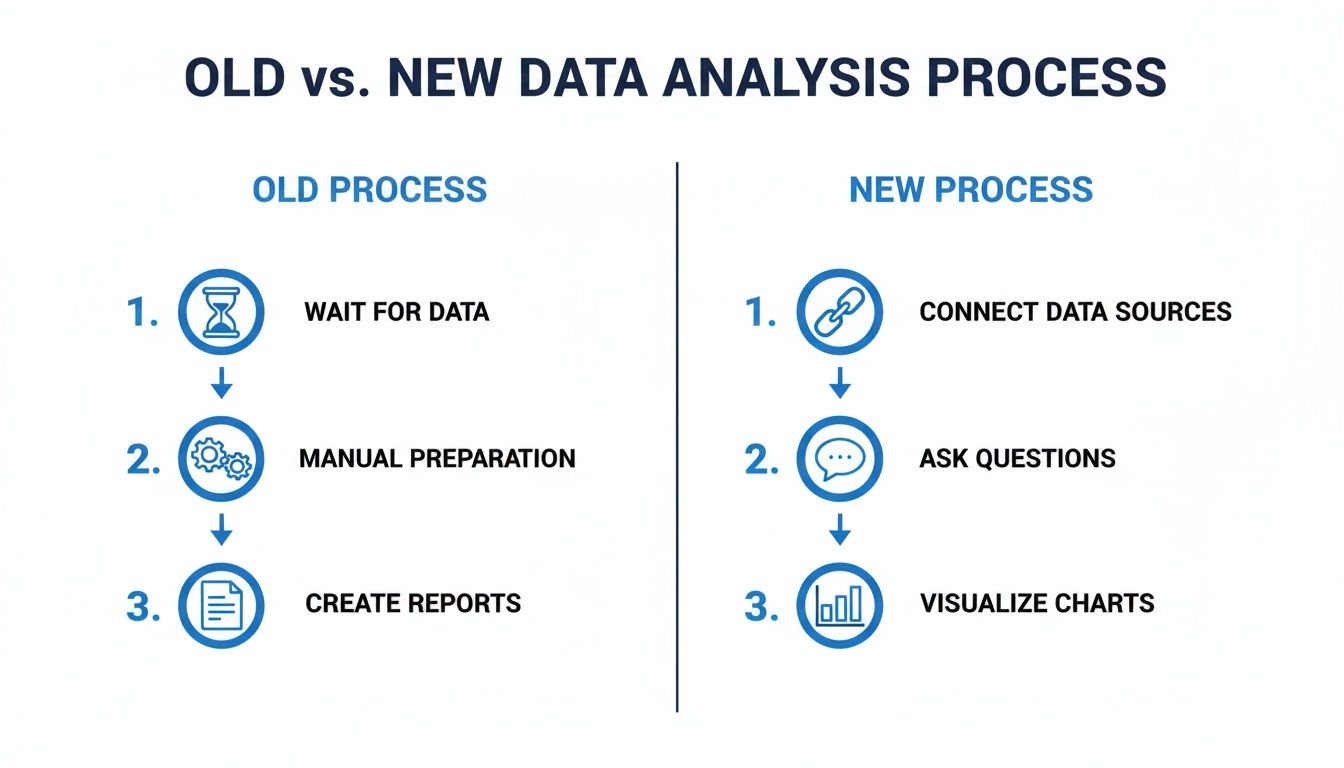
Infographic comparing old manual data analysis steps with new, efficient, and visual data analysis process.

The image above says it all: the frustrating "Wait, Manual, Report" cycle on one side, and the clean "Connect, Ask, Chart" approach on the other. It’s a massive leap in efficiency.

For Product Managers

Product managers live on user behavior data. Instead of waiting days for a report on a new feature, they can get answers right away. This kind of automated BI lets them iterate quicker and build a better product based on what's actually happening, not on hunches.

Try asking Statspresso: "Which features had the highest user engagement after our last release? Show me a daily trend line."

This speed turns roadmap planning from a slow, quarterly ritual into a dynamic, data-backed conversation.

For Marketing Leads

Marketing teams need to prove the value of their spend. With conversational analytics, a marketing lead can fine-tune campaigns in real-time. The days of waiting until month-end to find out a channel is a money pit are over.

  • Immediate Campaign ROI: Instantly check which campaigns are driving conversions.

  • Channel Optimization: Quickly compare what’s working across Google Ads, Facebook, and LinkedIn.

  • Audience Insights: Figure out which customer groups are responding best.

Try asking Statspresso: "Compare the conversion rates of our last three email campaigns by channel as a bar chart."

This allows for much more nimble budget decisions, helping turn marketing from a cost center into a predictable engine for growth.

For Founders and Executives

Founders need a 30,000-foot view of the business without getting stuck in the weeds. An AI agent for data analysis offers them a direct line to the KPIs that matter most.

AI adoption is expected to reach 72% of companies by 2025, and 63% of organizations are planning a global rollout of AI tools. Conversational analytics is becoming a fundamental part of how modern companies operate. You can learn more about these AI adoption findings from McKinsey's report.

With Statspresso, our Conversational AI Data Analyst, a founder can get a pulse on the entire business in seconds. They can finally skip the SQL and get back to steering the ship.

Integrating Your First AI Agent for Data Analysis

Getting started with an AI agent for data analysis is surprisingly straightforward. Forget six-month implementation projects. Today, you can go from question to answer in the time it takes to grab a coffee.

Hands holding a tablet displaying a data flow diagram: laptop, database with 'First Question', and security shield.

But before you dive in, know what to look for. Not all automated BI tools are created equal.

Choosing the Right Agent for Your Team

When evaluating an AI data agent, focus on three critical criteria:

  • Painless Connection: Does it support your databases out of the box? The connection process should be a secure, no-code setup that takes minutes, not weeks.

  • Zero-Training Usability: Can your team use it on day one? The interface should feel as natural as a chat app. If a tool requires a user manual, it has failed the simplicity test.

  • Trust and Transparency: A good 'GenBI' tool like Statspresso tackles this head-on by grounding every answer directly in your data. The agent should show its work, giving you complete confidence in the results.

Getting Started in Three Simple Steps

With a Conversational AI Data Analyst like Statspresso, the goal is to get you from curiosity to insight almost immediately. You can be up and running in under five minutes.

  1. Create Your Workspace: This is your team's central hub for data conversations.

  2. Connect Your First Data Source: Securely link your database or an app like Google Analytics.

  3. Ask Your First Question: That’s it. There is no step four.

Try asking Statspresso: "How many new users did we get last month from our Google Ads campaign?"

This approach removes the technical barriers that kept insights locked away. If you want to survey the landscape, our guide on AI data analysis tools offers a wider view. But honestly, the best way to understand an AI agent's power is to try one. Skip the SQL, connect your data, and just ask.

Why Conversational AI Is the Future of Analytics

Let's be blunt: traditional dashboards are rusty. They’re static, slow to build, and rarely answer the exact question you have in the moment. The future of business intelligence isn't another fixed report—it's dynamic, interactive, and conversational.

This is part of a bigger shift. Business software is finally becoming as intuitive as consumer apps. Instead of you learning the system's language, the system is learning to understand yours. That’s the powerful idea behind conversational analytics.

The Age of Instant Answers

Why wait days for a report when you can just ask a question? An AI agent for data analysis turns your database into a brilliant colleague you can talk to. This isn't just about moving faster; it's about creating a real competitive advantage.

This trend has serious momentum. North America is set to hold the largest AI market share in 2025 at 31.80%. Investment is staggering; in 2022, 542 different US AI companies each raised over USD 1.5 million. All that capital is fueling tools designed to tear down BI complexity. You can discover more insights on the AI market boom from Fortune Business Insights.

Bringing an AI agent for data analysis into your workflow is a strategic necessity for anyone who needs answers in seconds, not days.

Stop Waiting and Start a Conversation

The real magic of a tool like Statspresso, a Conversational AI Data Analyst, is how it empowers everyone. It gets rid of technical bottlenecks and puts data power directly into the hands of the people who need it.

  • No more ticket queues: Get answers instantly.

  • No more dashboard doom-scrolling: Just ask for the chart you need.

  • No more stale data: Make decisions based on what's happening right now.

The message is clear: Stop waiting for answers. Start a conversation with your data. It's time to skip the SQL and get the charts you need, right when you need them. For those who want to peek under the hood, the magic comes from advancements in Large Language Models (LLMs).

Ready to stop waiting and start asking? Connect your first data source to Statspresso for free and ask your first question.

Waiting weeks for a data analyst to build a dashboard is a relic of the past. You have gold sitting in your databases, but it's locked behind complex tools like SQL and Tableau. This lag between having a question and getting an answer kills momentum and leads to decisions based on gut feelings instead of hard numbers. This is the exact pain point an AI agent for data analysis solves—it gives you answers in seconds, not sprints.

The TL;DR: What to Remember About AI Data Agents

  • It’s a Conversation, Not Code: You can ask questions in plain English. With a Conversational AI Data Analyst like Statspresso, you skip the SQL and just ask your data a question to get a chart in seconds.

  • From Data to Answers, Instantly: Stop waiting for reports. An AI agent for data analysis puts the power to query data directly into your hands.

  • Self-Serve Insights for All: When marketing, product, and leadership can all get their own insights, the entire business becomes more responsive and data-driven.

  • Getting Started is Surprisingly Simple: You can connect a data source and ask your first meaningful question in minutes, not months.

Why Your Data Has Answers, But No One Has Time to Ask

We've all been there: staring at raw data from Shopify, Postgres, and HubSpot, feeling like the answers are just out of reach. You know there's gold in that data, but it's locked away behind complex tools and time-consuming queries. The old way of waiting weeks for an analyst to build a dashboard just doesn't cut it anymore.

This lag creates a frustrating gap between questions and decisions. Your most valuable information is right there, but you have no quick way to get to it. This is precisely the problem an AI agent for data analysis is built to solve.

The Shift to Conversational Analytics

The modern solution isn’t another complex dashboard; it's a simple conversation. Instead of needing to learn SQL or fight with a dozen filters, you can now just ask for what you need. It's as intuitive as talking to a team member.

A man analyzes data on a laptop, surrounded by icons for database security, privacy, and e-commerce.

This conversational approach is quickly becoming the new normal. A platform like Statspresso, a Conversational AI Data Analyst, takes your simple question and turns it into a ready-to-use chart instantly. You get to skip the SQL. Just ask your data a question and get a chart in seconds.

The broader trend confirms this shift. The global AI market is projected to hit an incredible USD 3,497.26 billion by 2033, fueled by a massive 30.6% CAGR from 2026 onwards. This explosive growth signals a global rush to adopt smarter, faster tools. You can read the full research on AI market growth trends to see the full picture.

Try asking Statspresso: "Show me my revenue by month for the last year as a bar chart."

This model gives power back to the people who need answers most—founders, product managers, and marketing leads. You no longer need to be a data guru to get expert-level insights, turning your raw data into your most strategic asset.

What Exactly Is an AI Agent for Data Analysis?

Let's cut through the buzzwords. An AI agent for data analysis isn't some far-off concept. Think of it as your smartest team member who happens to speak fluent 'data'—available 24/7, without needing coffee breaks. Essentially, it's an on-call analyst that understands plain English.

Man holding a colorful brain, ears, speech bubble, and bar graph, representing data analysis.

The core idea is straightforward. You have questions. Your data has the answers. The agent acts as the ultimate translator between the two, closing the gap that usually requires a technical expert.

How It Actually Works

This isn't magic; it's just smart automation. A modern AI agent for data analysis follows a few key steps to turn your question into a clear, actionable insight.

  • The Brain (Data Connection): The agent securely plugs into your databases and tools, whether that’s a Postgres database, Google Analytics, or your Shopify store. This gives it the raw material it needs—your actual, live business data.

  • The Ears (Natural Language Understanding): Next, it listens. When you ask, "What were our top-selling products last quarter?" it doesn't just register words; it grasps the intent behind them. This is the heart of conversational analytics.

  • The Voice (Automated Generation): Finally, it translates your English question into complex query code (the part you get to skip!). It runs that query, crunches the numbers, and instantly generates a clean chart or summary as the answer.

This entire process happens in seconds. A tool like Statspresso, a Conversational AI Data Analyst, is built to make this workflow effortless. You simply ask, and it delivers the chart.

Try asking Statspresso: “What were our top-selling products last month?”

The real breakthrough here is demolishing the technical barrier. To appreciate what these agents can do, it helps to understand the underlying AI agent frameworks that drive them. These are the engines that allow the agent to reason, plan, and execute tasks independently. You get to skip the SQL and go straight to the answer, making advanced analysis as easy as sending a message.

Old School BI vs. Modern AI: A Tale of Two Workflows

Let's be honest: for decades, getting answers from data has been a painful, drawn-out process. It’s a multi-step saga of tickets, emails, and a whole lot of waiting. You have a critical business question today, but you might not get the answer until next week.

The good news? That entire workflow is quickly becoming a relic. An AI agent for data analysis doesn't just speed things up; it rewrites the rules. It collapses a week-long request cycle into seconds.

Instead of fighting with technical dashboards or waiting in a data team's queue, you can now have a direct conversation with your data. This is the fundamental shift from old-school BI to modern conversational analytics.

The Agony of the Old Way

Think about the traditional path to getting a single chart. It was notoriously inefficient. You’d file a Jira ticket, explain the columns and filters you needed, and then wait. The analyst would write some SQL and send back a static image. See a mistake or want to tweak a date range? Back to the end of the line you go. This friction didn’t just slow down answers; it discouraged people from asking questions in the first place.

The Simplicity of the New Way

Now, contrast that with an AI-powered approach. With a tool like Statspresso, our Conversational AI Data Analyst, the workflow is refreshingly simple. No tickets, no queues, no code required. You just ask your question. You get your chart. It really is that direct.

For example, you could ask Statspresso: "Show me our monthly recurring revenue growth over the last 12 months, and break it down by subscription plan."

This isn’t just about being faster; it’s about becoming more agile. When answers are instant, you can ask follow-up questions, dig deeper into a trend, and make decisions while they still matter.

Data Analysis: The Old Way vs The New Way

Step

The Old Way (Manual SQL)

The New Way (Statspresso)

Getting Started

Submit a detailed ticket to the data team.

Connect your data source once (in minutes).

The Ask

Explain your needs via email; hope context isn't lost.

Ask a question directly in plain English.

Wait Time

Days or even weeks.

Seconds.

The Result

A static chart or a rigid dashboard.

An interactive chart you can immediately explore.

Follow-Up

Submit another ticket and go back into the queue.

Simply ask a follow-up question.

The new way is built for action. It removes every barrier between your curiosity and your answer. This is the power you get when you can skip the SQL. Just ask your data a question and get a chart in seconds.

How Different Teams Win with Conversational Analytics

An AI agent for data analysis isn’t just for your data team; it’s a genuine advantage for the entire company. When getting answers is as simple as asking a question, every department gets smarter and moves faster.

Infographic comparing old manual data analysis steps with new, efficient, and visual data analysis process.

The image above says it all: the frustrating "Wait, Manual, Report" cycle on one side, and the clean "Connect, Ask, Chart" approach on the other. It’s a massive leap in efficiency.

For Product Managers

Product managers live on user behavior data. Instead of waiting days for a report on a new feature, they can get answers right away. This kind of automated BI lets them iterate quicker and build a better product based on what's actually happening, not on hunches.

Try asking Statspresso: "Which features had the highest user engagement after our last release? Show me a daily trend line."

This speed turns roadmap planning from a slow, quarterly ritual into a dynamic, data-backed conversation.

For Marketing Leads

Marketing teams need to prove the value of their spend. With conversational analytics, a marketing lead can fine-tune campaigns in real-time. The days of waiting until month-end to find out a channel is a money pit are over.

  • Immediate Campaign ROI: Instantly check which campaigns are driving conversions.

  • Channel Optimization: Quickly compare what’s working across Google Ads, Facebook, and LinkedIn.

  • Audience Insights: Figure out which customer groups are responding best.

Try asking Statspresso: "Compare the conversion rates of our last three email campaigns by channel as a bar chart."

This allows for much more nimble budget decisions, helping turn marketing from a cost center into a predictable engine for growth.

For Founders and Executives

Founders need a 30,000-foot view of the business without getting stuck in the weeds. An AI agent for data analysis offers them a direct line to the KPIs that matter most.

AI adoption is expected to reach 72% of companies by 2025, and 63% of organizations are planning a global rollout of AI tools. Conversational analytics is becoming a fundamental part of how modern companies operate. You can learn more about these AI adoption findings from McKinsey's report.

With Statspresso, our Conversational AI Data Analyst, a founder can get a pulse on the entire business in seconds. They can finally skip the SQL and get back to steering the ship.

Integrating Your First AI Agent for Data Analysis

Getting started with an AI agent for data analysis is surprisingly straightforward. Forget six-month implementation projects. Today, you can go from question to answer in the time it takes to grab a coffee.

Hands holding a tablet displaying a data flow diagram: laptop, database with 'First Question', and security shield.

But before you dive in, know what to look for. Not all automated BI tools are created equal.

Choosing the Right Agent for Your Team

When evaluating an AI data agent, focus on three critical criteria:

  • Painless Connection: Does it support your databases out of the box? The connection process should be a secure, no-code setup that takes minutes, not weeks.

  • Zero-Training Usability: Can your team use it on day one? The interface should feel as natural as a chat app. If a tool requires a user manual, it has failed the simplicity test.

  • Trust and Transparency: A good 'GenBI' tool like Statspresso tackles this head-on by grounding every answer directly in your data. The agent should show its work, giving you complete confidence in the results.

Getting Started in Three Simple Steps

With a Conversational AI Data Analyst like Statspresso, the goal is to get you from curiosity to insight almost immediately. You can be up and running in under five minutes.

  1. Create Your Workspace: This is your team's central hub for data conversations.

  2. Connect Your First Data Source: Securely link your database or an app like Google Analytics.

  3. Ask Your First Question: That’s it. There is no step four.

Try asking Statspresso: "How many new users did we get last month from our Google Ads campaign?"

This approach removes the technical barriers that kept insights locked away. If you want to survey the landscape, our guide on AI data analysis tools offers a wider view. But honestly, the best way to understand an AI agent's power is to try one. Skip the SQL, connect your data, and just ask.

Why Conversational AI Is the Future of Analytics

Let's be blunt: traditional dashboards are rusty. They’re static, slow to build, and rarely answer the exact question you have in the moment. The future of business intelligence isn't another fixed report—it's dynamic, interactive, and conversational.

This is part of a bigger shift. Business software is finally becoming as intuitive as consumer apps. Instead of you learning the system's language, the system is learning to understand yours. That’s the powerful idea behind conversational analytics.

The Age of Instant Answers

Why wait days for a report when you can just ask a question? An AI agent for data analysis turns your database into a brilliant colleague you can talk to. This isn't just about moving faster; it's about creating a real competitive advantage.

This trend has serious momentum. North America is set to hold the largest AI market share in 2025 at 31.80%. Investment is staggering; in 2022, 542 different US AI companies each raised over USD 1.5 million. All that capital is fueling tools designed to tear down BI complexity. You can discover more insights on the AI market boom from Fortune Business Insights.

Bringing an AI agent for data analysis into your workflow is a strategic necessity for anyone who needs answers in seconds, not days.

Stop Waiting and Start a Conversation

The real magic of a tool like Statspresso, a Conversational AI Data Analyst, is how it empowers everyone. It gets rid of technical bottlenecks and puts data power directly into the hands of the people who need it.

  • No more ticket queues: Get answers instantly.

  • No more dashboard doom-scrolling: Just ask for the chart you need.

  • No more stale data: Make decisions based on what's happening right now.

The message is clear: Stop waiting for answers. Start a conversation with your data. It's time to skip the SQL and get the charts you need, right when you need them. For those who want to peek under the hood, the magic comes from advancements in Large Language Models (LLMs).

Ready to stop waiting and start asking? Connect your first data source to Statspresso for free and ask your first question.

Waiting weeks for a data analyst to build a dashboard is a relic of the past. You have gold sitting in your databases, but it's locked behind complex tools like SQL and Tableau. This lag between having a question and getting an answer kills momentum and leads to decisions based on gut feelings instead of hard numbers. This is the exact pain point an AI agent for data analysis solves—it gives you answers in seconds, not sprints.

The TL;DR: What to Remember About AI Data Agents

  • It’s a Conversation, Not Code: You can ask questions in plain English. With a Conversational AI Data Analyst like Statspresso, you skip the SQL and just ask your data a question to get a chart in seconds.

  • From Data to Answers, Instantly: Stop waiting for reports. An AI agent for data analysis puts the power to query data directly into your hands.

  • Self-Serve Insights for All: When marketing, product, and leadership can all get their own insights, the entire business becomes more responsive and data-driven.

  • Getting Started is Surprisingly Simple: You can connect a data source and ask your first meaningful question in minutes, not months.

Why Your Data Has Answers, But No One Has Time to Ask

We've all been there: staring at raw data from Shopify, Postgres, and HubSpot, feeling like the answers are just out of reach. You know there's gold in that data, but it's locked away behind complex tools and time-consuming queries. The old way of waiting weeks for an analyst to build a dashboard just doesn't cut it anymore.

This lag creates a frustrating gap between questions and decisions. Your most valuable information is right there, but you have no quick way to get to it. This is precisely the problem an AI agent for data analysis is built to solve.

The Shift to Conversational Analytics

The modern solution isn’t another complex dashboard; it's a simple conversation. Instead of needing to learn SQL or fight with a dozen filters, you can now just ask for what you need. It's as intuitive as talking to a team member.

A man analyzes data on a laptop, surrounded by icons for database security, privacy, and e-commerce.

This conversational approach is quickly becoming the new normal. A platform like Statspresso, a Conversational AI Data Analyst, takes your simple question and turns it into a ready-to-use chart instantly. You get to skip the SQL. Just ask your data a question and get a chart in seconds.

The broader trend confirms this shift. The global AI market is projected to hit an incredible USD 3,497.26 billion by 2033, fueled by a massive 30.6% CAGR from 2026 onwards. This explosive growth signals a global rush to adopt smarter, faster tools. You can read the full research on AI market growth trends to see the full picture.

Try asking Statspresso: "Show me my revenue by month for the last year as a bar chart."

This model gives power back to the people who need answers most—founders, product managers, and marketing leads. You no longer need to be a data guru to get expert-level insights, turning your raw data into your most strategic asset.

What Exactly Is an AI Agent for Data Analysis?

Let's cut through the buzzwords. An AI agent for data analysis isn't some far-off concept. Think of it as your smartest team member who happens to speak fluent 'data'—available 24/7, without needing coffee breaks. Essentially, it's an on-call analyst that understands plain English.

Man holding a colorful brain, ears, speech bubble, and bar graph, representing data analysis.

The core idea is straightforward. You have questions. Your data has the answers. The agent acts as the ultimate translator between the two, closing the gap that usually requires a technical expert.

How It Actually Works

This isn't magic; it's just smart automation. A modern AI agent for data analysis follows a few key steps to turn your question into a clear, actionable insight.

  • The Brain (Data Connection): The agent securely plugs into your databases and tools, whether that’s a Postgres database, Google Analytics, or your Shopify store. This gives it the raw material it needs—your actual, live business data.

  • The Ears (Natural Language Understanding): Next, it listens. When you ask, "What were our top-selling products last quarter?" it doesn't just register words; it grasps the intent behind them. This is the heart of conversational analytics.

  • The Voice (Automated Generation): Finally, it translates your English question into complex query code (the part you get to skip!). It runs that query, crunches the numbers, and instantly generates a clean chart or summary as the answer.

This entire process happens in seconds. A tool like Statspresso, a Conversational AI Data Analyst, is built to make this workflow effortless. You simply ask, and it delivers the chart.

Try asking Statspresso: “What were our top-selling products last month?”

The real breakthrough here is demolishing the technical barrier. To appreciate what these agents can do, it helps to understand the underlying AI agent frameworks that drive them. These are the engines that allow the agent to reason, plan, and execute tasks independently. You get to skip the SQL and go straight to the answer, making advanced analysis as easy as sending a message.

Old School BI vs. Modern AI: A Tale of Two Workflows

Let's be honest: for decades, getting answers from data has been a painful, drawn-out process. It’s a multi-step saga of tickets, emails, and a whole lot of waiting. You have a critical business question today, but you might not get the answer until next week.

The good news? That entire workflow is quickly becoming a relic. An AI agent for data analysis doesn't just speed things up; it rewrites the rules. It collapses a week-long request cycle into seconds.

Instead of fighting with technical dashboards or waiting in a data team's queue, you can now have a direct conversation with your data. This is the fundamental shift from old-school BI to modern conversational analytics.

The Agony of the Old Way

Think about the traditional path to getting a single chart. It was notoriously inefficient. You’d file a Jira ticket, explain the columns and filters you needed, and then wait. The analyst would write some SQL and send back a static image. See a mistake or want to tweak a date range? Back to the end of the line you go. This friction didn’t just slow down answers; it discouraged people from asking questions in the first place.

The Simplicity of the New Way

Now, contrast that with an AI-powered approach. With a tool like Statspresso, our Conversational AI Data Analyst, the workflow is refreshingly simple. No tickets, no queues, no code required. You just ask your question. You get your chart. It really is that direct.

For example, you could ask Statspresso: "Show me our monthly recurring revenue growth over the last 12 months, and break it down by subscription plan."

This isn’t just about being faster; it’s about becoming more agile. When answers are instant, you can ask follow-up questions, dig deeper into a trend, and make decisions while they still matter.

Data Analysis: The Old Way vs The New Way

Step

The Old Way (Manual SQL)

The New Way (Statspresso)

Getting Started

Submit a detailed ticket to the data team.

Connect your data source once (in minutes).

The Ask

Explain your needs via email; hope context isn't lost.

Ask a question directly in plain English.

Wait Time

Days or even weeks.

Seconds.

The Result

A static chart or a rigid dashboard.

An interactive chart you can immediately explore.

Follow-Up

Submit another ticket and go back into the queue.

Simply ask a follow-up question.

The new way is built for action. It removes every barrier between your curiosity and your answer. This is the power you get when you can skip the SQL. Just ask your data a question and get a chart in seconds.

How Different Teams Win with Conversational Analytics

An AI agent for data analysis isn’t just for your data team; it’s a genuine advantage for the entire company. When getting answers is as simple as asking a question, every department gets smarter and moves faster.

Infographic comparing old manual data analysis steps with new, efficient, and visual data analysis process.

The image above says it all: the frustrating "Wait, Manual, Report" cycle on one side, and the clean "Connect, Ask, Chart" approach on the other. It’s a massive leap in efficiency.

For Product Managers

Product managers live on user behavior data. Instead of waiting days for a report on a new feature, they can get answers right away. This kind of automated BI lets them iterate quicker and build a better product based on what's actually happening, not on hunches.

Try asking Statspresso: "Which features had the highest user engagement after our last release? Show me a daily trend line."

This speed turns roadmap planning from a slow, quarterly ritual into a dynamic, data-backed conversation.

For Marketing Leads

Marketing teams need to prove the value of their spend. With conversational analytics, a marketing lead can fine-tune campaigns in real-time. The days of waiting until month-end to find out a channel is a money pit are over.

  • Immediate Campaign ROI: Instantly check which campaigns are driving conversions.

  • Channel Optimization: Quickly compare what’s working across Google Ads, Facebook, and LinkedIn.

  • Audience Insights: Figure out which customer groups are responding best.

Try asking Statspresso: "Compare the conversion rates of our last three email campaigns by channel as a bar chart."

This allows for much more nimble budget decisions, helping turn marketing from a cost center into a predictable engine for growth.

For Founders and Executives

Founders need a 30,000-foot view of the business without getting stuck in the weeds. An AI agent for data analysis offers them a direct line to the KPIs that matter most.

AI adoption is expected to reach 72% of companies by 2025, and 63% of organizations are planning a global rollout of AI tools. Conversational analytics is becoming a fundamental part of how modern companies operate. You can learn more about these AI adoption findings from McKinsey's report.

With Statspresso, our Conversational AI Data Analyst, a founder can get a pulse on the entire business in seconds. They can finally skip the SQL and get back to steering the ship.

Integrating Your First AI Agent for Data Analysis

Getting started with an AI agent for data analysis is surprisingly straightforward. Forget six-month implementation projects. Today, you can go from question to answer in the time it takes to grab a coffee.

Hands holding a tablet displaying a data flow diagram: laptop, database with 'First Question', and security shield.

But before you dive in, know what to look for. Not all automated BI tools are created equal.

Choosing the Right Agent for Your Team

When evaluating an AI data agent, focus on three critical criteria:

  • Painless Connection: Does it support your databases out of the box? The connection process should be a secure, no-code setup that takes minutes, not weeks.

  • Zero-Training Usability: Can your team use it on day one? The interface should feel as natural as a chat app. If a tool requires a user manual, it has failed the simplicity test.

  • Trust and Transparency: A good 'GenBI' tool like Statspresso tackles this head-on by grounding every answer directly in your data. The agent should show its work, giving you complete confidence in the results.

Getting Started in Three Simple Steps

With a Conversational AI Data Analyst like Statspresso, the goal is to get you from curiosity to insight almost immediately. You can be up and running in under five minutes.

  1. Create Your Workspace: This is your team's central hub for data conversations.

  2. Connect Your First Data Source: Securely link your database or an app like Google Analytics.

  3. Ask Your First Question: That’s it. There is no step four.

Try asking Statspresso: "How many new users did we get last month from our Google Ads campaign?"

This approach removes the technical barriers that kept insights locked away. If you want to survey the landscape, our guide on AI data analysis tools offers a wider view. But honestly, the best way to understand an AI agent's power is to try one. Skip the SQL, connect your data, and just ask.

Why Conversational AI Is the Future of Analytics

Let's be blunt: traditional dashboards are rusty. They’re static, slow to build, and rarely answer the exact question you have in the moment. The future of business intelligence isn't another fixed report—it's dynamic, interactive, and conversational.

This is part of a bigger shift. Business software is finally becoming as intuitive as consumer apps. Instead of you learning the system's language, the system is learning to understand yours. That’s the powerful idea behind conversational analytics.

The Age of Instant Answers

Why wait days for a report when you can just ask a question? An AI agent for data analysis turns your database into a brilliant colleague you can talk to. This isn't just about moving faster; it's about creating a real competitive advantage.

This trend has serious momentum. North America is set to hold the largest AI market share in 2025 at 31.80%. Investment is staggering; in 2022, 542 different US AI companies each raised over USD 1.5 million. All that capital is fueling tools designed to tear down BI complexity. You can discover more insights on the AI market boom from Fortune Business Insights.

Bringing an AI agent for data analysis into your workflow is a strategic necessity for anyone who needs answers in seconds, not days.

Stop Waiting and Start a Conversation

The real magic of a tool like Statspresso, a Conversational AI Data Analyst, is how it empowers everyone. It gets rid of technical bottlenecks and puts data power directly into the hands of the people who need it.

  • No more ticket queues: Get answers instantly.

  • No more dashboard doom-scrolling: Just ask for the chart you need.

  • No more stale data: Make decisions based on what's happening right now.

The message is clear: Stop waiting for answers. Start a conversation with your data. It's time to skip the SQL and get the charts you need, right when you need them. For those who want to peek under the hood, the magic comes from advancements in Large Language Models (LLMs).

Ready to stop waiting and start asking? Connect your first data source to Statspresso for free and ask your first question.