

Unlock Instant Insights with Agentic AI for Business Intelligence

Tired of waiting for a data analyst to build a dashboard? That whole process is a relic of the past. Agentic AI for business intelligence isn't just another tool; it's an autonomous data analyst that joins your team. Instead of fumbling with SQL or BI software, you just ask a question. The AI finds the data, runs the analysis, and gives you a chart in seconds. It’s that simple.

TL;DR: Key Takeaways

  • Agentic AI is an Autonomous Analyst: Think of it as a Conversational AI Data Analyst that understands your goals, not just your commands. It figures out how to get an answer on its own.

  • Skip the SQL: The core benefit is speed. You can ask complex questions in plain English and get charts and insights immediately. No more waiting for data experts.

  • It's a Simple Workflow: Agentic AI works on an "Observe-Think-Act" loop. It understands your question, plans the analysis, and executes it without you lifting a finger.

  • Real-World Ready: This isn't science fiction. Tools like Statspresso connect directly to your data sources (Postgres, Shopify, etc.) and provide instant answers for founders, product managers, and marketers.

  • Get Started in Minutes: The old way meant a multi-week ticket. The new way is to connect your database and ask your first question.

Your Data Analyst Is Now an AI

A robot presents data on a tablet to a businessman, illustrating AI data analysis.

Let's be honest. You have an urgent question. The answer is buried in your company’s data. And the analysts who can find it are completely swamped. Waiting weeks for a new report is a classic bottleneck that kills momentum.

This is exactly what agentic AI for business intelligence solves. This isn't another chatbot or a fancier dashboard. It’s a new way to interact with your data. Think of it as an autonomous team member—a Conversational AI Data Analyst like Statspresso that's always on, ready to help the moment you need it.

The Leap from Fetching Data to Understanding Goals

Traditional BI tools are reactive. You have to tell them exactly what to do—which data to pull, from which tables, and how to display it. An agentic AI, on the other hand, is proactive. It understands your intent.

When you ask a question in plain English, the AI performs a whole series of tasks:

  • Identifies the Goal: It figures out the business question you're really trying to answer.

  • Selects the Right Tools: It determines which data sources hold the key, whether that's your Postgres database or your Google Analytics account.

  • Executes a Plan: It formulates and runs the necessary queries on its own.

  • Delivers the Insight: It decides the best way to present the findings, from a simple number to a full bar chart.

This isn't a theoretical concept. Recent industry reports project that by 2026, a significant number of companies will have adopted AI agents into their core operations. For busy founders and managers, it means no more waiting. Just answers. The value is simple: you can finally skip the SQL. Just ask your data a question and get a chart in seconds. This strategic move toward solutions like AI automation for businesses clarifies how roles are evolving, putting data power in everyone's hands.

How Agentic AI Actually Works

Think about the difference between a great accountant and a simple calculator.

A standard AI model is like a calculator. Give it a specific command, "add 2+2," and it returns a specific answer: "4." It’s fast and accurate, but it has no clue what your goal is. An agentic AI, however, is your accountant. You don't tell them which cells to sum. You give them a goal: "I need to understand our profitability for Q3." From there, they take over. That's what makes an AI "agentic."

The Observe-Think-Act Loop

So how does it do this? At its core, an agentic AI runs on a constant Observe-Think-Act loop. This feels much more like a human thought process than a rigid computer program.

  • Observe: The agent reads your question in plain English and takes stock of the available data sources—like your Postgres database or Google Analytics account.

  • Think: This is the strategy part. The agent breaks your broad goal into smaller tasks. If you ask, "Which marketing channels drove the most sales last quarter?" it thinks, "Okay, first I need sales data. Then, marketing data. I'll join them, filter by date, group by channel, and sum the revenue."

  • Act: With a plan in place, the agent gets to work. It runs queries, joins tables, and performs calculations. It might even decide a bar chart is the clearest way to show the results and generate one for you.

This iterative cycle is what allows it to handle complex follow-up questions and refine an analysis with you in real-time.

From Vague Questions to Concrete Charts

A Conversational AI Data Analyst like Statspresso uses this agentic workflow to close the gap between everyday business questions and complex data. An agent's real power is its autonomy. It's responsible for figuring out how to get the answer, not just executing commands.

Picture a product manager checking a key metric. Instead of filing a ticket and waiting days, they can just ask the AI analyst directly.

Try asking Statspresso: "Show me user retention by weekly cohort for customers who signed up in the last three months."

An agentic system translates that request into a sequence of actions. It connects to the database, finds signup dates, calculates cohorts, and builds a retention curve. You skip the SQL and get a chart immediately. This transforms data analysis from a formal project into a quick, conversational task.

How We Get Data Insights: The Old Way vs. The New Way

You know the old data drill. It starts with a great question and ends with a lot of waiting. You file a ticket, explain your idea to an analyst, and cross your fingers that the report you get back two weeks later is still useful. That entire workflow is a dinosaur.

The difference between the old way and the new, agent-driven approach is night and day. This is why the agentic AI for business intelligence market is taking off.

Analysis Step

The Old Way (Manual SQL & Dashboards)

The New Way (Statspresso's Agentic AI)

Initial Request

File a ticket; wait for an analyst to pick it up.

Ask a question directly in a chat interface.

Data Exploration

Analyst writes and rewrites SQL queries.

AI autonomously formulates and runs queries.

Revisions

Back-and-forth emails to tweak the chart.

Ask follow-up questions to iterate in seconds.

Final Delivery

A static dashboard arrives days/weeks later.

Get a live chart and explanation immediately.

From Question to Answer in Seconds

In the old model, you carefully crafted a request in a project management tool. With an agentic AI, you just ask in plain English.

For example, you could ask Statspresso: "Compare our Q1 revenue from new vs. returning customers as a pie chart."

The AI agent follows its simple, powerful loop: it observes your goal, thinks through a plan, and acts on it.
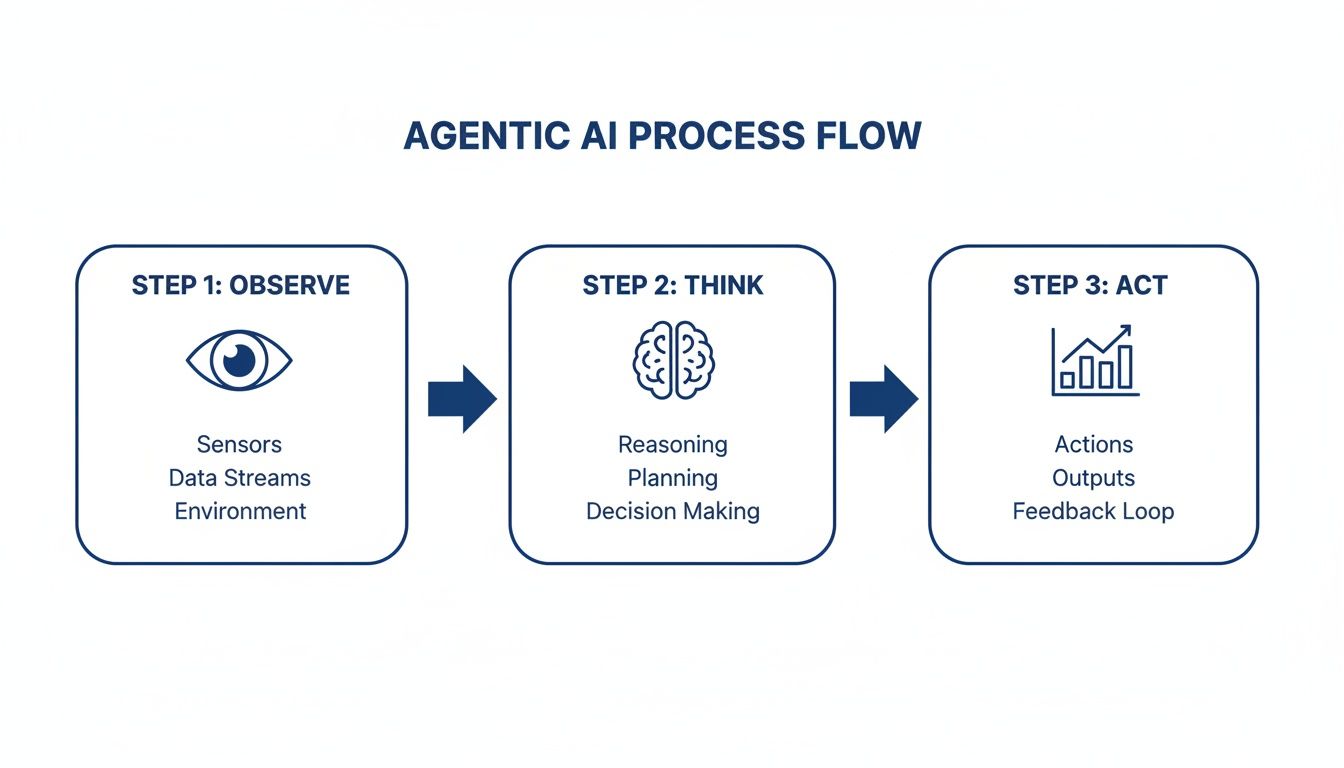
Diagram illustrating the Agentic AI process flow: Observe, Think, Act, with key components for each step.

This workflow is a practical application of a bigger idea: AI automation. It’s about building systems that can independently work toward a goal. A Conversational AI Data Analyst like Statspresso gives founders, product managers, and marketing leads direct access to answers. You can finally skip the SQL. Just ask your data a question and get a chart in seconds, turning data from a bottleneck into your best asset.

Putting Agentic AI to Work on Real Business Questions
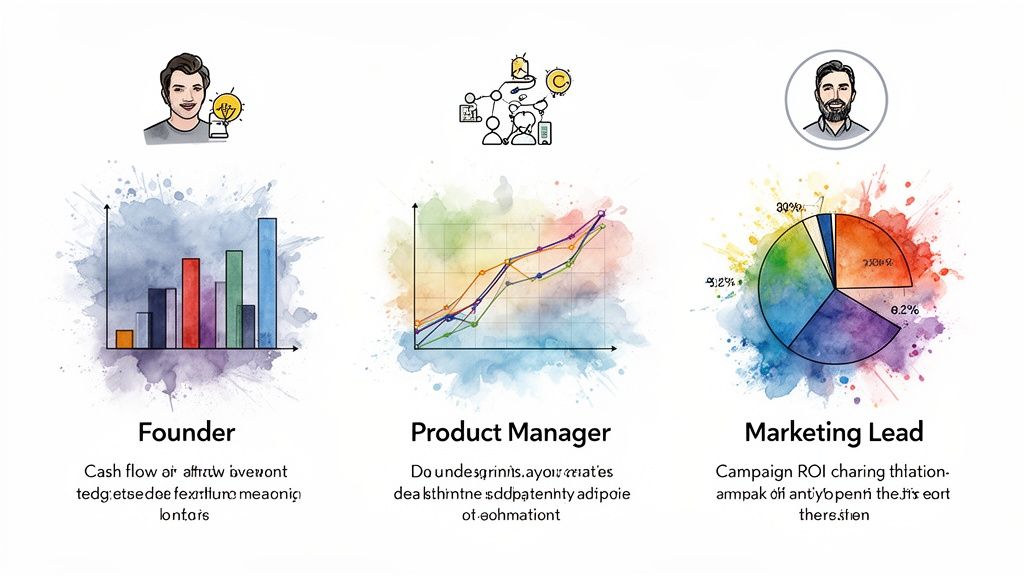
Three business roles: Founder, Product Manager, Marketing Lead, with data visualizations.

The theory is one thing, but how does this help you on a busy Tuesday afternoon? It's all about asking simple questions and getting immediate, useful answers. That’s where a Conversational AI Data Analyst like Statspresso becomes your most valuable teammate. You state your goal in plain English, and the agent figures out how to get you an answer.

For the Founder Watching the Bottom Line

Every founder is obsessed with cash flow. Instead of wrestling with CSVs or waiting on a report, you get a live look with a simple question.

Try asking Statspresso: "What was our monthly burn rate versus revenue for the last 6 months as a line chart?"

The AI agent springs into action. It knows where your financial data lives, calculates "burn rate" and "revenue," filters it, and builds the chart you asked for. The whole thing takes seconds. You skip the SQL. Just ask your data a question and get a chart in seconds.

For the Product Manager Tracking Adoption

You just pushed a new feature. Is anyone using it? The old way meant filing a ticket with engineering and waiting. With an agentic approach, you go right to the source.

  • Your Goal: Understand the immediate impact of a new feature.

  • The Old Process: File a ticket, wait, get a partial answer, argue about what "active user" means.

  • The New Way: Ask a direct question.

Try asking Statspresso: "Show me the daily active users for our 'New Dashboard' feature since it launched last week."

The AI agent understands the context. It finds the launch date, isolates user events for that feature, and charts the daily active users. You get a clear picture of adoption in hours, not weeks. This self-serve power is a cornerstone of AI-powered business intelligence, giving product teams the autonomy they need.

For the Marketing Lead Measuring ROI

Marketing teams are always under pressure to prove their worth. Connecting campaign spend to revenue is a massive headache. An agentic AI makes this surprisingly simple.

Try asking Statspresso: "Which of our Google Ads campaigns from Q2 had the best return on ad spend (ROAS)?"

Behind the scenes, the AI is running a multi-step analysis that would take a data expert all day:

  1. Pulls campaign spending from Google Ads data.

  2. Connects to your sales database (like Shopify or a Postgres DB) to find revenue.

  3. Joins the two datasets.

  4. Calculates ROAS for each campaign and gives you a sorted list.

The result is a clear answer to a million-dollar question, delivered without you writing a single line of code.

Building Your Autonomous BI Engine in Minutes

Setting up an agentic AI for business intelligence sounds like a massive engineering project. Not anymore. Modern platforms handle the heavy lifting, turning a six-month ordeal into a six-minute setup. Your only job? Connect your data.

This shift has changed the market. You can dig into more data on the agentic AI market to see just how fast things are moving. With a platform like Statspresso, you're getting a pre-built, fine-tuned agentic system from the get-go.

The Core Components Handled for You

Here’s a quick look at what’s happening under the hood, all managed for you:

  • Data Connectors: Securely link to your data sources—like Postgres, Shopify, or HubSpot—with a few clicks.

  • The LLM 'Brain': A large language model understands your questions and maps out a plan.

  • Tool-Use Module: This is the "doer." It executes the plan by writing and running queries.

  • The User Interface: A clean, simple chat interface where you ask questions and get insights.

You don't build any of these pieces; you just put them to work.

Keeping the Human in the Loop

Even with all this autonomy, you are always in control. This "human-in-the-loop" design is critical. You guide the agent, and the agent does the grunt work.

This collaboration is seamless:

  • Guide the Conversation: Ask follow-up questions to dig deeper. If a chart isn’t right, just say, "Change this to a bar chart."

  • Save Valuable Insights: Find something important? One click saves the AI-generated chart to a shared dashboard.

  • Ensure Governance: The AI operates through secure, read-only connections, so your source data is never modified.

You don't need an engineering team to get started with agentic AI. With a Conversational AI Data Analyst like Statspresso, you can connect your database and ask your first question in minutes.

Your Next Move: From Reading to Analyzing

If you’re still waiting days for data reports, your business is operating with a hand tied behind its back. The old way of doing business intelligence is officially obsolete. It's time to stop waiting.

The Bottom Line: What You Need to Know

Let's distill it down to the essentials.

  • Traditional BI is a Bottleneck: The process of getting answers from data is a frustrating waiting game.

  • Agentic AI is Your Autonomous Analyst: It understands your goal, figures out what to do, and brings back the insights.

  • Plain English is the New SQL: With a Conversational AI Data Analyst like Statspresso, you can skip the SQL. Just ask your data a question and get a chart in seconds.

  • This Technology is Here Now: Thousands of teams are already getting instant answers from their data sources like Postgres, Shopify, and HubSpot.

You've spent enough time waiting for reports. The next step isn't to read another article—it's to see how quickly you can get answers from your own data. Stop letting data bottlenecks dictate your pace.

Stop waiting for reports. Connect your first data source for free and ask your first question in the next five minutes.

Frequently Asked Questions

When we talk about bringing an agentic AI for business intelligence into a company, a few key questions always come up. Let's tackle them head-on.

Is My Data Secure When Using an Agentic AI?

This is the right question to ask first. A properly designed Conversational AI Data Analyst, like Statspresso, is built with security as a non-negotiable foundation. It works on a simple, safe principle: read-only access.

The AI connects to your data but fundamentally cannot change, delete, or write anything. Your data stays right where it is, under your control. On top of that, all communication is protected with end-to-end encryption. The vault is never compromised.

How Accurate Are the AI-Generated Answers?

A fast, wrong answer is dangerous. We get that. That’s why agentic AI systems are designed to ground every single response directly in your company’s own data. This isn't a general AI pulling facts from the internet; it works exclusively with the data you connect.

The system is built on total verifiability. For every chart the AI delivers, you can see the exact query it ran. This transparency allows anyone to audit the AI's logic and build trust. It’s not magic, it’s just math.

Can This Replace Our Existing BI Tools?

The answer isn't a simple yes or no. Agentic AI isn't meant to "rip and replace" your entire BI stack. It’s better to think of it as a powerful new layer that fills a huge gap: speed and accessibility.

  • Your existing BI tools are for complex, official company dashboards.

  • An agentic AI is your rapid-response team for the dozens of "what if" questions that pop up every day.

A platform like Statspresso sits alongside your existing systems. It gives everyone the power to get instant answers themselves, which frees up your dedicated data team for bigger projects. It’s about democratizing data so everyone can skip the SQL. Just ask your data a question and get a chart in seconds.

What Data Sources Can I Connect?

An agentic AI is only as useful as the data it can reach. You should be able to connect to the tools you already use with a few clicks. The most common connections are:

The goal is to bring your scattered data together in one conversational interface, giving your team a single place to get a complete picture of the business.

Ready to stop waiting and start getting answers?

Connect your first data source for free and ask your first question in the next five minutes.

Tired of waiting for a data analyst to build a dashboard? That whole process is a relic of the past. Agentic AI for business intelligence isn't just another tool; it's an autonomous data analyst that joins your team. Instead of fumbling with SQL or BI software, you just ask a question. The AI finds the data, runs the analysis, and gives you a chart in seconds. It’s that simple.

TL;DR: Key Takeaways

  • Agentic AI is an Autonomous Analyst: Think of it as a Conversational AI Data Analyst that understands your goals, not just your commands. It figures out how to get an answer on its own.

  • Skip the SQL: The core benefit is speed. You can ask complex questions in plain English and get charts and insights immediately. No more waiting for data experts.

  • It's a Simple Workflow: Agentic AI works on an "Observe-Think-Act" loop. It understands your question, plans the analysis, and executes it without you lifting a finger.

  • Real-World Ready: This isn't science fiction. Tools like Statspresso connect directly to your data sources (Postgres, Shopify, etc.) and provide instant answers for founders, product managers, and marketers.

  • Get Started in Minutes: The old way meant a multi-week ticket. The new way is to connect your database and ask your first question.

Your Data Analyst Is Now an AI

A robot presents data on a tablet to a businessman, illustrating AI data analysis.

Let's be honest. You have an urgent question. The answer is buried in your company’s data. And the analysts who can find it are completely swamped. Waiting weeks for a new report is a classic bottleneck that kills momentum.

This is exactly what agentic AI for business intelligence solves. This isn't another chatbot or a fancier dashboard. It’s a new way to interact with your data. Think of it as an autonomous team member—a Conversational AI Data Analyst like Statspresso that's always on, ready to help the moment you need it.

The Leap from Fetching Data to Understanding Goals

Traditional BI tools are reactive. You have to tell them exactly what to do—which data to pull, from which tables, and how to display it. An agentic AI, on the other hand, is proactive. It understands your intent.

When you ask a question in plain English, the AI performs a whole series of tasks:

  • Identifies the Goal: It figures out the business question you're really trying to answer.

  • Selects the Right Tools: It determines which data sources hold the key, whether that's your Postgres database or your Google Analytics account.

  • Executes a Plan: It formulates and runs the necessary queries on its own.

  • Delivers the Insight: It decides the best way to present the findings, from a simple number to a full bar chart.

This isn't a theoretical concept. Recent industry reports project that by 2026, a significant number of companies will have adopted AI agents into their core operations. For busy founders and managers, it means no more waiting. Just answers. The value is simple: you can finally skip the SQL. Just ask your data a question and get a chart in seconds. This strategic move toward solutions like AI automation for businesses clarifies how roles are evolving, putting data power in everyone's hands.

How Agentic AI Actually Works

Think about the difference between a great accountant and a simple calculator.

A standard AI model is like a calculator. Give it a specific command, "add 2+2," and it returns a specific answer: "4." It’s fast and accurate, but it has no clue what your goal is. An agentic AI, however, is your accountant. You don't tell them which cells to sum. You give them a goal: "I need to understand our profitability for Q3." From there, they take over. That's what makes an AI "agentic."

The Observe-Think-Act Loop

So how does it do this? At its core, an agentic AI runs on a constant Observe-Think-Act loop. This feels much more like a human thought process than a rigid computer program.

  • Observe: The agent reads your question in plain English and takes stock of the available data sources—like your Postgres database or Google Analytics account.

  • Think: This is the strategy part. The agent breaks your broad goal into smaller tasks. If you ask, "Which marketing channels drove the most sales last quarter?" it thinks, "Okay, first I need sales data. Then, marketing data. I'll join them, filter by date, group by channel, and sum the revenue."

  • Act: With a plan in place, the agent gets to work. It runs queries, joins tables, and performs calculations. It might even decide a bar chart is the clearest way to show the results and generate one for you.

This iterative cycle is what allows it to handle complex follow-up questions and refine an analysis with you in real-time.

From Vague Questions to Concrete Charts

A Conversational AI Data Analyst like Statspresso uses this agentic workflow to close the gap between everyday business questions and complex data. An agent's real power is its autonomy. It's responsible for figuring out how to get the answer, not just executing commands.

Picture a product manager checking a key metric. Instead of filing a ticket and waiting days, they can just ask the AI analyst directly.

Try asking Statspresso: "Show me user retention by weekly cohort for customers who signed up in the last three months."

An agentic system translates that request into a sequence of actions. It connects to the database, finds signup dates, calculates cohorts, and builds a retention curve. You skip the SQL and get a chart immediately. This transforms data analysis from a formal project into a quick, conversational task.

How We Get Data Insights: The Old Way vs. The New Way

You know the old data drill. It starts with a great question and ends with a lot of waiting. You file a ticket, explain your idea to an analyst, and cross your fingers that the report you get back two weeks later is still useful. That entire workflow is a dinosaur.

The difference between the old way and the new, agent-driven approach is night and day. This is why the agentic AI for business intelligence market is taking off.

Analysis Step

The Old Way (Manual SQL & Dashboards)

The New Way (Statspresso's Agentic AI)

Initial Request

File a ticket; wait for an analyst to pick it up.

Ask a question directly in a chat interface.

Data Exploration

Analyst writes and rewrites SQL queries.

AI autonomously formulates and runs queries.

Revisions

Back-and-forth emails to tweak the chart.

Ask follow-up questions to iterate in seconds.

Final Delivery

A static dashboard arrives days/weeks later.

Get a live chart and explanation immediately.

From Question to Answer in Seconds

In the old model, you carefully crafted a request in a project management tool. With an agentic AI, you just ask in plain English.

For example, you could ask Statspresso: "Compare our Q1 revenue from new vs. returning customers as a pie chart."

The AI agent follows its simple, powerful loop: it observes your goal, thinks through a plan, and acts on it.

Diagram illustrating the Agentic AI process flow: Observe, Think, Act, with key components for each step.

This workflow is a practical application of a bigger idea: AI automation. It’s about building systems that can independently work toward a goal. A Conversational AI Data Analyst like Statspresso gives founders, product managers, and marketing leads direct access to answers. You can finally skip the SQL. Just ask your data a question and get a chart in seconds, turning data from a bottleneck into your best asset.

Putting Agentic AI to Work on Real Business Questions

Three business roles: Founder, Product Manager, Marketing Lead, with data visualizations.

The theory is one thing, but how does this help you on a busy Tuesday afternoon? It's all about asking simple questions and getting immediate, useful answers. That’s where a Conversational AI Data Analyst like Statspresso becomes your most valuable teammate. You state your goal in plain English, and the agent figures out how to get you an answer.

For the Founder Watching the Bottom Line

Every founder is obsessed with cash flow. Instead of wrestling with CSVs or waiting on a report, you get a live look with a simple question.

Try asking Statspresso: "What was our monthly burn rate versus revenue for the last 6 months as a line chart?"

The AI agent springs into action. It knows where your financial data lives, calculates "burn rate" and "revenue," filters it, and builds the chart you asked for. The whole thing takes seconds. You skip the SQL. Just ask your data a question and get a chart in seconds.

For the Product Manager Tracking Adoption

You just pushed a new feature. Is anyone using it? The old way meant filing a ticket with engineering and waiting. With an agentic approach, you go right to the source.

  • Your Goal: Understand the immediate impact of a new feature.

  • The Old Process: File a ticket, wait, get a partial answer, argue about what "active user" means.

  • The New Way: Ask a direct question.

Try asking Statspresso: "Show me the daily active users for our 'New Dashboard' feature since it launched last week."

The AI agent understands the context. It finds the launch date, isolates user events for that feature, and charts the daily active users. You get a clear picture of adoption in hours, not weeks. This self-serve power is a cornerstone of AI-powered business intelligence, giving product teams the autonomy they need.

For the Marketing Lead Measuring ROI

Marketing teams are always under pressure to prove their worth. Connecting campaign spend to revenue is a massive headache. An agentic AI makes this surprisingly simple.

Try asking Statspresso: "Which of our Google Ads campaigns from Q2 had the best return on ad spend (ROAS)?"

Behind the scenes, the AI is running a multi-step analysis that would take a data expert all day:

  1. Pulls campaign spending from Google Ads data.

  2. Connects to your sales database (like Shopify or a Postgres DB) to find revenue.

  3. Joins the two datasets.

  4. Calculates ROAS for each campaign and gives you a sorted list.

The result is a clear answer to a million-dollar question, delivered without you writing a single line of code.

Building Your Autonomous BI Engine in Minutes

Setting up an agentic AI for business intelligence sounds like a massive engineering project. Not anymore. Modern platforms handle the heavy lifting, turning a six-month ordeal into a six-minute setup. Your only job? Connect your data.

This shift has changed the market. You can dig into more data on the agentic AI market to see just how fast things are moving. With a platform like Statspresso, you're getting a pre-built, fine-tuned agentic system from the get-go.

The Core Components Handled for You

Here’s a quick look at what’s happening under the hood, all managed for you:

  • Data Connectors: Securely link to your data sources—like Postgres, Shopify, or HubSpot—with a few clicks.

  • The LLM 'Brain': A large language model understands your questions and maps out a plan.

  • Tool-Use Module: This is the "doer." It executes the plan by writing and running queries.

  • The User Interface: A clean, simple chat interface where you ask questions and get insights.

You don't build any of these pieces; you just put them to work.

Keeping the Human in the Loop

Even with all this autonomy, you are always in control. This "human-in-the-loop" design is critical. You guide the agent, and the agent does the grunt work.

This collaboration is seamless:

  • Guide the Conversation: Ask follow-up questions to dig deeper. If a chart isn’t right, just say, "Change this to a bar chart."

  • Save Valuable Insights: Find something important? One click saves the AI-generated chart to a shared dashboard.

  • Ensure Governance: The AI operates through secure, read-only connections, so your source data is never modified.

You don't need an engineering team to get started with agentic AI. With a Conversational AI Data Analyst like Statspresso, you can connect your database and ask your first question in minutes.

Your Next Move: From Reading to Analyzing

If you’re still waiting days for data reports, your business is operating with a hand tied behind its back. The old way of doing business intelligence is officially obsolete. It's time to stop waiting.

The Bottom Line: What You Need to Know

Let's distill it down to the essentials.

  • Traditional BI is a Bottleneck: The process of getting answers from data is a frustrating waiting game.

  • Agentic AI is Your Autonomous Analyst: It understands your goal, figures out what to do, and brings back the insights.

  • Plain English is the New SQL: With a Conversational AI Data Analyst like Statspresso, you can skip the SQL. Just ask your data a question and get a chart in seconds.

  • This Technology is Here Now: Thousands of teams are already getting instant answers from their data sources like Postgres, Shopify, and HubSpot.

You've spent enough time waiting for reports. The next step isn't to read another article—it's to see how quickly you can get answers from your own data. Stop letting data bottlenecks dictate your pace.

Stop waiting for reports. Connect your first data source for free and ask your first question in the next five minutes.

Frequently Asked Questions

When we talk about bringing an agentic AI for business intelligence into a company, a few key questions always come up. Let's tackle them head-on.

Is My Data Secure When Using an Agentic AI?

This is the right question to ask first. A properly designed Conversational AI Data Analyst, like Statspresso, is built with security as a non-negotiable foundation. It works on a simple, safe principle: read-only access.

The AI connects to your data but fundamentally cannot change, delete, or write anything. Your data stays right where it is, under your control. On top of that, all communication is protected with end-to-end encryption. The vault is never compromised.

How Accurate Are the AI-Generated Answers?

A fast, wrong answer is dangerous. We get that. That’s why agentic AI systems are designed to ground every single response directly in your company’s own data. This isn't a general AI pulling facts from the internet; it works exclusively with the data you connect.

The system is built on total verifiability. For every chart the AI delivers, you can see the exact query it ran. This transparency allows anyone to audit the AI's logic and build trust. It’s not magic, it’s just math.

Can This Replace Our Existing BI Tools?

The answer isn't a simple yes or no. Agentic AI isn't meant to "rip and replace" your entire BI stack. It’s better to think of it as a powerful new layer that fills a huge gap: speed and accessibility.

  • Your existing BI tools are for complex, official company dashboards.

  • An agentic AI is your rapid-response team for the dozens of "what if" questions that pop up every day.

A platform like Statspresso sits alongside your existing systems. It gives everyone the power to get instant answers themselves, which frees up your dedicated data team for bigger projects. It’s about democratizing data so everyone can skip the SQL. Just ask your data a question and get a chart in seconds.

What Data Sources Can I Connect?

An agentic AI is only as useful as the data it can reach. You should be able to connect to the tools you already use with a few clicks. The most common connections are:

The goal is to bring your scattered data together in one conversational interface, giving your team a single place to get a complete picture of the business.

Ready to stop waiting and start getting answers?

Connect your first data source for free and ask your first question in the next five minutes.

Tired of waiting for a data analyst to build a dashboard? That whole process is a relic of the past. Agentic AI for business intelligence isn't just another tool; it's an autonomous data analyst that joins your team. Instead of fumbling with SQL or BI software, you just ask a question. The AI finds the data, runs the analysis, and gives you a chart in seconds. It’s that simple.

TL;DR: Key Takeaways

  • Agentic AI is an Autonomous Analyst: Think of it as a Conversational AI Data Analyst that understands your goals, not just your commands. It figures out how to get an answer on its own.

  • Skip the SQL: The core benefit is speed. You can ask complex questions in plain English and get charts and insights immediately. No more waiting for data experts.

  • It's a Simple Workflow: Agentic AI works on an "Observe-Think-Act" loop. It understands your question, plans the analysis, and executes it without you lifting a finger.

  • Real-World Ready: This isn't science fiction. Tools like Statspresso connect directly to your data sources (Postgres, Shopify, etc.) and provide instant answers for founders, product managers, and marketers.

  • Get Started in Minutes: The old way meant a multi-week ticket. The new way is to connect your database and ask your first question.

Your Data Analyst Is Now an AI

A robot presents data on a tablet to a businessman, illustrating AI data analysis.

Let's be honest. You have an urgent question. The answer is buried in your company’s data. And the analysts who can find it are completely swamped. Waiting weeks for a new report is a classic bottleneck that kills momentum.

This is exactly what agentic AI for business intelligence solves. This isn't another chatbot or a fancier dashboard. It’s a new way to interact with your data. Think of it as an autonomous team member—a Conversational AI Data Analyst like Statspresso that's always on, ready to help the moment you need it.

The Leap from Fetching Data to Understanding Goals

Traditional BI tools are reactive. You have to tell them exactly what to do—which data to pull, from which tables, and how to display it. An agentic AI, on the other hand, is proactive. It understands your intent.

When you ask a question in plain English, the AI performs a whole series of tasks:

  • Identifies the Goal: It figures out the business question you're really trying to answer.

  • Selects the Right Tools: It determines which data sources hold the key, whether that's your Postgres database or your Google Analytics account.

  • Executes a Plan: It formulates and runs the necessary queries on its own.

  • Delivers the Insight: It decides the best way to present the findings, from a simple number to a full bar chart.

This isn't a theoretical concept. Recent industry reports project that by 2026, a significant number of companies will have adopted AI agents into their core operations. For busy founders and managers, it means no more waiting. Just answers. The value is simple: you can finally skip the SQL. Just ask your data a question and get a chart in seconds. This strategic move toward solutions like AI automation for businesses clarifies how roles are evolving, putting data power in everyone's hands.

How Agentic AI Actually Works

Think about the difference between a great accountant and a simple calculator.

A standard AI model is like a calculator. Give it a specific command, "add 2+2," and it returns a specific answer: "4." It’s fast and accurate, but it has no clue what your goal is. An agentic AI, however, is your accountant. You don't tell them which cells to sum. You give them a goal: "I need to understand our profitability for Q3." From there, they take over. That's what makes an AI "agentic."

The Observe-Think-Act Loop

So how does it do this? At its core, an agentic AI runs on a constant Observe-Think-Act loop. This feels much more like a human thought process than a rigid computer program.

  • Observe: The agent reads your question in plain English and takes stock of the available data sources—like your Postgres database or Google Analytics account.

  • Think: This is the strategy part. The agent breaks your broad goal into smaller tasks. If you ask, "Which marketing channels drove the most sales last quarter?" it thinks, "Okay, first I need sales data. Then, marketing data. I'll join them, filter by date, group by channel, and sum the revenue."

  • Act: With a plan in place, the agent gets to work. It runs queries, joins tables, and performs calculations. It might even decide a bar chart is the clearest way to show the results and generate one for you.

This iterative cycle is what allows it to handle complex follow-up questions and refine an analysis with you in real-time.

From Vague Questions to Concrete Charts

A Conversational AI Data Analyst like Statspresso uses this agentic workflow to close the gap between everyday business questions and complex data. An agent's real power is its autonomy. It's responsible for figuring out how to get the answer, not just executing commands.

Picture a product manager checking a key metric. Instead of filing a ticket and waiting days, they can just ask the AI analyst directly.

Try asking Statspresso: "Show me user retention by weekly cohort for customers who signed up in the last three months."

An agentic system translates that request into a sequence of actions. It connects to the database, finds signup dates, calculates cohorts, and builds a retention curve. You skip the SQL and get a chart immediately. This transforms data analysis from a formal project into a quick, conversational task.

How We Get Data Insights: The Old Way vs. The New Way

You know the old data drill. It starts with a great question and ends with a lot of waiting. You file a ticket, explain your idea to an analyst, and cross your fingers that the report you get back two weeks later is still useful. That entire workflow is a dinosaur.

The difference between the old way and the new, agent-driven approach is night and day. This is why the agentic AI for business intelligence market is taking off.

Analysis Step

The Old Way (Manual SQL & Dashboards)

The New Way (Statspresso's Agentic AI)

Initial Request

File a ticket; wait for an analyst to pick it up.

Ask a question directly in a chat interface.

Data Exploration

Analyst writes and rewrites SQL queries.

AI autonomously formulates and runs queries.

Revisions

Back-and-forth emails to tweak the chart.

Ask follow-up questions to iterate in seconds.

Final Delivery

A static dashboard arrives days/weeks later.

Get a live chart and explanation immediately.

From Question to Answer in Seconds

In the old model, you carefully crafted a request in a project management tool. With an agentic AI, you just ask in plain English.

For example, you could ask Statspresso: "Compare our Q1 revenue from new vs. returning customers as a pie chart."

The AI agent follows its simple, powerful loop: it observes your goal, thinks through a plan, and acts on it.

Diagram illustrating the Agentic AI process flow: Observe, Think, Act, with key components for each step.

This workflow is a practical application of a bigger idea: AI automation. It’s about building systems that can independently work toward a goal. A Conversational AI Data Analyst like Statspresso gives founders, product managers, and marketing leads direct access to answers. You can finally skip the SQL. Just ask your data a question and get a chart in seconds, turning data from a bottleneck into your best asset.

Putting Agentic AI to Work on Real Business Questions

Three business roles: Founder, Product Manager, Marketing Lead, with data visualizations.

The theory is one thing, but how does this help you on a busy Tuesday afternoon? It's all about asking simple questions and getting immediate, useful answers. That’s where a Conversational AI Data Analyst like Statspresso becomes your most valuable teammate. You state your goal in plain English, and the agent figures out how to get you an answer.

For the Founder Watching the Bottom Line

Every founder is obsessed with cash flow. Instead of wrestling with CSVs or waiting on a report, you get a live look with a simple question.

Try asking Statspresso: "What was our monthly burn rate versus revenue for the last 6 months as a line chart?"

The AI agent springs into action. It knows where your financial data lives, calculates "burn rate" and "revenue," filters it, and builds the chart you asked for. The whole thing takes seconds. You skip the SQL. Just ask your data a question and get a chart in seconds.

For the Product Manager Tracking Adoption

You just pushed a new feature. Is anyone using it? The old way meant filing a ticket with engineering and waiting. With an agentic approach, you go right to the source.

  • Your Goal: Understand the immediate impact of a new feature.

  • The Old Process: File a ticket, wait, get a partial answer, argue about what "active user" means.

  • The New Way: Ask a direct question.

Try asking Statspresso: "Show me the daily active users for our 'New Dashboard' feature since it launched last week."

The AI agent understands the context. It finds the launch date, isolates user events for that feature, and charts the daily active users. You get a clear picture of adoption in hours, not weeks. This self-serve power is a cornerstone of AI-powered business intelligence, giving product teams the autonomy they need.

For the Marketing Lead Measuring ROI

Marketing teams are always under pressure to prove their worth. Connecting campaign spend to revenue is a massive headache. An agentic AI makes this surprisingly simple.

Try asking Statspresso: "Which of our Google Ads campaigns from Q2 had the best return on ad spend (ROAS)?"

Behind the scenes, the AI is running a multi-step analysis that would take a data expert all day:

  1. Pulls campaign spending from Google Ads data.

  2. Connects to your sales database (like Shopify or a Postgres DB) to find revenue.

  3. Joins the two datasets.

  4. Calculates ROAS for each campaign and gives you a sorted list.

The result is a clear answer to a million-dollar question, delivered without you writing a single line of code.

Building Your Autonomous BI Engine in Minutes

Setting up an agentic AI for business intelligence sounds like a massive engineering project. Not anymore. Modern platforms handle the heavy lifting, turning a six-month ordeal into a six-minute setup. Your only job? Connect your data.

This shift has changed the market. You can dig into more data on the agentic AI market to see just how fast things are moving. With a platform like Statspresso, you're getting a pre-built, fine-tuned agentic system from the get-go.

The Core Components Handled for You

Here’s a quick look at what’s happening under the hood, all managed for you:

  • Data Connectors: Securely link to your data sources—like Postgres, Shopify, or HubSpot—with a few clicks.

  • The LLM 'Brain': A large language model understands your questions and maps out a plan.

  • Tool-Use Module: This is the "doer." It executes the plan by writing and running queries.

  • The User Interface: A clean, simple chat interface where you ask questions and get insights.

You don't build any of these pieces; you just put them to work.

Keeping the Human in the Loop

Even with all this autonomy, you are always in control. This "human-in-the-loop" design is critical. You guide the agent, and the agent does the grunt work.

This collaboration is seamless:

  • Guide the Conversation: Ask follow-up questions to dig deeper. If a chart isn’t right, just say, "Change this to a bar chart."

  • Save Valuable Insights: Find something important? One click saves the AI-generated chart to a shared dashboard.

  • Ensure Governance: The AI operates through secure, read-only connections, so your source data is never modified.

You don't need an engineering team to get started with agentic AI. With a Conversational AI Data Analyst like Statspresso, you can connect your database and ask your first question in minutes.

Your Next Move: From Reading to Analyzing

If you’re still waiting days for data reports, your business is operating with a hand tied behind its back. The old way of doing business intelligence is officially obsolete. It's time to stop waiting.

The Bottom Line: What You Need to Know

Let's distill it down to the essentials.

  • Traditional BI is a Bottleneck: The process of getting answers from data is a frustrating waiting game.

  • Agentic AI is Your Autonomous Analyst: It understands your goal, figures out what to do, and brings back the insights.

  • Plain English is the New SQL: With a Conversational AI Data Analyst like Statspresso, you can skip the SQL. Just ask your data a question and get a chart in seconds.

  • This Technology is Here Now: Thousands of teams are already getting instant answers from their data sources like Postgres, Shopify, and HubSpot.

You've spent enough time waiting for reports. The next step isn't to read another article—it's to see how quickly you can get answers from your own data. Stop letting data bottlenecks dictate your pace.

Stop waiting for reports. Connect your first data source for free and ask your first question in the next five minutes.

Frequently Asked Questions

When we talk about bringing an agentic AI for business intelligence into a company, a few key questions always come up. Let's tackle them head-on.

Is My Data Secure When Using an Agentic AI?

This is the right question to ask first. A properly designed Conversational AI Data Analyst, like Statspresso, is built with security as a non-negotiable foundation. It works on a simple, safe principle: read-only access.

The AI connects to your data but fundamentally cannot change, delete, or write anything. Your data stays right where it is, under your control. On top of that, all communication is protected with end-to-end encryption. The vault is never compromised.

How Accurate Are the AI-Generated Answers?

A fast, wrong answer is dangerous. We get that. That’s why agentic AI systems are designed to ground every single response directly in your company’s own data. This isn't a general AI pulling facts from the internet; it works exclusively with the data you connect.

The system is built on total verifiability. For every chart the AI delivers, you can see the exact query it ran. This transparency allows anyone to audit the AI's logic and build trust. It’s not magic, it’s just math.

Can This Replace Our Existing BI Tools?

The answer isn't a simple yes or no. Agentic AI isn't meant to "rip and replace" your entire BI stack. It’s better to think of it as a powerful new layer that fills a huge gap: speed and accessibility.

  • Your existing BI tools are for complex, official company dashboards.

  • An agentic AI is your rapid-response team for the dozens of "what if" questions that pop up every day.

A platform like Statspresso sits alongside your existing systems. It gives everyone the power to get instant answers themselves, which frees up your dedicated data team for bigger projects. It’s about democratizing data so everyone can skip the SQL. Just ask your data a question and get a chart in seconds.

What Data Sources Can I Connect?

An agentic AI is only as useful as the data it can reach. You should be able to connect to the tools you already use with a few clicks. The most common connections are:

The goal is to bring your scattered data together in one conversational interface, giving your team a single place to get a complete picture of the business.

Ready to stop waiting and start getting answers?

Connect your first data source for free and ask your first question in the next five minutes.