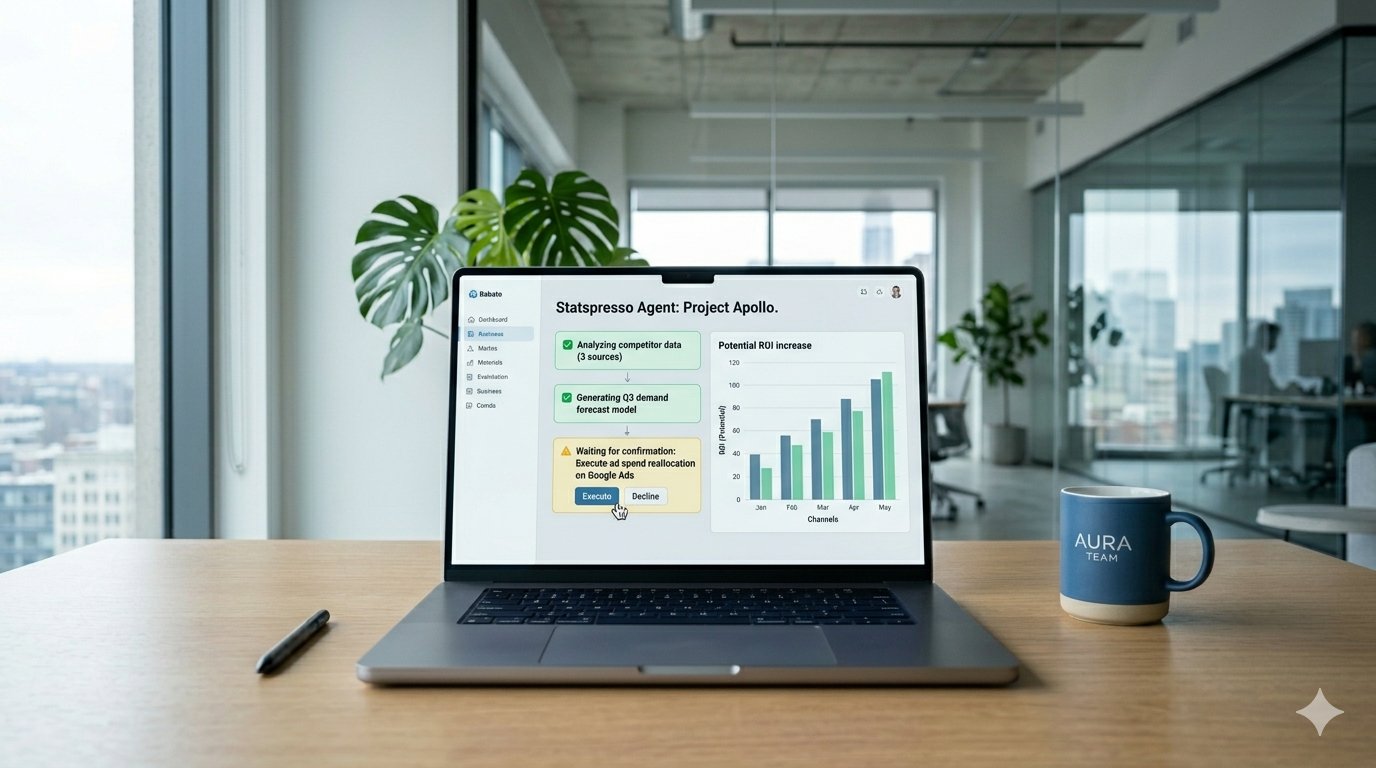

Your New Coworker Is an AI Agent for Analytics

Your data is full of answers. The problem? You're a busy founder, not a full-time data wizard. Filing a ticket and waiting weeks for a data analyst to build a dashboard is a relic of the past. Getting a simple chart shouldn't be a project. It should take seconds.

That old process is officially broken.

Your Data Has Answers, But Who Has Time to Ask?

Waiting for a dashboard just doesn't cut it anymore. Every critical business question—"Which marketing channel has the best ROI?" or "Why did user signups dip last Tuesday?"—demands an immediate, data-backed answer. The bottleneck isn't a lack of data; it's the painfully slow process of getting to it.

This is exactly where an AI agent for analytics changes the game.

Stressed man at desk, calendar, database, key, and AI agent offering to 'Skip the SQL'.

Think of it as a smart assistant that speaks your language and already knows its way around your database. While your data holds immense value, the traditional hurdles of figuring out how to analyze data often leave businesses guessing. An AI agent removes that friction.

The New Way to Work with Data

Instead of writing complex code or wrestling with clunky dashboard filters, you just ask a question. This new approach is powered by a Conversational AI Data Analyst like Statspresso, which is built on a simple promise: skip the SQL. Just ask your data a question and get a chart in seconds.

The growth in automated BI is staggering. The AI in data analytics market is projected to grow from $48 billion in 2024 to over $279 billion by 2029. This isn’t hype; it’s a direct response to the overwhelming need for faster, more accessible insights.

It’s all about empowering everyone on your team to make confident decisions right when they need to, turning a complex data request into a simple conversation.

What Exactly Is an AI Analytics Agent?

Let's cut the jargon. What are we really talking about when we say "AI agent for analytics"?

Think of your traditional BI tools, like Tableau or Power BI. They’re like a high-end workshop full of specialized power tools. In the hands of a skilled craftsman, they build incredible things. But for most of us, figuring out which tool to use—let alone how to use it—is a huge barrier.

An AI agent for analytics is a completely different animal. It’s like having an expert craftsman right there with you. You just describe what you want, and they figure out the best way to get it done. This is the entire philosophy behind Statspresso, a Conversational AI Data Analyst designed to work this way from day one.

The Brains Behind the Conversation

This isn't just a chatbot guessing at answers. A true AI agent combines three key technologies that work in harmony to turn your everyday language into powerful data insights.

  • Natural Language Processing (NLP) Frontend: This is how the agent understands you. It takes a plain-English question, like "What were our sales in New York last month?", and deciphers your actual intent.

  • Query Generation Engine: This is the bridge to your data. The agent translates your question into the precise, technical language your databases understand (like SQL), ensuring it pulls the exact information needed.

  • Visualization Layer: This is the storyteller. After fetching the data, the agent determines the best way to present the answer—a simple KPI, a trend line, or a comparison bar chart—and builds it for you automatically.

This move toward conversational analytics is already mainstream. In 2024, GenAI adoption has hit 65% of organizations, with these businesses reporting tangible cost savings and revenue growth by folding GenBI tools into their daily operations.

It's an Interactive Partner, Not Another Dashboard

Here’s the most important distinction: an AI agent is a partner in a dialogue, not a static report you view. It’s an intelligent collaborator that helps you explore your data. Many agents present their findings in a dedicated Agent Analytics Dashboard, which serves as a canvas for your ongoing conversation.

This conversational model completely removes the technical roadblocks. You can ask follow-up questions, pivot your analysis, and dig deeper in real time. You stay in the flow of your curiosity, without ever having to write code or wait for a new report.

Try asking Statspresso: 'Show me my revenue by month for the last year as a bar chart.'

The Old Way vs. The New Way of Getting Answers

Let’s be honest: getting answers from data used to be painful. The gap between asking a question and getting a real, data-backed answer was a chasm filled with friction and frustrating delays.

For anyone on a business team, the routine was all too familiar. You'd have a question, file a ticket, and then wait. And wait. Your request would sit in a data team's queue, and when you finally got something back, it often led to a long back-and-forth of emails to tweak a chart. This bottleneck meant teams were often forced to make decisions on instinct rather than insight.

From Manual Labor to Instant Conversation

The new way, powered by an AI agent for analytics, collapses that entire, drawn-out process into a single step: you just ask your question. This is the whole idea behind a Conversational AI Data Analyst like Statspresso. You get to skip the SQL entirely and go straight from question to insight.

Behind the scenes, the AI agent does all the heavy lifting. It uses NLP to understand what you're asking, an engine to retrieve the right data, and a visualization layer to build the perfect chart on the fly.
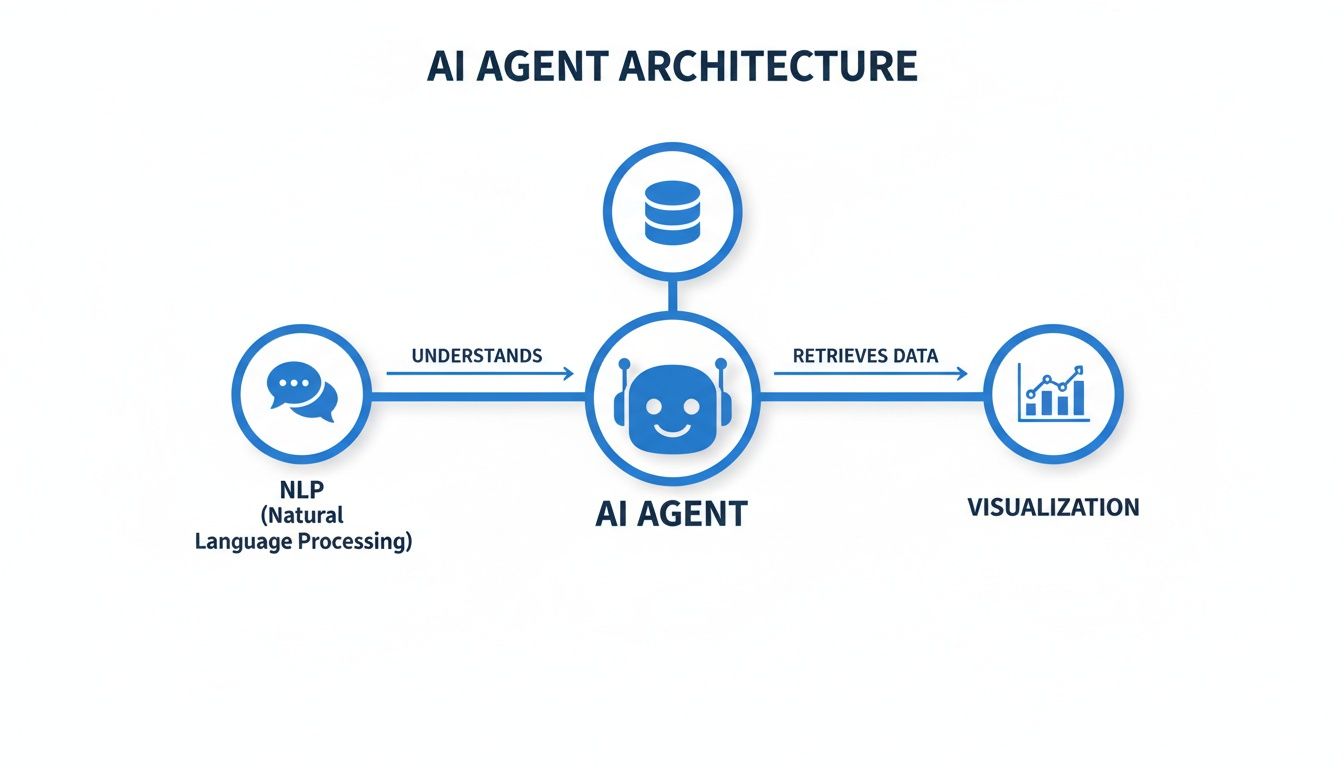
Diagram showing AI agent architecture: NLP understands input, AI agent retrieves data, generating visualization.

This architecture turns a complex, multi-person workflow into an automated, one-on-one conversation with your data. Let's break down the difference.

Analytics Workflow: The Old Way vs. The New Way

Phase

The Old Way (Manual SQL & BI Dashboards)

The New Way (AI Agent for Analytics - Statspresso)

Asking a Question

File a ticket with the data team; explain your needs perfectly to avoid rework.

Type your question in plain English, like messaging a colleague.

Data Translation

An analyst manually writes, tests, and debugs a complex SQL query.

The AI agent instantly translates your question into a flawless SQL query.

Visualization

The analyst builds a chart, which often requires follow-up tweaks.

A chart is automatically generated and delivered within seconds.

Time to Insight

Days or weeks. The process is slow and full of handoffs.

Seconds. The answer is immediate, enabling decisions in real time.

The new approach removes nearly all the friction. Instead of waiting for someone else to build a report, you explore the data yourself, following your curiosity wherever it leads. This puts incredible power directly into the hands of non-technical users.

Try asking Statspresso: 'Compare my user signups from HubSpot and organic traffic last quarter as a line chart.'

A single prompt like that replaces what used to be a chain of emails and Jira tickets. It's not just a faster way to get old reports; it’s a fundamentally more direct way to run your business.

How an AI Agent Actually Works for You: 3 Everyday Examples

It's one thing to talk theory, but another to see how it changes your day-to-day. Let's look at the concrete workflows an AI agent for analytics handles. This isn't about generating another report—it's about getting straight answers to your most pressing questions, right when you think of them.
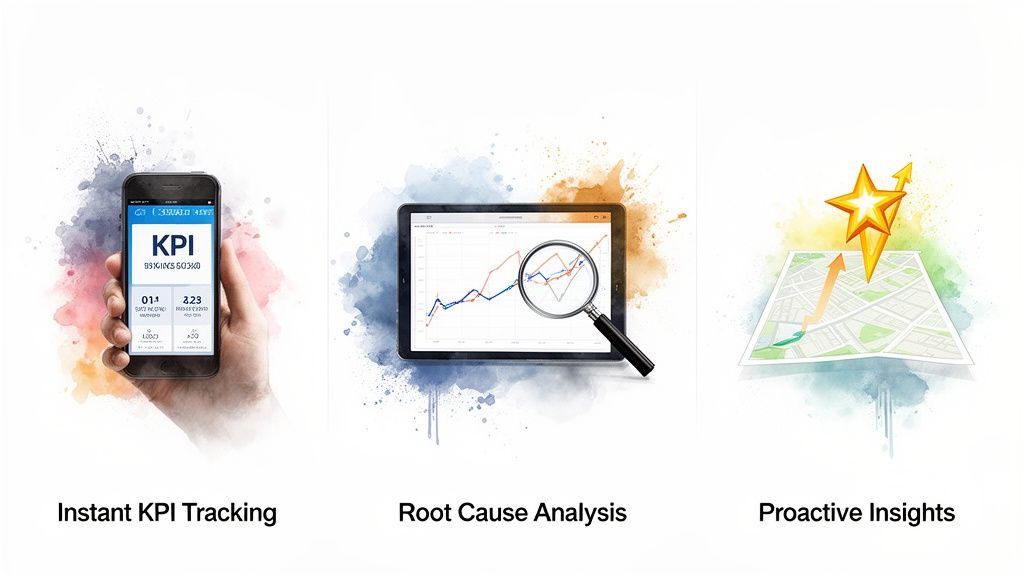
Illustrations depicting instant KPI tracking on a phone, root cause analysis on a tablet, and proactive insights with a map.

Here are three real-world scenarios that founders, product managers, and marketing leaders can use today.

1. Instant KPI Tracking

This is where you feel the impact first. No more sifting through outdated dashboards or pinging your data team. Imagine you're a marketing lead preparing for a meeting. You need one crucial metric, fast.

Instead of waiting, you just ask. A question like, "What's our MQL to SQL conversion rate this month?" gets you a direct number in seconds, not a help desk ticket that sits in a queue. It’s a simple, conversational way to stay on top of your most important metrics.

2. Root Cause Analysis on Demand

When a key metric suddenly tanks (or soars), the immediate follow-up is always, "Why?" An AI agent is your first line of investigation.

Let’s say a product manager sees a sudden dip in user activity. They can immediately ask, "Why did user engagement dip last Tuesday?" The agent gets to work, checking for connections between that dip and other events—a new feature launch, a change in a marketing campaign, or a spike in support tickets. What used to take hours of manual data digging becomes a quick, guided discovery.

Try asking Statspresso: 'Show me my top 5 converting blog posts from the last 90 days.'

3. From Reactive Answers to Proactive Insights

This is where an AI agent stops being a tool and starts feeling like a strategic partner. The most advanced systems don't just wait for you to ask questions. They find the important questions you should be asking. This is the core of proactive analytics.

For example, Statspresso's AI scans your data for hidden trends, anomalies, and growth opportunities, then brings them to your attention. You might see notifications like:

  • "Your sales in California have grown 30% faster than any other state."

  • "The new 'Productivity' blog category is driving signups at 2x the average rate."

  • "Users who integrate with HubSpot are 40% less likely to churn in their first month."

This completely changes your relationship with data. Instead of just pulling numbers, you have a system constantly looking for ways to grow your business. If you want to take back more of your time, learning to automate your reports with AI is a fantastic place to start. An AI agent doesn't just speed up reporting; it makes your whole team smarter.

How to Choose the Right AI Analytics Agent

Not all AI tools are created equal. The market is flooded with options, and it’s easy to get mesmerized by a slick demo, only to discover the tool crumbles when it meets your actual, messy data. You're sold on the concept, but now for the hard part: picking the right one.

Choosing an AI agent for analytics isn't about chasing the flashiest features; it's about finding a reliable partner for your team. This means asking tough, practical questions that go beyond marketing hype. The explosion of AI tools—part of a global AI software market expected to reach $1.8 trillion by 2030 according to this market analysis by ABI Research—gives you plenty of choices, but you need a solid framework to sift through them.

Your AI Agent Evaluation Checklist

Before you connect a single data source, put every potential AI agent through this four-point test. If a tool can't pass, it’s not ready for your business.

  • Data Connectivity: Can it actually talk to your data? An AI agent is worthless if it can't connect to your essential platforms—your Postgres database, Shopify store, HubSpot CRM, or Google Analytics. The more native connectors, the better.

  • Accuracy and Data Grounding: Can you trust its answers? An AI that operates like a black box is a liability. You need an agent that shows its work. A trustworthy tool will let you inspect the exact SQL query it generated, so you can personally verify that the logic is sound.

  • Governance and Security: Is your data safe? This is non-negotiable. Look for platforms with serious security credentials like SOC 2 compliance, end-to-end data encryption, and granular, role-based access controls. You must maintain full control over who sees what.

  • Genuine Usability: Will your team actually use it? The entire point is to skip the SQL and make data accessible. If it requires a week of training, it has failed. The experience should be as intuitive as sending a Slack message.

When you evaluate a tool like Statspresso, remember you aren't just buying software. You're effectively hiring a Conversational AI Data Analyst. It has to be trustworthy, dependable, and easy to work with from day one.

These criteria are the foundation of a system your team will either embrace or abandon. A platform that nails these four points stops being a novelty and becomes an indispensable teammate that delivers fast, reliable insights.

TL;DR: The Key Takeaways

  • Talk to Your Data: An AI agent for analytics lets you ask questions in plain English. No code required.

  • Get Instant Answers: Go from question to chart in seconds, not days or weeks. Skip the SQL. Just ask.

  • Empower Your Team: Founders, marketers, and PMs can pull their own numbers without waiting on a data expert.

  • Pick the Right Tool: Prioritize data connectivity, accuracy, security, and true ease of use. A Conversational AI Data Analyst like Statspresso checks these boxes.

Stop Waiting and Start Asking

The biggest slowdown in analytics today isn't technology. It’s the gap between the people with questions and the databases with answers. That familiar cycle of filing a ticket and waiting for an analyst to have a spare moment is over. An AI agent for analytics is built to demolish that barrier.

It’s time to stop waiting for insights and simply start a conversation. A Conversational AI Data Analyst like Statspresso lets you do exactly that. You can skip the SQL, bypass complex dashboards, and just ask for what you need in plain English.

The only setup required is connecting your data sources, which is the first step to starting this new dialogue.

This straightforward interface is your new front door to getting immediate answers from the platforms that run your business. Ultimately, it’s about making smarter decisions faster by putting the power of your data directly into the hands of people on the front lines.

Ready to get answers in seconds? Connect your first data source for free and ask your first question.

Frequently Asked Questions

You're thinking about bringing an AI agent for analytics into the mix. Smart. It's also smart to have questions. Here are the straight-up answers to what we hear most.

Will an AI Agent Replace Our Data Analysts?

Not a chance. In fact, it's going to make them superheroes.

Think of it this way: your data analysts are probably drowning in ad-hoc report requests. An AI agent takes over that repetitive "query-and-answer" duty. This frees up your human experts to tackle the deep, strategic work that actually pushes the business forward. They can finally spend their time on work that matters:

  • Building out sophisticated data models.

  • Running complex A/B test analyses.

  • Digging into the "why" behind the data, not just the "what."

A tool like Statspresso, a Conversational AI Data Analyst, doesn’t replace your talented people; it gives them the leverage to do their best work.

How Secure Is My Data When I Connect It?

This is always the first—and most important—question. Any platform that doesn't treat security as its number one priority isn't worth your time. Here are the non-negotiables:

  • SOC 2 Compliance: A rigorous, third-party audit proving a company has ironclad processes for handling customer data.

  • End-to-End Encryption: Your data must be encrypted both in transit (moving between systems) and at rest (being stored).

  • Role-Based Access Controls (RBAC): You need precise control over which team members can see and query specific datasets.

We built Statspresso with these security principles at its core, so your most sensitive information is always protected.

How Does It Handle Complex Questions or Messy Data?

Let's be real: this tech is powerful, but not magic. An AI agent is only as good as the data it can access and how clearly you ask your question.

The best AI agents handle complexity by showing their work. This is called data grounding. When you ask a question, the agent should return not just an answer, but also the exact SQL query it generated to find it. This transparency is essential for building trust.

And for messy data or fuzzy questions? The best platforms don't just give up. They engage in a dialogue, just like a human analyst would, allowing you to clarify your terms and refine your query. It’s a conversation, not a one-way command.

Ready to stop waiting and start asking?

Connect your first data source for free and ask your first question.

Your data is full of answers. The problem? You're a busy founder, not a full-time data wizard. Filing a ticket and waiting weeks for a data analyst to build a dashboard is a relic of the past. Getting a simple chart shouldn't be a project. It should take seconds.

That old process is officially broken.

Your Data Has Answers, But Who Has Time to Ask?

Waiting for a dashboard just doesn't cut it anymore. Every critical business question—"Which marketing channel has the best ROI?" or "Why did user signups dip last Tuesday?"—demands an immediate, data-backed answer. The bottleneck isn't a lack of data; it's the painfully slow process of getting to it.

This is exactly where an AI agent for analytics changes the game.

Stressed man at desk, calendar, database, key, and AI agent offering to 'Skip the SQL'.

Think of it as a smart assistant that speaks your language and already knows its way around your database. While your data holds immense value, the traditional hurdles of figuring out how to analyze data often leave businesses guessing. An AI agent removes that friction.

The New Way to Work with Data

Instead of writing complex code or wrestling with clunky dashboard filters, you just ask a question. This new approach is powered by a Conversational AI Data Analyst like Statspresso, which is built on a simple promise: skip the SQL. Just ask your data a question and get a chart in seconds.

The growth in automated BI is staggering. The AI in data analytics market is projected to grow from $48 billion in 2024 to over $279 billion by 2029. This isn’t hype; it’s a direct response to the overwhelming need for faster, more accessible insights.

It’s all about empowering everyone on your team to make confident decisions right when they need to, turning a complex data request into a simple conversation.

What Exactly Is an AI Analytics Agent?

Let's cut the jargon. What are we really talking about when we say "AI agent for analytics"?

Think of your traditional BI tools, like Tableau or Power BI. They’re like a high-end workshop full of specialized power tools. In the hands of a skilled craftsman, they build incredible things. But for most of us, figuring out which tool to use—let alone how to use it—is a huge barrier.

An AI agent for analytics is a completely different animal. It’s like having an expert craftsman right there with you. You just describe what you want, and they figure out the best way to get it done. This is the entire philosophy behind Statspresso, a Conversational AI Data Analyst designed to work this way from day one.

The Brains Behind the Conversation

This isn't just a chatbot guessing at answers. A true AI agent combines three key technologies that work in harmony to turn your everyday language into powerful data insights.

  • Natural Language Processing (NLP) Frontend: This is how the agent understands you. It takes a plain-English question, like "What were our sales in New York last month?", and deciphers your actual intent.

  • Query Generation Engine: This is the bridge to your data. The agent translates your question into the precise, technical language your databases understand (like SQL), ensuring it pulls the exact information needed.

  • Visualization Layer: This is the storyteller. After fetching the data, the agent determines the best way to present the answer—a simple KPI, a trend line, or a comparison bar chart—and builds it for you automatically.

This move toward conversational analytics is already mainstream. In 2024, GenAI adoption has hit 65% of organizations, with these businesses reporting tangible cost savings and revenue growth by folding GenBI tools into their daily operations.

It's an Interactive Partner, Not Another Dashboard

Here’s the most important distinction: an AI agent is a partner in a dialogue, not a static report you view. It’s an intelligent collaborator that helps you explore your data. Many agents present their findings in a dedicated Agent Analytics Dashboard, which serves as a canvas for your ongoing conversation.

This conversational model completely removes the technical roadblocks. You can ask follow-up questions, pivot your analysis, and dig deeper in real time. You stay in the flow of your curiosity, without ever having to write code or wait for a new report.

Try asking Statspresso: 'Show me my revenue by month for the last year as a bar chart.'

The Old Way vs. The New Way of Getting Answers

Let’s be honest: getting answers from data used to be painful. The gap between asking a question and getting a real, data-backed answer was a chasm filled with friction and frustrating delays.

For anyone on a business team, the routine was all too familiar. You'd have a question, file a ticket, and then wait. And wait. Your request would sit in a data team's queue, and when you finally got something back, it often led to a long back-and-forth of emails to tweak a chart. This bottleneck meant teams were often forced to make decisions on instinct rather than insight.

From Manual Labor to Instant Conversation

The new way, powered by an AI agent for analytics, collapses that entire, drawn-out process into a single step: you just ask your question. This is the whole idea behind a Conversational AI Data Analyst like Statspresso. You get to skip the SQL entirely and go straight from question to insight.

Behind the scenes, the AI agent does all the heavy lifting. It uses NLP to understand what you're asking, an engine to retrieve the right data, and a visualization layer to build the perfect chart on the fly.

Diagram showing AI agent architecture: NLP understands input, AI agent retrieves data, generating visualization.

This architecture turns a complex, multi-person workflow into an automated, one-on-one conversation with your data. Let's break down the difference.

Analytics Workflow: The Old Way vs. The New Way

Phase

The Old Way (Manual SQL & BI Dashboards)

The New Way (AI Agent for Analytics - Statspresso)

Asking a Question

File a ticket with the data team; explain your needs perfectly to avoid rework.

Type your question in plain English, like messaging a colleague.

Data Translation

An analyst manually writes, tests, and debugs a complex SQL query.

The AI agent instantly translates your question into a flawless SQL query.

Visualization

The analyst builds a chart, which often requires follow-up tweaks.

A chart is automatically generated and delivered within seconds.

Time to Insight

Days or weeks. The process is slow and full of handoffs.

Seconds. The answer is immediate, enabling decisions in real time.

The new approach removes nearly all the friction. Instead of waiting for someone else to build a report, you explore the data yourself, following your curiosity wherever it leads. This puts incredible power directly into the hands of non-technical users.

Try asking Statspresso: 'Compare my user signups from HubSpot and organic traffic last quarter as a line chart.'

A single prompt like that replaces what used to be a chain of emails and Jira tickets. It's not just a faster way to get old reports; it’s a fundamentally more direct way to run your business.

How an AI Agent Actually Works for You: 3 Everyday Examples

It's one thing to talk theory, but another to see how it changes your day-to-day. Let's look at the concrete workflows an AI agent for analytics handles. This isn't about generating another report—it's about getting straight answers to your most pressing questions, right when you think of them.

Illustrations depicting instant KPI tracking on a phone, root cause analysis on a tablet, and proactive insights with a map.

Here are three real-world scenarios that founders, product managers, and marketing leaders can use today.

1. Instant KPI Tracking

This is where you feel the impact first. No more sifting through outdated dashboards or pinging your data team. Imagine you're a marketing lead preparing for a meeting. You need one crucial metric, fast.

Instead of waiting, you just ask. A question like, "What's our MQL to SQL conversion rate this month?" gets you a direct number in seconds, not a help desk ticket that sits in a queue. It’s a simple, conversational way to stay on top of your most important metrics.

2. Root Cause Analysis on Demand

When a key metric suddenly tanks (or soars), the immediate follow-up is always, "Why?" An AI agent is your first line of investigation.

Let’s say a product manager sees a sudden dip in user activity. They can immediately ask, "Why did user engagement dip last Tuesday?" The agent gets to work, checking for connections between that dip and other events—a new feature launch, a change in a marketing campaign, or a spike in support tickets. What used to take hours of manual data digging becomes a quick, guided discovery.

Try asking Statspresso: 'Show me my top 5 converting blog posts from the last 90 days.'

3. From Reactive Answers to Proactive Insights

This is where an AI agent stops being a tool and starts feeling like a strategic partner. The most advanced systems don't just wait for you to ask questions. They find the important questions you should be asking. This is the core of proactive analytics.

For example, Statspresso's AI scans your data for hidden trends, anomalies, and growth opportunities, then brings them to your attention. You might see notifications like:

  • "Your sales in California have grown 30% faster than any other state."

  • "The new 'Productivity' blog category is driving signups at 2x the average rate."

  • "Users who integrate with HubSpot are 40% less likely to churn in their first month."

This completely changes your relationship with data. Instead of just pulling numbers, you have a system constantly looking for ways to grow your business. If you want to take back more of your time, learning to automate your reports with AI is a fantastic place to start. An AI agent doesn't just speed up reporting; it makes your whole team smarter.

How to Choose the Right AI Analytics Agent

Not all AI tools are created equal. The market is flooded with options, and it’s easy to get mesmerized by a slick demo, only to discover the tool crumbles when it meets your actual, messy data. You're sold on the concept, but now for the hard part: picking the right one.

Choosing an AI agent for analytics isn't about chasing the flashiest features; it's about finding a reliable partner for your team. This means asking tough, practical questions that go beyond marketing hype. The explosion of AI tools—part of a global AI software market expected to reach $1.8 trillion by 2030 according to this market analysis by ABI Research—gives you plenty of choices, but you need a solid framework to sift through them.

Your AI Agent Evaluation Checklist

Before you connect a single data source, put every potential AI agent through this four-point test. If a tool can't pass, it’s not ready for your business.

  • Data Connectivity: Can it actually talk to your data? An AI agent is worthless if it can't connect to your essential platforms—your Postgres database, Shopify store, HubSpot CRM, or Google Analytics. The more native connectors, the better.

  • Accuracy and Data Grounding: Can you trust its answers? An AI that operates like a black box is a liability. You need an agent that shows its work. A trustworthy tool will let you inspect the exact SQL query it generated, so you can personally verify that the logic is sound.

  • Governance and Security: Is your data safe? This is non-negotiable. Look for platforms with serious security credentials like SOC 2 compliance, end-to-end data encryption, and granular, role-based access controls. You must maintain full control over who sees what.

  • Genuine Usability: Will your team actually use it? The entire point is to skip the SQL and make data accessible. If it requires a week of training, it has failed. The experience should be as intuitive as sending a Slack message.

When you evaluate a tool like Statspresso, remember you aren't just buying software. You're effectively hiring a Conversational AI Data Analyst. It has to be trustworthy, dependable, and easy to work with from day one.

These criteria are the foundation of a system your team will either embrace or abandon. A platform that nails these four points stops being a novelty and becomes an indispensable teammate that delivers fast, reliable insights.

TL;DR: The Key Takeaways

  • Talk to Your Data: An AI agent for analytics lets you ask questions in plain English. No code required.

  • Get Instant Answers: Go from question to chart in seconds, not days or weeks. Skip the SQL. Just ask.

  • Empower Your Team: Founders, marketers, and PMs can pull their own numbers without waiting on a data expert.

  • Pick the Right Tool: Prioritize data connectivity, accuracy, security, and true ease of use. A Conversational AI Data Analyst like Statspresso checks these boxes.

Stop Waiting and Start Asking

The biggest slowdown in analytics today isn't technology. It’s the gap between the people with questions and the databases with answers. That familiar cycle of filing a ticket and waiting for an analyst to have a spare moment is over. An AI agent for analytics is built to demolish that barrier.

It’s time to stop waiting for insights and simply start a conversation. A Conversational AI Data Analyst like Statspresso lets you do exactly that. You can skip the SQL, bypass complex dashboards, and just ask for what you need in plain English.

The only setup required is connecting your data sources, which is the first step to starting this new dialogue.

This straightforward interface is your new front door to getting immediate answers from the platforms that run your business. Ultimately, it’s about making smarter decisions faster by putting the power of your data directly into the hands of people on the front lines.

Ready to get answers in seconds? Connect your first data source for free and ask your first question.

Frequently Asked Questions

You're thinking about bringing an AI agent for analytics into the mix. Smart. It's also smart to have questions. Here are the straight-up answers to what we hear most.

Will an AI Agent Replace Our Data Analysts?

Not a chance. In fact, it's going to make them superheroes.

Think of it this way: your data analysts are probably drowning in ad-hoc report requests. An AI agent takes over that repetitive "query-and-answer" duty. This frees up your human experts to tackle the deep, strategic work that actually pushes the business forward. They can finally spend their time on work that matters:

  • Building out sophisticated data models.

  • Running complex A/B test analyses.

  • Digging into the "why" behind the data, not just the "what."

A tool like Statspresso, a Conversational AI Data Analyst, doesn’t replace your talented people; it gives them the leverage to do their best work.

How Secure Is My Data When I Connect It?

This is always the first—and most important—question. Any platform that doesn't treat security as its number one priority isn't worth your time. Here are the non-negotiables:

  • SOC 2 Compliance: A rigorous, third-party audit proving a company has ironclad processes for handling customer data.

  • End-to-End Encryption: Your data must be encrypted both in transit (moving between systems) and at rest (being stored).

  • Role-Based Access Controls (RBAC): You need precise control over which team members can see and query specific datasets.

We built Statspresso with these security principles at its core, so your most sensitive information is always protected.

How Does It Handle Complex Questions or Messy Data?

Let's be real: this tech is powerful, but not magic. An AI agent is only as good as the data it can access and how clearly you ask your question.

The best AI agents handle complexity by showing their work. This is called data grounding. When you ask a question, the agent should return not just an answer, but also the exact SQL query it generated to find it. This transparency is essential for building trust.

And for messy data or fuzzy questions? The best platforms don't just give up. They engage in a dialogue, just like a human analyst would, allowing you to clarify your terms and refine your query. It’s a conversation, not a one-way command.

Ready to stop waiting and start asking?

Connect your first data source for free and ask your first question.

Your data is full of answers. The problem? You're a busy founder, not a full-time data wizard. Filing a ticket and waiting weeks for a data analyst to build a dashboard is a relic of the past. Getting a simple chart shouldn't be a project. It should take seconds.

That old process is officially broken.

Your Data Has Answers, But Who Has Time to Ask?

Waiting for a dashboard just doesn't cut it anymore. Every critical business question—"Which marketing channel has the best ROI?" or "Why did user signups dip last Tuesday?"—demands an immediate, data-backed answer. The bottleneck isn't a lack of data; it's the painfully slow process of getting to it.

This is exactly where an AI agent for analytics changes the game.

Stressed man at desk, calendar, database, key, and AI agent offering to 'Skip the SQL'.

Think of it as a smart assistant that speaks your language and already knows its way around your database. While your data holds immense value, the traditional hurdles of figuring out how to analyze data often leave businesses guessing. An AI agent removes that friction.

The New Way to Work with Data

Instead of writing complex code or wrestling with clunky dashboard filters, you just ask a question. This new approach is powered by a Conversational AI Data Analyst like Statspresso, which is built on a simple promise: skip the SQL. Just ask your data a question and get a chart in seconds.

The growth in automated BI is staggering. The AI in data analytics market is projected to grow from $48 billion in 2024 to over $279 billion by 2029. This isn’t hype; it’s a direct response to the overwhelming need for faster, more accessible insights.

It’s all about empowering everyone on your team to make confident decisions right when they need to, turning a complex data request into a simple conversation.

What Exactly Is an AI Analytics Agent?

Let's cut the jargon. What are we really talking about when we say "AI agent for analytics"?

Think of your traditional BI tools, like Tableau or Power BI. They’re like a high-end workshop full of specialized power tools. In the hands of a skilled craftsman, they build incredible things. But for most of us, figuring out which tool to use—let alone how to use it—is a huge barrier.

An AI agent for analytics is a completely different animal. It’s like having an expert craftsman right there with you. You just describe what you want, and they figure out the best way to get it done. This is the entire philosophy behind Statspresso, a Conversational AI Data Analyst designed to work this way from day one.

The Brains Behind the Conversation

This isn't just a chatbot guessing at answers. A true AI agent combines three key technologies that work in harmony to turn your everyday language into powerful data insights.

  • Natural Language Processing (NLP) Frontend: This is how the agent understands you. It takes a plain-English question, like "What were our sales in New York last month?", and deciphers your actual intent.

  • Query Generation Engine: This is the bridge to your data. The agent translates your question into the precise, technical language your databases understand (like SQL), ensuring it pulls the exact information needed.

  • Visualization Layer: This is the storyteller. After fetching the data, the agent determines the best way to present the answer—a simple KPI, a trend line, or a comparison bar chart—and builds it for you automatically.

This move toward conversational analytics is already mainstream. In 2024, GenAI adoption has hit 65% of organizations, with these businesses reporting tangible cost savings and revenue growth by folding GenBI tools into their daily operations.

It's an Interactive Partner, Not Another Dashboard

Here’s the most important distinction: an AI agent is a partner in a dialogue, not a static report you view. It’s an intelligent collaborator that helps you explore your data. Many agents present their findings in a dedicated Agent Analytics Dashboard, which serves as a canvas for your ongoing conversation.

This conversational model completely removes the technical roadblocks. You can ask follow-up questions, pivot your analysis, and dig deeper in real time. You stay in the flow of your curiosity, without ever having to write code or wait for a new report.

Try asking Statspresso: 'Show me my revenue by month for the last year as a bar chart.'

The Old Way vs. The New Way of Getting Answers

Let’s be honest: getting answers from data used to be painful. The gap between asking a question and getting a real, data-backed answer was a chasm filled with friction and frustrating delays.

For anyone on a business team, the routine was all too familiar. You'd have a question, file a ticket, and then wait. And wait. Your request would sit in a data team's queue, and when you finally got something back, it often led to a long back-and-forth of emails to tweak a chart. This bottleneck meant teams were often forced to make decisions on instinct rather than insight.

From Manual Labor to Instant Conversation

The new way, powered by an AI agent for analytics, collapses that entire, drawn-out process into a single step: you just ask your question. This is the whole idea behind a Conversational AI Data Analyst like Statspresso. You get to skip the SQL entirely and go straight from question to insight.

Behind the scenes, the AI agent does all the heavy lifting. It uses NLP to understand what you're asking, an engine to retrieve the right data, and a visualization layer to build the perfect chart on the fly.

Diagram showing AI agent architecture: NLP understands input, AI agent retrieves data, generating visualization.

This architecture turns a complex, multi-person workflow into an automated, one-on-one conversation with your data. Let's break down the difference.

Analytics Workflow: The Old Way vs. The New Way

Phase

The Old Way (Manual SQL & BI Dashboards)

The New Way (AI Agent for Analytics - Statspresso)

Asking a Question

File a ticket with the data team; explain your needs perfectly to avoid rework.

Type your question in plain English, like messaging a colleague.

Data Translation

An analyst manually writes, tests, and debugs a complex SQL query.

The AI agent instantly translates your question into a flawless SQL query.

Visualization

The analyst builds a chart, which often requires follow-up tweaks.

A chart is automatically generated and delivered within seconds.

Time to Insight

Days or weeks. The process is slow and full of handoffs.

Seconds. The answer is immediate, enabling decisions in real time.

The new approach removes nearly all the friction. Instead of waiting for someone else to build a report, you explore the data yourself, following your curiosity wherever it leads. This puts incredible power directly into the hands of non-technical users.

Try asking Statspresso: 'Compare my user signups from HubSpot and organic traffic last quarter as a line chart.'

A single prompt like that replaces what used to be a chain of emails and Jira tickets. It's not just a faster way to get old reports; it’s a fundamentally more direct way to run your business.

How an AI Agent Actually Works for You: 3 Everyday Examples

It's one thing to talk theory, but another to see how it changes your day-to-day. Let's look at the concrete workflows an AI agent for analytics handles. This isn't about generating another report—it's about getting straight answers to your most pressing questions, right when you think of them.

Illustrations depicting instant KPI tracking on a phone, root cause analysis on a tablet, and proactive insights with a map.

Here are three real-world scenarios that founders, product managers, and marketing leaders can use today.

1. Instant KPI Tracking

This is where you feel the impact first. No more sifting through outdated dashboards or pinging your data team. Imagine you're a marketing lead preparing for a meeting. You need one crucial metric, fast.

Instead of waiting, you just ask. A question like, "What's our MQL to SQL conversion rate this month?" gets you a direct number in seconds, not a help desk ticket that sits in a queue. It’s a simple, conversational way to stay on top of your most important metrics.

2. Root Cause Analysis on Demand

When a key metric suddenly tanks (or soars), the immediate follow-up is always, "Why?" An AI agent is your first line of investigation.

Let’s say a product manager sees a sudden dip in user activity. They can immediately ask, "Why did user engagement dip last Tuesday?" The agent gets to work, checking for connections between that dip and other events—a new feature launch, a change in a marketing campaign, or a spike in support tickets. What used to take hours of manual data digging becomes a quick, guided discovery.

Try asking Statspresso: 'Show me my top 5 converting blog posts from the last 90 days.'

3. From Reactive Answers to Proactive Insights

This is where an AI agent stops being a tool and starts feeling like a strategic partner. The most advanced systems don't just wait for you to ask questions. They find the important questions you should be asking. This is the core of proactive analytics.

For example, Statspresso's AI scans your data for hidden trends, anomalies, and growth opportunities, then brings them to your attention. You might see notifications like:

  • "Your sales in California have grown 30% faster than any other state."

  • "The new 'Productivity' blog category is driving signups at 2x the average rate."

  • "Users who integrate with HubSpot are 40% less likely to churn in their first month."

This completely changes your relationship with data. Instead of just pulling numbers, you have a system constantly looking for ways to grow your business. If you want to take back more of your time, learning to automate your reports with AI is a fantastic place to start. An AI agent doesn't just speed up reporting; it makes your whole team smarter.

How to Choose the Right AI Analytics Agent

Not all AI tools are created equal. The market is flooded with options, and it’s easy to get mesmerized by a slick demo, only to discover the tool crumbles when it meets your actual, messy data. You're sold on the concept, but now for the hard part: picking the right one.

Choosing an AI agent for analytics isn't about chasing the flashiest features; it's about finding a reliable partner for your team. This means asking tough, practical questions that go beyond marketing hype. The explosion of AI tools—part of a global AI software market expected to reach $1.8 trillion by 2030 according to this market analysis by ABI Research—gives you plenty of choices, but you need a solid framework to sift through them.

Your AI Agent Evaluation Checklist

Before you connect a single data source, put every potential AI agent through this four-point test. If a tool can't pass, it’s not ready for your business.

  • Data Connectivity: Can it actually talk to your data? An AI agent is worthless if it can't connect to your essential platforms—your Postgres database, Shopify store, HubSpot CRM, or Google Analytics. The more native connectors, the better.

  • Accuracy and Data Grounding: Can you trust its answers? An AI that operates like a black box is a liability. You need an agent that shows its work. A trustworthy tool will let you inspect the exact SQL query it generated, so you can personally verify that the logic is sound.

  • Governance and Security: Is your data safe? This is non-negotiable. Look for platforms with serious security credentials like SOC 2 compliance, end-to-end data encryption, and granular, role-based access controls. You must maintain full control over who sees what.

  • Genuine Usability: Will your team actually use it? The entire point is to skip the SQL and make data accessible. If it requires a week of training, it has failed. The experience should be as intuitive as sending a Slack message.

When you evaluate a tool like Statspresso, remember you aren't just buying software. You're effectively hiring a Conversational AI Data Analyst. It has to be trustworthy, dependable, and easy to work with from day one.

These criteria are the foundation of a system your team will either embrace or abandon. A platform that nails these four points stops being a novelty and becomes an indispensable teammate that delivers fast, reliable insights.

TL;DR: The Key Takeaways

  • Talk to Your Data: An AI agent for analytics lets you ask questions in plain English. No code required.

  • Get Instant Answers: Go from question to chart in seconds, not days or weeks. Skip the SQL. Just ask.

  • Empower Your Team: Founders, marketers, and PMs can pull their own numbers without waiting on a data expert.

  • Pick the Right Tool: Prioritize data connectivity, accuracy, security, and true ease of use. A Conversational AI Data Analyst like Statspresso checks these boxes.

Stop Waiting and Start Asking

The biggest slowdown in analytics today isn't technology. It’s the gap between the people with questions and the databases with answers. That familiar cycle of filing a ticket and waiting for an analyst to have a spare moment is over. An AI agent for analytics is built to demolish that barrier.

It’s time to stop waiting for insights and simply start a conversation. A Conversational AI Data Analyst like Statspresso lets you do exactly that. You can skip the SQL, bypass complex dashboards, and just ask for what you need in plain English.

The only setup required is connecting your data sources, which is the first step to starting this new dialogue.

This straightforward interface is your new front door to getting immediate answers from the platforms that run your business. Ultimately, it’s about making smarter decisions faster by putting the power of your data directly into the hands of people on the front lines.

Ready to get answers in seconds? Connect your first data source for free and ask your first question.

Frequently Asked Questions

You're thinking about bringing an AI agent for analytics into the mix. Smart. It's also smart to have questions. Here are the straight-up answers to what we hear most.

Will an AI Agent Replace Our Data Analysts?

Not a chance. In fact, it's going to make them superheroes.

Think of it this way: your data analysts are probably drowning in ad-hoc report requests. An AI agent takes over that repetitive "query-and-answer" duty. This frees up your human experts to tackle the deep, strategic work that actually pushes the business forward. They can finally spend their time on work that matters:

  • Building out sophisticated data models.

  • Running complex A/B test analyses.

  • Digging into the "why" behind the data, not just the "what."

A tool like Statspresso, a Conversational AI Data Analyst, doesn’t replace your talented people; it gives them the leverage to do their best work.

How Secure Is My Data When I Connect It?

This is always the first—and most important—question. Any platform that doesn't treat security as its number one priority isn't worth your time. Here are the non-negotiables:

  • SOC 2 Compliance: A rigorous, third-party audit proving a company has ironclad processes for handling customer data.

  • End-to-End Encryption: Your data must be encrypted both in transit (moving between systems) and at rest (being stored).

  • Role-Based Access Controls (RBAC): You need precise control over which team members can see and query specific datasets.

We built Statspresso with these security principles at its core, so your most sensitive information is always protected.

How Does It Handle Complex Questions or Messy Data?

Let's be real: this tech is powerful, but not magic. An AI agent is only as good as the data it can access and how clearly you ask your question.

The best AI agents handle complexity by showing their work. This is called data grounding. When you ask a question, the agent should return not just an answer, but also the exact SQL query it generated to find it. This transparency is essential for building trust.

And for messy data or fuzzy questions? The best platforms don't just give up. They engage in a dialogue, just like a human analyst would, allowing you to clarify your terms and refine your query. It’s a conversation, not a one-way command.

Ready to stop waiting and start asking?

Connect your first data source for free and ask your first question.